The remains of the castle can be visited
CastleDuingt
Château de Duingt
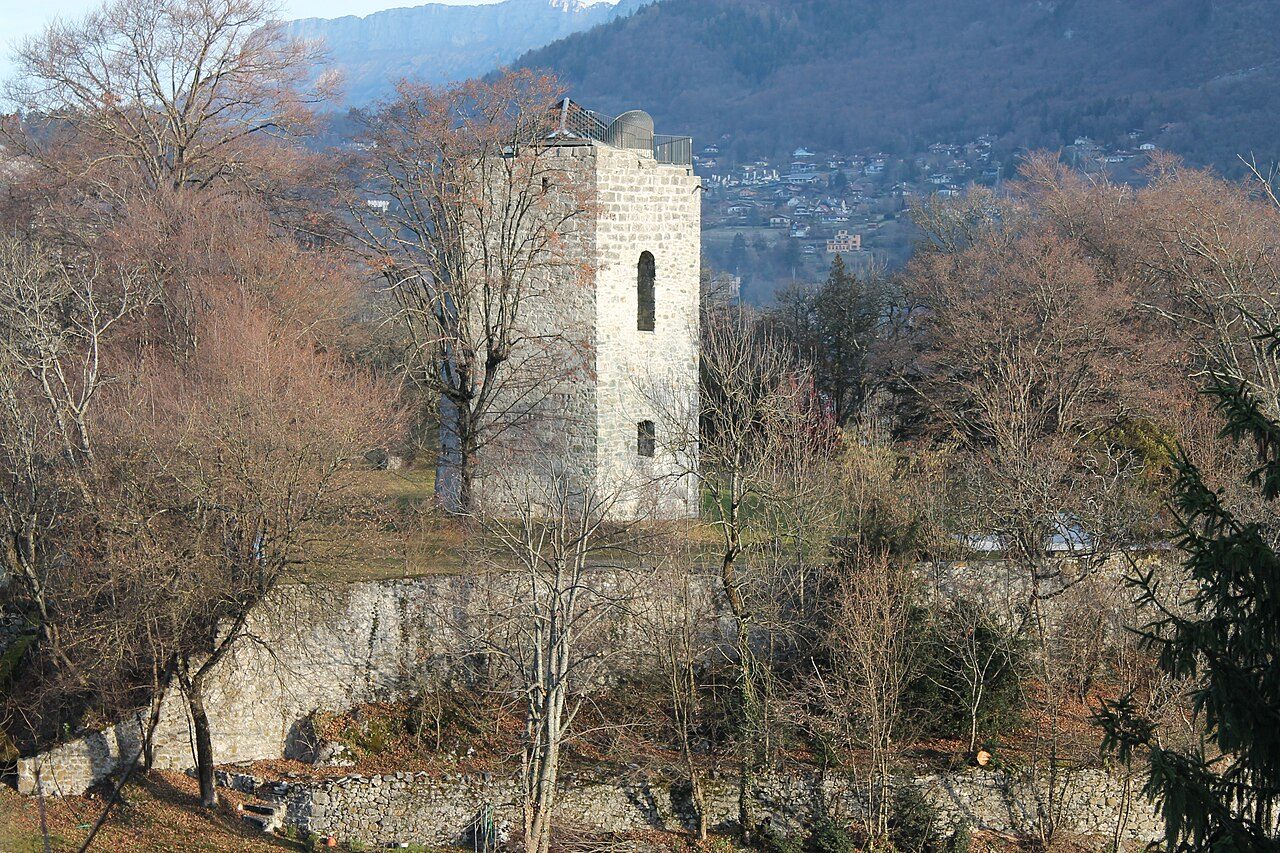
The castle of Duingt (Duyn), also called the castle of La Salle, Châteauneuf, the castle of l'Esplanade or the castle of Roc, is an old fortified castle, remodelled in the 14th or 15th century, whose ruins stand in the commune of Duingt in the department of Haute-Savoie in the Auvergne-Rhône-Alpes region.
Location+
The remains of Duingt Castle are located in the French department of Haute-Savoie in the commune of Duingt, on a rocky promontory overlooking the village. It controlled the old road between Geneva and Moûtiers running along the western shore of Lake Annecy, using an old secondary Roman road. Its defensive system was complemented by the Château de Châteauvieux.
History+
Duingt Castle (Castrum Duini), whose origin remains unknown, belonged from a very early period to the Duin or Duyn family, vassals of the Counts of Geneva. The castle first appears in texts between 1103 and 1148 under the term castra. A certain Raymondus Doint stood surety for the count for the sum of 1,100 sols in 1219 during a transaction between Count William II of Geneva and the Bishop of Geneva, Aymon de Grandson. In 1288, Raoul/Rodolphe de Duin, alias de Conflans, paid homage to the Count of Geneva and promised to make his fief available to the count in case of conflict with neighboring Savoy. In 1296, he ceded his castle of Duingt to Count Amadeus II of Geneva for 2,500 livres, and kept that of Châteauvieux. Duingt Castle remained the possession of the Counts of Geneva until August 5, 1401. On that date, it passed into the hands of the Dukes of Savoy, along with the entire County of Geneva. In 1451, it was purchased by Perrin d'Antioche, made lord of the said place by the duke in 1455, who ceded it in 1462 to Janus (1440-1491), younger son of Duke Louis of Savoy, appanage count of Genevois. Upon his death, he bequeathed it to Hélène de Luxembourg, daughter of Louis de Luxembourg and Jeanne de Bar, his wife, who brought it in her second marriage to Viscount François des Martigues. It then passed into the hands of Louise de Savoie (1467-1522), Marquise de Baugé, Lady of Évian, daughter of Janus de Savoie and Hélène de Luxembourg, granddaughter of Duke Louis I of Savoy. The castle was passed down to her descendants François, Sébastien and Marie de Luxembourg. A possession of the Genevois-Nemours family, Jeanne-Baptiste de Genevois-Nemours brought it as a dowry in 1665 to her husband Duke Charles-Emmanuel II. In 1681, the Monthoux family acquired both castles, Duingt and Châteauvieux, and sold them in 1696 to François-Nicolas de Montpiton, lord of Noiret and Saint-Jorioz. In 1698, the castles were purchased by the de Sales family, who kept them until the Revolution. Declared national property, they were awarded in 1796 to Jean Berthet, who resold them in 1833 to Baron Scipion Ruphy. Isaure Ruphy later brought them as a dowry to her husband, Count Henri de la Barge de Certeau.
Description+
Of Duingt Castle, only an octagonal tower remains, ruined above the village, and remnants of the enclosure.
Source: Wikipedia · Licence: CC BY-SA 4.0 · Image: B. Brassoud / CC BY-SA 4.0 via Wikimedia Commons
This description draws on the facts documented in the linked Wikipedia article; Wikipedia content is licensed under CC BY-SA 4.0. Wording and editing: Mobile History.
Location: 45.8288, 6.2059