To be privately owned
CastleSaint-Cyprien
Château de Fages
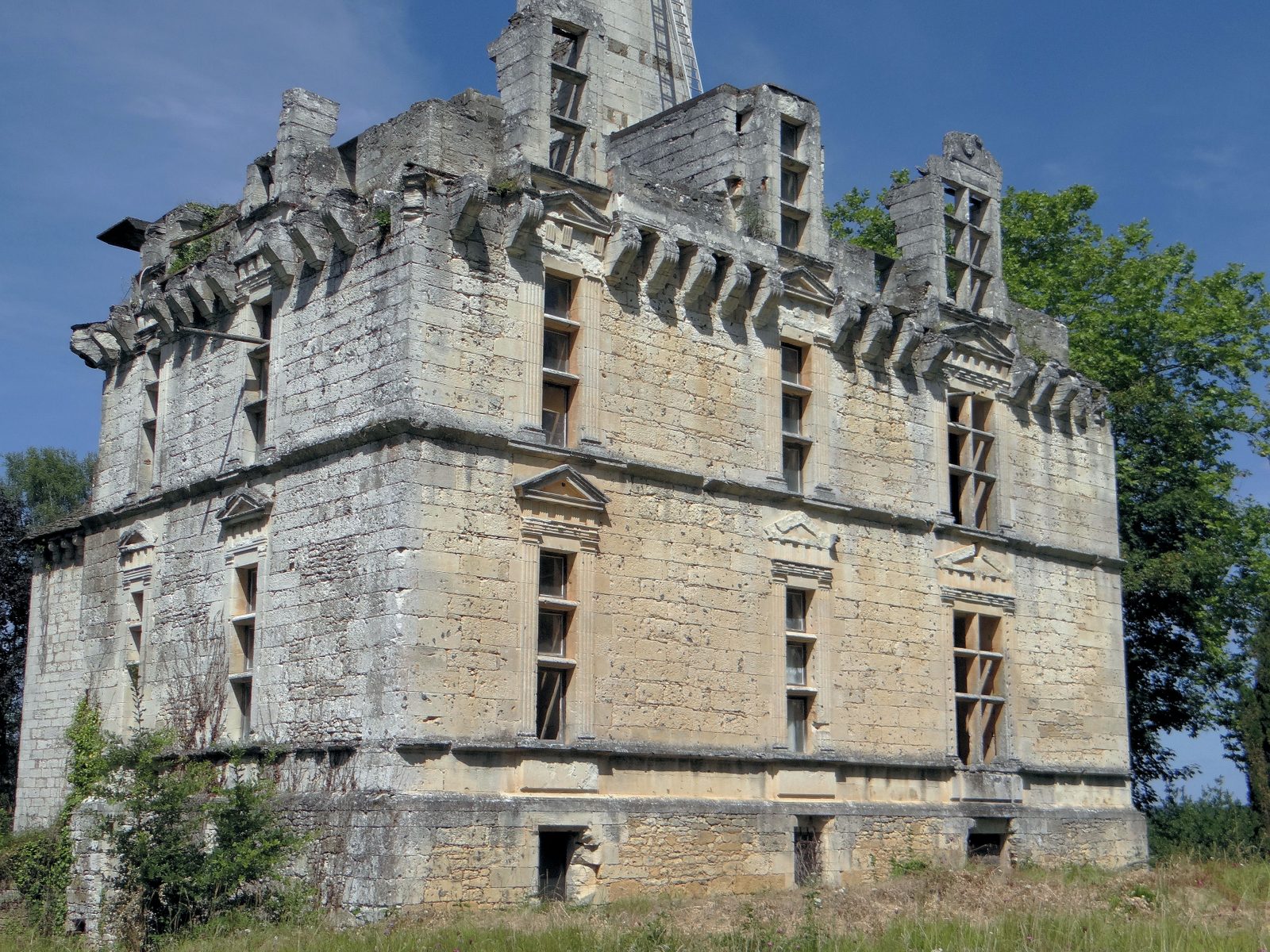
The Château de Fages is a French castle in Saint-Cyprien, in the Périgord Noir in the Dordogne department. It is a listed historic monument.
History+
The castle is located on the site of a Gallo-Roman oppidum. In the 13th century, a castle existed, mentioned in texts as Turris dicta de Fagas. A rectangular keep from the 12th or 13th century is preserved in the center of a quadrangular curtain wall. A northern wall, doubly protected by a moat, is also preserved. To the left of the entrance is a square chapel with a ribbed vault, beneath which is a burial chamber. Opposite the entrance is a multi-story residential building, rebuilt in the 16th century and revised in the 17th century, containing the grand staircase with two straight flights per floor. It is attached to the keep. To the south, a new Renaissance pavilion was built on vaulted cellars in the 16th century, but no text allows for determining the exact start of construction. The castle belonged to Jean de Fages and his wife Anne de Salignac de La Mothe in the mid-16th century. Their daughter Anne was a lady-in-waiting to the Queen of Navarre. In 1553, she married Joachim de Monluc, Sieur de Lioux, brother of Blaise de Montluc, who died before 1567. The latter was received by his sister-in-law at the castle during his battles against the Huguenots, shortly before the Battle of Vergt. The castle was attacked and plundered by Protestants in 1568. Anne de Fages married Jean de Monlezun, Sieur de Caussens, one of Admiral de Coligny's executioners during the St. Bartholomew's Day Massacre, in 1570. The Lord of Limeuil captured the castle in 1574, which was partially destroyed by a gunpowder explosion. The castle was occupied in 1585 by a gang leader, Captain Piolletou. In 1637, the castle belonged to Bernard de Montesquiou, knight, Lord of Fages, Saint-Cyprien, Tursac, Le Bousquet, etc. On July 25, 1637, his daughter Catherine de Montesquiou-Monluc-de-Sainte-Colombe married Jean-Jacques de Saint-Astier at the castle. On January 28, 1700, Marie de Montesquieu de Montluc married Bernard de Hautefort, known as Marquis d'Ajat, bringing him the Château de Fages, from which descended:
Marie-Thérèse de Hautefort, Lady of Ajat, Bauzens, Fages and other places after the death of her brother, married to Jacques Arlot de Frugie (†1795), Count of La Roque, Lord of Ajat or Ajac, Bauzens, Fages, le Bousquet, le Mas, etc., Lieutenant General of the Royal Armies, Commander of the Order of Saint-Louis; Suzanne-Thérèse d'Arlot de Frugie de la Roque, married in 1759 to Henri-Jacques de Taillefer (1739-1805); Henry François Athanase de Taillefer, known as Count Wlgrin de Taillefer, Charles Alduin Wulgrin de Taillefer (1818-1885), married in 1869 to Emma Félicie Taillardat de la Maisonneuve (circa 1848-1933), Madeleine Wlgrin de Taillefer (1871-1933), married in 1895 to Georges Joseph Camille Armand de Maillard-Lacombe (1869-1944), Count of Hust and of the Holy Roman Empire, Thérèse Marie Valentine de Maillard-Taillefer (1896-1920), married to Jean Marie Richard de Boysson (1888-1920), Catherine Thérèse Wlgrin de Taillefer (1823-1904), married in 1841 to Albert de Calvimont (1804-1858), who was Prefect of the Dordogne in 1851, Marie-Thérèse-Fortunée de Taillefer (1760- ), married in 1780 to Guillaume-Joseph de Lartigue de Casaux, President of the Parliament of Bordeaux; The building was abandoned at the end of the 19th century and the estate fragmented. The castle was taken over by Valentine de Maillard-Taillefer, who wanted to restore the castle with the help of her husband, but the couple died in the sinking of the passenger ship "Afrique" on January 12, 1920. The castle was abandoned. It served as a tobacco dryer and was then bought by Mr. Clouzel, who set up a maggot farm there. The property interested Sucreries Say. In 1954, Mr. Lafuge, director of Sucreries Say, dismantled the property, which shrank from 44 hectares to 1.4 hectares. The castle was plundered and devastated. The castle is currently being restored by the Association for the Safeguarding of the Church of Castels and the Château de Fages and can be visited, especially during the European Heritage Days.
Protection+
The chapel and the ruins of the castle have been listed as historical monuments since April 13, 1933, and the Renaissance pavilion was classified on September 9, 1965.
Take Mobile History with you
You are reading this text for free. Premium adds what matters on the road: descriptions read aloud, sites found through your camera, whole regions taken offline.
- Every description, including the ~17,700 Premium sites
- Audio guide: have descriptions read to you on location
- AR finder: see sites through your camera, with distance and bearing
- Unlimited saved sites
14 days free, then from €2.99 a month. Cancel anytime.
Source: Wikipedia · Licence: CC BY-SA 4.0 · Image: MOSSOT · Wikimedia Commons · CC BY-SA 3.0
This description is a machine translation of an excerpt from the linked Wikipedia article. The source text was written by its authors, the translation is by Mobile History; like the original it is licensed under CC BY-SA 4.0.
Location: 44.8768, 1.0414