To be privately owned
CastleSaint-Georges-sur-Erve
Château de Foulletorte
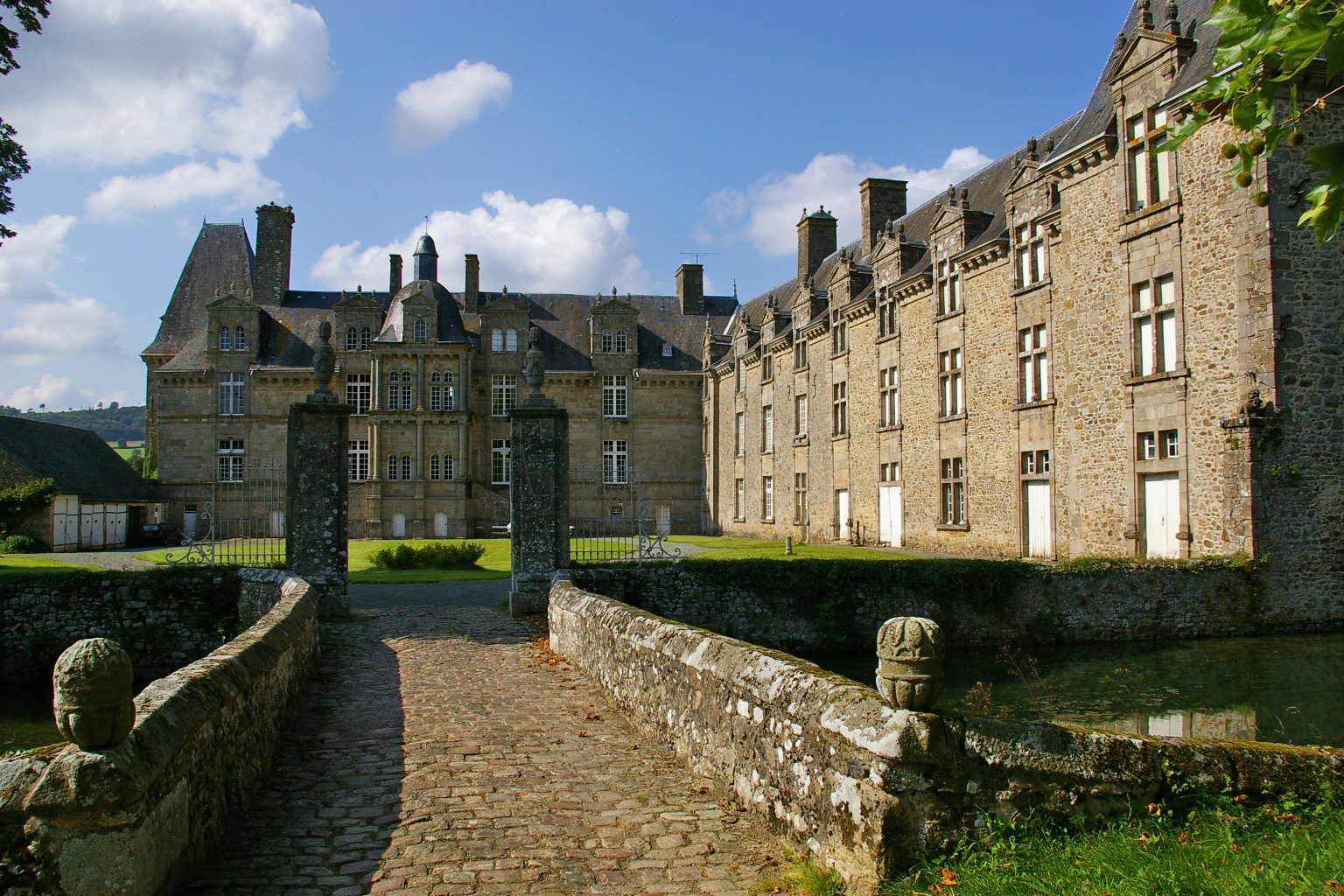
Foulletorte Castle, 2 km from Saint-Georges-sur-Erve in Mayenne, is a 16th and 17th-century building erected on the site of a feudal structure located on a mound surrounded by moats, on the edge of a pond fed by the Erve river.
Origin+
The current castle, built on the site of an old fortress, dates, as its style indicates, from around 1570. It is one of the most beautiful castles of this era preserved in Mayenne. It is not comparable in terms of the richness of its ornamentation to the Renaissance gallery of Rocher Castle or other buildings of a different era, but in terms of the majesty of the whole, the breadth of its lines, Foulletorte is of great beauty (Abbé Angot).
Hardly built, the castle was the scene of warlike events: in 1571, it was occupied by René Bourré, Lord of Jarzé, to whom the inhabitants of Villaines entrusted themselves. In 1590, Antoine de Vassé was besieged there by René de Bouillé, by order of the King and the Prince of Conti. In February 1795, a group of Chouans occupied the castle. On the 16th Ventôse of Year III, "General Gency ordered the commander of the garrison of Évron to search Foulletorte Castle, a den of brigands and one of their arsenals."
Architecture+
The loggia pavilion, which occupies the center of the facade and is accessed by a double staircase where the grand staircase unfolds, is not poor in richness with its two entablatures supported by columns. The projecting cornice with consoles, which runs around these immense dwelling buildings, crowned by round or cross-mullioned windows with triangular gables adorned with vases, forms a prominent and jagged line of happy effect. It is possible that the critical circumstances under which the castle was built led Antoine de Vassé to seek solidity rather than elegance, sacrificing days and ornaments. This would be the cause of what Léon Palustre calls ill-conceived masses and an ornamentation that is both heavy and poor. The moats, into which the course of the Erve was diverted, are remarkably wide and deep. The castle is referred to in 1643 as a Fortified House, with a walled courtyard, towers, ditches, moats, drawbridge; a mound also surrounded by ditches and moats and the forest of Les Haies of 100 acres are mentioned. The chapel, called Royault or of the Three Kings, dating at least from the 15th century, was endowed with "tithes of grain and other enfeoffed things." When building a house by the roadside, a stone was reused, supposedly from this chapel, carved with a coat of arms showing on the right the arms of Vassé and on the left a bar accompanied at the top by a crescent and at the bottom by a bird. A granite holy water font lies at the foot of the wall. Among the chaplains:
René de Vassé, †1572 Christophe de Vassé, son of Antoine de Vassé, 1578 Louis-François de Vassé, Canon of Paris, residing in the cloister of Notre-Dame, 1656, resigned, 1683 André Serveau, from Évron, 1723, †1729 Charles de l'Île-du-Gast, Doctor of Sorbonne, Canon of Chartres, Prior of Notre-Dame de Rahard, 1730, 1747.
The Lords and Owners of Foulletorte+
From the 14th century to the beginning of the 18th century, the castle belonged to the de Vassé family.
End of the 11th century: Robert de Folletorte 1168 Guillaume de Foulletorte is a witness to a donation from Guillaume de Sillé to Savigny Abbey. 1250 Guillaume de Foulletorte appears in a similar act in the cartulary of Champagne.
De Vassé Family+
1314 Jean de Vassé, then de Neuville family. 1387 Guillaume de Vassé, youngest son of Jean de Vassé and Peronnelle Le Voyer. May 18, 1450 Jean de Vassé, curator of Groignet de Vassé, his cousin; 1452 witness for Jean de Mathefelon, his nephew; 1469 tenant of the Abbot of Évron, still alive in 1474. Husband of Renée Mellet, he bought back on June 8, 1468, for a rent of 10 Écus, the rights that Etienne de la Saugère (from Châtres-la-Forêt) had to Foulletorte, from Jeanne d'Autheville, his wife. He married Charles, his son, to Jeanne Nepveu, minor, daughter of Jean, Lord of l'Aunay-Péan, and Françoise de Macon, on June 4, 1531, promising to withdraw the land of Voutré from the Lord of Champiré d'Orvaux, husband of Anne de Vassé. 1531 Charles de Vassé, husband of Jeanne or Anastase Nepveu, renders homage to the Abbot of Évron in 1541; still alive in 1554. 1570 Antoine de Vassé, Knight of the King's Order, husband of Esther Ponnet (?), was with his company in Villaines-la-Juhel in 1571. He barely survived the capture of his castle in 1590. 1591 Annibal de Vassé, heir under inventory of his father, Lord of Vaufleury and Foulletorte 1619, 1656 Jacques de Vassé, ordinary gentleman of the royal chamber, husband of Anne du Verger, daughter of Charles du V. and Geneviève Bausson. 1700 Pierre de Vassé, who took the title of Marquis de Saint-Georges, was Lord of Vimarcé, la Jarris, Crevant, Chassignole; married before 1664 to Madeleine-Angélique de Crevant. 1709 Abbot Louis-François de Vassé, son of Jacques de Vassé and Anne du Verger, last of the name in Foulletorte, sells Foulletorte to Abbot Hardy, counselor in the Parliament of Paris.
Pinon Family+
In 1711, Abbot Hardy bequeathed the estate to Paul-Louis Pinon d'Avor, Maître des requêtes, son of Anne-Louis Pinon de Quincy, who used it. Anne-Louis Pinon de Quincy, Marquis de Saint-Georges, born April 22, 1720, imprisoned during the Reign of Terror, husband of Marie-Angélique-Julie Ferrand de Vernay, died December 27, 1806. His son, Anne-Louis Pinon de Saint-Georges, born in 1774, emigrated in 1791, came to Foulletorte, where he died in 1850, leaving by Marie-Alexandrine-Élisabeth Bigot de Morogues Marie-Louise-Nathalie (1805-1873), who married Armand de Malherbe in 1826.
De Malherbe Family+
In 1873, her son, Raymond de Malherbe, Senator of Oise, inherited the castle. Louis Paul Christian de Malherbe, Count of Malherbe (1853-1920) René de Malherbe (1881-1931), Count of Malherbe, aviator Patrice de Malherbe (1918-1987) Today, Foulletorte Castle still belongs to the de Malherbe family, whose eldest family member is Florence Mollinger-de Malherbe (born 1943), great-great-granddaughter of Raymond.
Visits+
As Foulletorte Castle is private, the interior cannot be visited. Only exterior viewing: one can walk along the avenue to the bridge in front of the main courtyard, from where there is a beautiful view of this estate. The 11-hectare site was listed by decree of February 24, 1943. A dovecote with 800 nesting holes stands on a small peninsula.
Take Mobile History with you
You are reading this text for free. Premium adds what matters on the road: descriptions read aloud, sites found through your camera, whole regions taken offline.
- Every description, including the ~17,700 Premium sites
- Audio guide: have descriptions read to you on location
- AR finder: see sites through your camera, with distance and bearing
- Unlimited saved sites
14 days free, then from €2.99 a month. Cancel anytime.
Source: Wikipedia · Licence: CC BY-SA 4.0 · Image: MontdErve · Wikimedia Commons · Public domain
This description is a machine translation of an excerpt from the linked Wikipedia article. The source text was written by its authors, the translation is by Mobile History; like the original it is licensed under CC BY-SA 4.0.
Location: 48.1753, -0.2725