To be privately owned
ManorLa Boissière
Château de La Boissière (Mayenne)
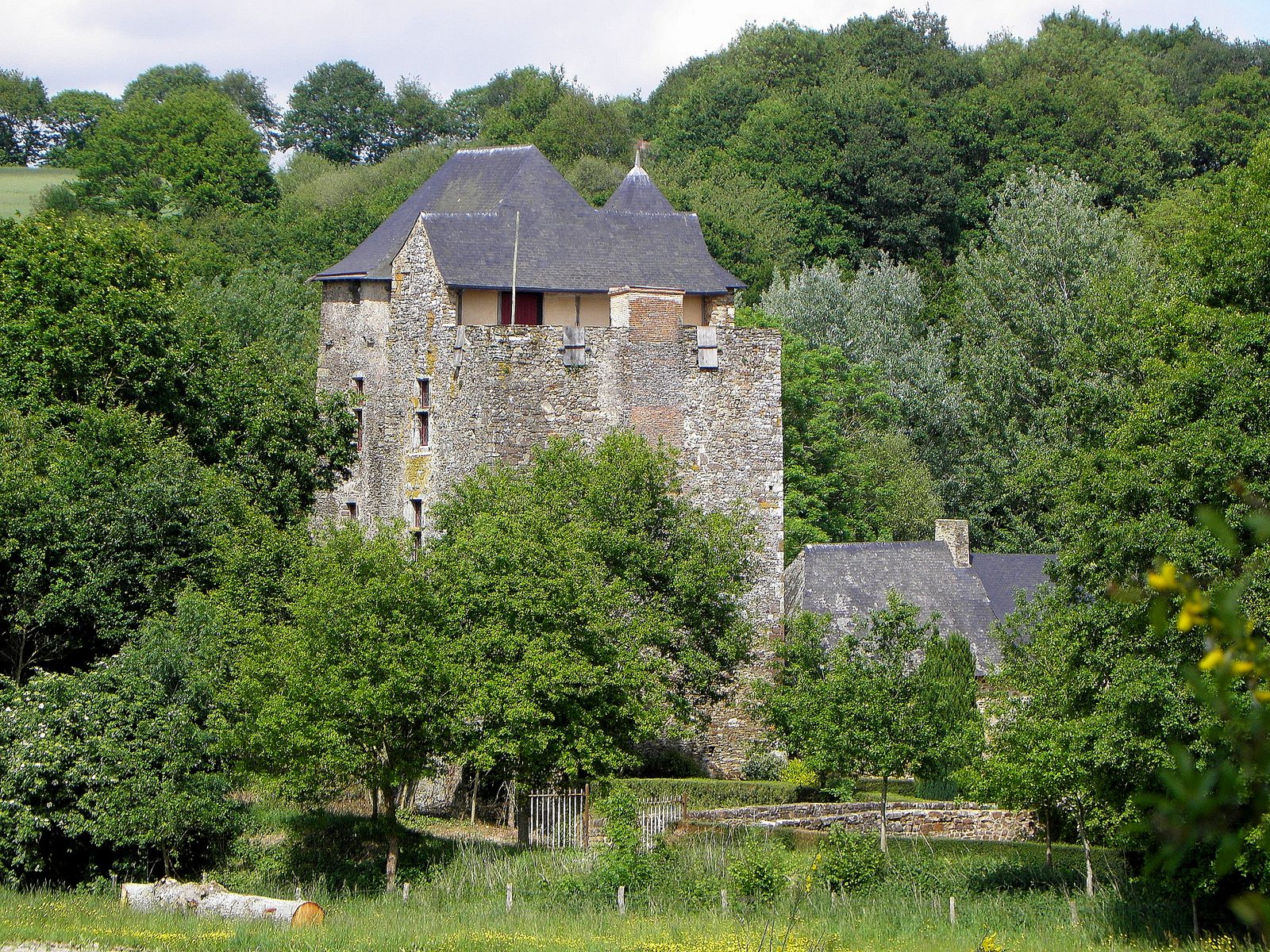
The Château de La Boissière is located in the commune of La Boissière, in the department of Mayenne and in the Pays de la Loire region.
Name+
According to Abbé Angot, the expression "Tour de Saint-Christophe de la Boissière" probably refers to the castle, as the parish itself is sometimes called "Saint-Christophe-de-la-Boissière".
History+
René-Jean Pommerais, justice of the peace in Craon, discovered a megalithic complex around 1860 in the field of Fontenelles near the Château de La Boissière. The châtellenie of La Boissière, inaccurately designated as it possessed neither fairs nor contract seals, was attached to the castle and subject to the fealty and homage of the châtellenie of Savonnières. The castle was among the fortresses occupied by the English from 1356 to 1361. The lordship was united with the châtellenie of Coulonges in Châtelais in 1764. In the 12th century, there was only a watchtower, used by soldiers to defend the Duchy of Anjou against the Duchy of Brittany. It was built at the level of a ford that allowed crossing the local river Chéran. Access to the floors of the tower was via internal ladders.[Citation needed] Around the 14th century, the tower became a castle with an extension to the south, adding a large room on each floor as well as a large staircase in a turret.[Citation needed] In the 18th century, the following were attributed to it as immediate property: the farm of La Boissière, the mill of La Chapellière, the coppice of Bois-Robert and the pond of La Queille (12 journals); as usufruct or feudal rights, the rights of escheat, bastardy, confiscation, the lordship of the fiefs of Bignon and La Morandière, the interests; finally, the ordinary honorary rights of the founders and patrons. Finally, towards the end of the 14th century, an infill tower gave the castle its current square shape by adding latrines. Adjacent to the castle, an old city wall was demolished in the 17th century to build a farmhouse.[Citation needed] The castle, of which a very tall building remains, found its defense in the wide moats that surrounded it and are still visible on one side. The d'Angennes sometimes visited this fortress. Jacques d'Angennes was there on June 7, 1550. From the 17th century, the castellan or tenant resided there. Renée Marcillé, Dame de Malaunay, died there in 1612 and was buried in the church of Saint-Clément de Craon. Simon Gasset and Renée Guillon were tenants in 1631, and René Vallot, Sieur du Mesnil, husband of René Bouchard, in 1699. The monument was listed as a historical monument on January 16, 1987. Private castle, open for visits on certain summer days.
Take Mobile History with you
You are reading this text for free. Premium adds what matters on the road: descriptions read aloud, sites found through your camera, whole regions taken offline.
- Every description, including the ~17,700 Premium sites
- Audio guide: have descriptions read to you on location
- AR finder: see sites through your camera, with distance and bearing
- Unlimited saved sites
14 days free, then from €2.99 a month. Cancel anytime.
Source: Wikipedia · Licence: CC BY-SA 4.0 · Image: GO69 · Wikimedia Commons · CC BY-SA 4.0
This description is a machine translation of an excerpt from the linked Wikipedia article. The source text was written by its authors, the translation is by Mobile History; like the original it is licensed under CC BY-SA 4.0.
Location: 47.7826, -0.9762