The lordship of La Roche, 15th century (Aveu). La Roche-Pichemer, 1524; Jaillot; Cassini The estate, fief and lordship of La Roche-Pichemer, 1525 La Roche-Pichemère (Ét.-M.).
CastleSaint-Ouën-des-Vallons
Château de la Roche-Pichemer
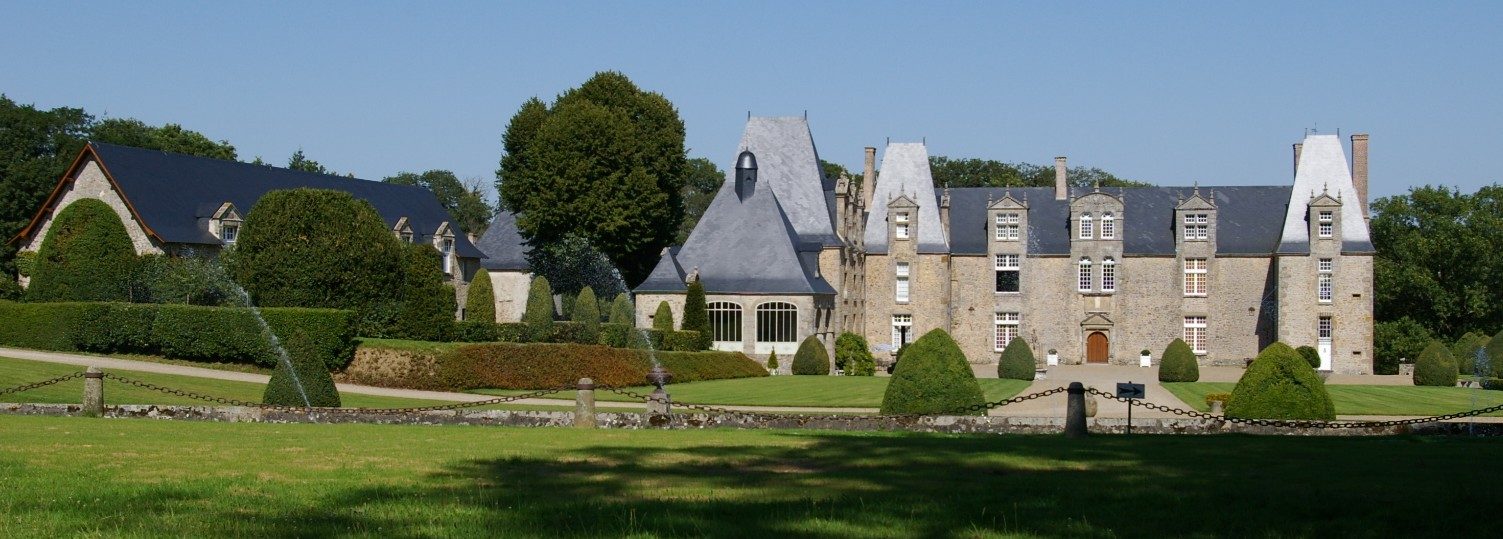
La Roche-Pichemer is a castle in the commune of Saint-Ouën-des-Vallons in Mayenne, located 300 m east of the village. Buildings from the 13th and 16th centuries. Two residential buildings, framed by three large pavilions; chapel rebuilt in the 19th century.
Designation+
Feudalism+
Fief depending on La Chapelle-Rainsouin, to which, at least since the 15th century, the parish lordship of Saint-Ouën is annexed. The lord had the right to grant grain and wine measures, taking the patron and essief of his lord; twelve deniers on the duty of goods sold on the day of the fair of Saint-Berthemi; four mansois from each barrel of wine sold on the said day of Saint-Berthelemy; wrecks, the right to take namps and gaiges for unpaid duties; the sixth denier on the sales of contracts; the right to force the subjects of the village of Saint-Ouën to the ban oven and those of the land of La Roche and Saint-Ouën to his grain, cloth, serge and office or other cloth mills; printed luitre around the church, both inside and out.
The Castle+
The castle of La Roche-Pichemer, certainly built by Louis du Plessis (°1542 - † 1570), comprises a rectangular residential building with a square pavilion at each corner of the facade, as a porch. In the center, a round arch portal, pilasters and triangular gable, a twin window on the first floor, a dormer window also with a double opening, surmounted by a round gable and fleurons in the attic, are carefully layered in granite. The same decorative motif is repeated in the other openings of the facade and the pavilions, except that the gables are triangular and less massive. An angled part of the building, built later in a simpler style, has been adapted to the ensemble since 1840. The north facade preserves a round tower at the northwest corner; it is assumed that a second, symmetrical one existed before the construction of the east wing. The chapel is mentioned in 1630; a request for preservation is made in 1804; it has since been housed in the castle. The castle enjoys two protection measures as historical monuments, dated September 17, 1973: a classification for the facades and roofs of the castle and the three pavilions, the dovecote, various rooms on the first floor and an inscription for the facades and roofs of the outbuildings.
The Legend of Catherine-sans-pitié+
The legendary lady of La Roche-Pichemer, Catherine-sans-pitié, was not a "good lady". Among other things, she is accused of having tied a man and an ox together and, to see who would survive the other, starved them to death. She was therefore rightly condemned for centuries to nocturnal rides on a fire cart on winter nights. Since there are several Catherines among the ladies of La Roche-Pichemer, it would be presumptuous to say which one was the Merciless. The legend was put into verse and printed.
Maucourt de Bourjolly+
The historian Charles Maucourt de Bourjolly, son of Louis Maucourt de Bourjolly and Julienne Boullant, was born on November 19, 1645, at La Roche-Pichemer Castle, where his father was the general farmer.
The Lords of La Roche-Pichemer+
The estate was notably owned by the du Plessis family until 1645, the de Montesson family from 1645 to 1778, and the de Hercé and d'Ozouville families since the beginning of the 19th century.
Du Plessis Family+
Jean du Plessis († <1435). His wife, Jeanne Triganne, sold the places La Touche and Le Val to free him from the hands of the English. Guillaume du Plessis, brother of the aforementioned, husband of Anne du Boiscornu, grants his sister-in-law on October 2, 1435, the use of La Fauconnière and La Gaisnière until she can regain La Touche and Le Val. He lived in 1464. René du Plessis, 1476, 1520. Jeanne Hatry, his widow, 1526. Ambroise, his daughter, widow of N. Le Cornu, married Guillaume Drouault, Lord of Villeray (Montourtier). Olivier du Plessis, 1524. His wife Renée de Sumeraine dies in 1553. Louis du Plessis († 1573) married Françoise de Feschal, sister of Jean de Feschal, Lord of Thuré. Renée (1545), Jeanne (1547), René (1551), Julien (1554), Françoise (1557) are born in La Roche-Pichemer. Françoise de Feschal is buried in the church on August 22, 1589. René du Plessis; Ambroise du Plessis is referred to as Lord of La Roche-Pichemer in 1607. His brother Charles du Plessis (°1586) is killed in a duel in 1609 by the Lord of La Fresnaye, leaving Philippe de Saint-Offange as his widow. His other brother François du Plessis (°1588 - † 1642) marries Catherine de Beaumanoir de Lavardin on January 31, 1612, in the chapel of Malicorne. They have: Catherine (1612), François (1617), Charles (1619), Marin (1621). Their father, who kills the son of the Lord of La Rochehue in a duel in 1625, is buried in 1642 in the church of Saint-Ouën de Saint-Ouën-des-Vallons.
De Montesson Family+
Charles de Montesson (1608-1672), husband of Marie Prévost de Saint-Cyr, acquired La Roche-Pichemer Castle on May 22, 1645, from René du Plessis, husband of Catherine Lamy, and his brother Marin du Plessis. Marie de Montesson, daughter of the castle lord, married Alexandre, Marquis d'Aché, Lord of La Roche-Talbot, in the castle chapel in 1668. Guy de Montesson, son of Charles de Montesson, Marquis de La Roche-Pichemer. Jean-Baptiste de Montesson (1646-1731) and his son, also named Jean-Baptiste (Jean-Baptiste de Montesson (1687-1769)), also sometimes resided in La Roche-Pichemer. After the death of the latter, Marie des Nos, wife of Joseph d'Aliney d'Elva, on her own behalf and on behalf of the numerous co-heirs of her branch, sold the estate by deed of March 16, 1778, to François and Jean Lilavois, merchants in Port-au-Prince (Saint-Domingue), represented by their sister Marie Lilavois, widow of Guillaume Foucault de Vauguyon.
De Hercé, d'Ozouville Family+
It was the daughter of the latter, Marie-Françoise Foucault de Vauguyon, wife of Jean de la Haie de Bellegarde, who owned this estate. Marie de la Haie de Bellegarde married Jean-François de Hercé (°February 18, 1776 Mayenne - † January 31, 1849 Nantes) in 1804, Mayor of Saint-Ouën-des-Vallons (1804) and then of Laval (1814-1829), finally Bishop of Nantes.
Their only daughter, Marie-Lucie de Hercé (° January 18, 1800 - † July 5, 1840, founder of the House of Sisters of Charity in Laval), married Guillaume-François d'Ozouville (° May 16, 1794 - † January 23, 1859) on September 7, 1825, himself Mayor of Saint-Ouën-des-Vallons from 1827 to 1830 and then from 1850 until his death in January 1859, founder of the new church of Saint-Ouën-des-Vallons, also a historian. Commander of the Roman Order of Saint Gregory the Great.
Visit of the Castle+
La Roche-Pichemer Castle is private; the interior is not open to the public. Access to the exterior and the park via the marked path (free visit). Opening hours 2007: from July 1 to August 15, daily between 2 PM and 6 PM.
Take Mobile History with you
You are reading this text for free. Premium adds what matters on the road: descriptions read aloud, sites found through your camera, whole regions taken offline.
- Every description, including the ~17,700 Premium sites
- Audio guide: have descriptions read to you on location
- AR finder: see sites through your camera, with distance and bearing
- Unlimited saved sites
14 days free, then from €2.99 a month. Cancel anytime.
Source: Wikipedia · Licence: CC BY-SA 4.0 · Image: MontdErve · Wikimedia Commons · Public domain
This description is a machine translation of an excerpt from the linked Wikipedia article. The source text was written by its authors, the translation is by Mobile History; like the original it is licensed under CC BY-SA 4.0.
Location: 48.1664, -0.5361