To be privately owned
CastleSaint-Sulpice
Château de la Rongère
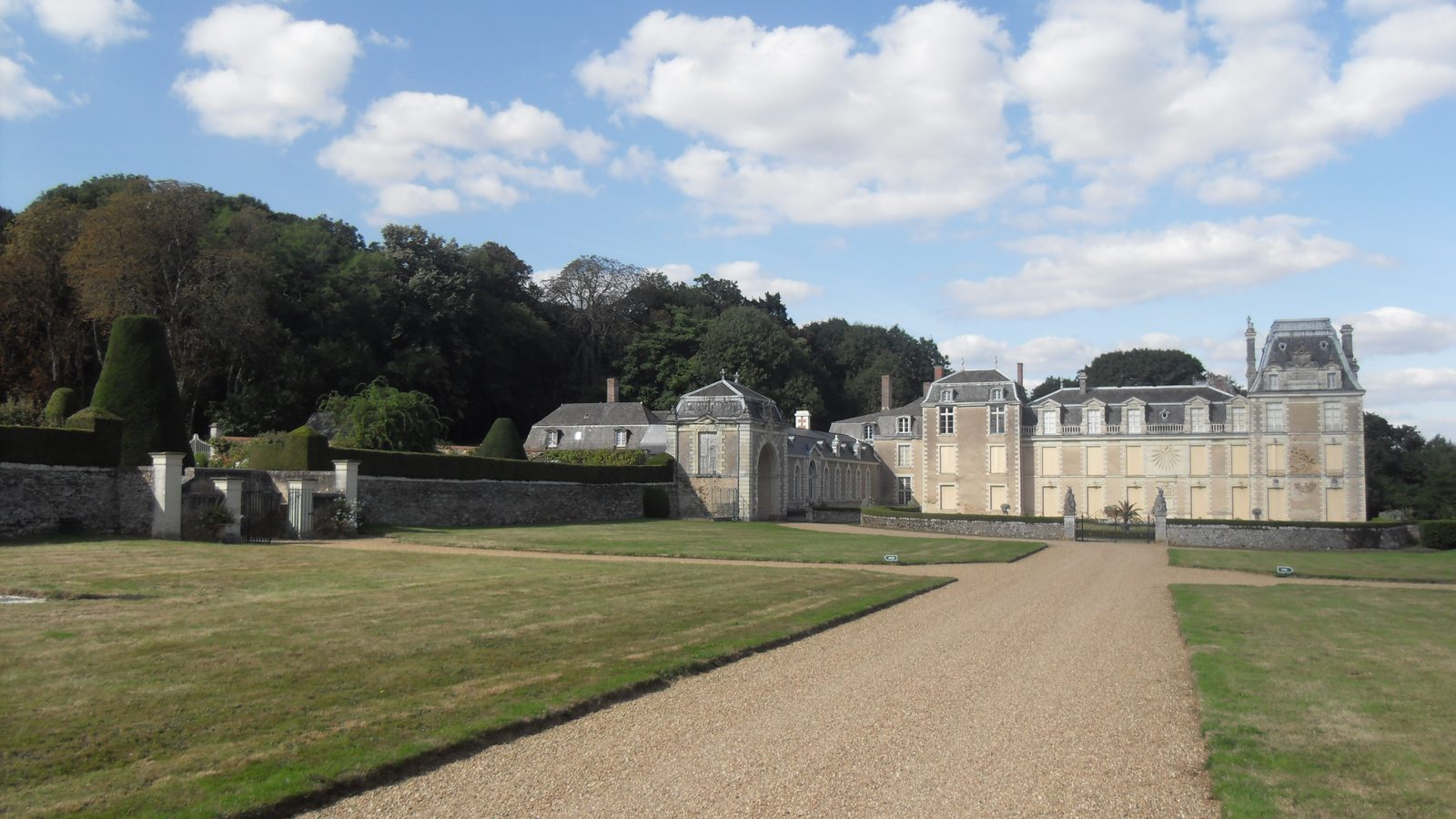
The Château de La Rongère is located in Saint-Sulpice, 1 km from the village, in the Mayenne department. A 1,000 m long tributary of the Mayenne originates there.
Designation+
H. de Rongeria, 1239; Le hebergement de la Rongère, 1414; La haute justice, tere, fief et seigneurerie de la Rongère, 1778; La Rongère, castle, avenue planted towards the village.
History+
Feudalism+
Fief of Château-Gontier, with the obligation of 40 days of guard duty and the obligation to have those who were to guard La Rongère also guard the town of Château-Gontier for eight days and eight nights. The feudal lordship of La Rongère was given in 1239 by the Lord of Laval to Jacques de Château-Gontier, who married Avoise de Laval. The right of high justice was recognized in 1404 and 1431, but not the title of a castellany. All the more so, the quality of Marquis de la Rongère, which the Quatrebarbes sometimes assumed, was purely personal. The 15th-century inn was replaced by a castle from 1545 to 1571. It received a visit from the Duke of Rohan, leader of a Protestant party, against whom the Huguenots of the country had warned Gilles de Quatrebarbes. "But the Lord Duke, who had entered this house without resistance, where he was received with respect and recognized the cunning of those who had deceived and surprised him, left it without having committed any hostile act, and honored the Lord of La Rongère with his friendship, as evidenced by a letter from Guy Chauvin, Lord of Limarault, written on behalf of the Duke from Blain Castle." In this manor, where a new residential wing had recently been built, the inventory of 1675 lists as works of art: an old Flemish tapestry with small figures playing stick; ... two large paintings above the fireplace depicting shepherds and shepherdesses; ... an old Flemish tapestry with large figures; ... very fine Gobelin tapestry; more than 30 ells of Flemish and Bergamask tapestries with greenery; a gilded leather tapestry from Antwerp; 130 marks of silverware. The modern castle dates from the 18th century. Its location is excellent, with terraces and gardens overlooking the Mayenne, beautiful avenues, a park and lawns interspersed with groves and beautiful trees. The building, according to Abbé Angot, is of simple but tasteful architecture. The picture gallery includes a series of portraits of the de Froulay family.
French Revolution+
In 1797, Jean Bezier lived in Saint-Sulpice, in the mill of La Rongère, then in 1800 in the Château de La Rongère. In this castle, he was received by Madame la Marquise Henri-Frédéric de Chavagnac, Dame de la Rongère, née Henriette-Françoise de Montecler. Jean Bézier was awarded the Knight of the Royal and Military Order of Saint-Louis in 1814 in L'Île-d'Yeu, which he received from the hands of the Count of Artois (the future Charles X of France). Appointed Colonel of the Legion of the Royal Army of Maine, the Marquise de Chavagnac, Dame de la Rongère, née Henriette-Françoise de Monteclerc, welcomed him to her table after he had received the Cross of Saint-Louis. The facades and roofs of the castle have been listed as historical monuments since May 16, 1991, while the park has been classified since October 10, 1991.
The Passage of La Rongère+
The ferry of La Rongère was one of the frequented passages of the Mayenne; there was also a port for boats. The parish procession went there in 1669 by barge to Villiers, and the minister granted aid of 700# in 1774 for the construction of the road from the ferry to the boat. Boats stopping at the port paid tolls, but those merely passing through were exempted from the claims of the Lord of La Rongère under Francis I. There was a windmill in La Petite-Rongère, 1355. One of the two mills on the dam belonged in 1460 to Jean du Coudray, who sold it to Pierre Quatrebarbes for a rent of 4 bushels of rye. A republican post on the dam of La Rongère was attacked on the night of May 18-19, 1794, by Chouans, who killed two men and wounded a third.
The Chapel+
The chapel, founded in 1365 under the patronage of Saint James with the obligation of three masses, in quadam capella sita in villa Sancti Sulpicii ac prope ecclesiam dictae villae, decreed on the Thursday after Saint Clement (November 25, 1365), had among others almost all from the Quatrebarbes family as chaplains:
Louis de Quatrebarbes, Prior of Saint-Malo, Parish Priest of Fontenay [Which one?], 1470, testament, 1502; Robert Rolland, 1482; Jean de Quatrebarbes, died 1656; Claude de Quatrebarbes, 1656, 1661; Elie de Quatrebarbes, 1661, 1667; Claude de Quatrebarbes, 1667, 1668; Jacques de Quatrebarbes, 1668, died 1703; François de la Lande, Parish Priest of Saint-Sulpice, 1703, died 1736; Joseph-François de Monteclerc, 1736, died 1768. Gaspard L'Enfant, Lord of Saint-Gilles, married Suzanne-Thérèse de la Matraye in the chapel in 1738, the preservation of which was requested in year XIII.
Lords+
La Rongère+
Hamelin de la Rongère, witness around 1090 to a charter of Guy II of Laval in favor of the Abbey of Marmoutier; It is stated that Gervais de la Rongère crossed with Guillaume d'Orange, Herbert or Hubert de Brée, Payen de la Chapelle Rainsouin and many other knights accompanying Geoffroy III of Mayenne, Baron of Mayenne. This historical version regarding the crusaders of Mayenne is a historical deception; Hamelin de la Rongère, whose fief, Homagium et Fidem, cum omni jure et dominio, in 1239, Jacques de Château-Gontier receives as dowry from Avoise de Laval, his wife.
Quatrebarbes+
Macé Quatrebarbes, husband of Jeanne de Barchesac, buyer of the preceding for 12,000# in 1293; Maurice Quatrebarbes gives a tithe in Saint-Sulpice to the Abbey of La Réal, 1319, still alive in 1340; Pierre Quatrebarbes receives an acknowledgment in 1350, marries Olive de la Jaille in 1353 and makes his will in 1401, mentioning his father and grandfather, Maurice and Macé. He outlived Jean Quatrebarbes, his son, mentioned in a charter of 1391, whose widow Roberde Bourelle remarried Bernard Haussé in 1405; Macé Quatrebarbes makes an acknowledgment in 1410, marries Jeanne de Sourches and dies childless, killed in the Battle of Verneuil (1424) with three of his brothers; Jean Quatrebarbes, brother of the preceding, studied at the University of Paris in 1425, was chamberlain to the king in 1445, who gave him letters of protection in 1458 and allowed him to affix the royal coats of arms on his lands. Isabeau Frézeau, his widow, widow of La Rongère, made her will on February 17, 1486; Pierre Quatrebarbes also served against the English, married Catherine de la Jaille and was buried in the church of Marson, where his wife, who made her will in 1514, followed him; Jacques Quatrebarbes ratified in 1492 the division given to his brothers by his father, married by dispensation of October 4, 1520 Julienne Le Porc, whose united coats of arms with his were seen on the vault of a chapel of the church of Saint-Sulpice, and died childless in 1529; Jean Quatrebarbes, brother of the preceding, refused the hand of a Demoiselle du Bouchet, undoubtedly of the Lords of Villiers, his neighbors, and died without issue; Guillaume Quatrebarbes, 3rd cousin of the preceding, succeeded him before 1559, was godfather to René de la Roussardière, his nephew, in Parné in 1561. He died on August 9, 1571, and was buried in the choir of the church of Saint-Sulpice, where his wife Jeanne de la Roussardière, who remained Catholic despite the apostasy of her family, followed him in 1611; François de Quatrebarbes, born on August 7, 1552, under the sign of Aries, on the seventh day of the moon, married Louise de la Croix, lived as a Catholic, but as a poor manager, had to give up his property in 1604 and died in 1614; Lancelot de Quatrebarbes, a man of great spirit and admirable judgment, married Françoise de Cervon in 1606, restored the fortune of his house and died on January 29, 1638; René de Quatrebarbes; Hyacinthe de Quatrebarbes.
Menon+
François Henri de Menon (de Turbilly), from the de Menon family, Count of Turbilly, married the eldest, Henriette-Antoinette de Quatrebarbes, received the castle, the high forests, the pond of La Rongère, the lordship of the parish in 1705 and died in La Rongère in 1742, father of Hyacinthe de Menon de Turbilly. [Source required]
Montecler+
Joseph-François, Marquis de Montecler (1694-1766), married in 1716 in the chapel of Chéronne, in Tuffé, Jeanne Hyacinthe de Menon de Turbilly, Dame de la Rongère (1699-1742), daughter of François Henri, whose beauty the Marquis de Sourches praises. At this time and until the end of the 17th century, La Rongère became the usual residence of the Marquis de Montecler; Hyacinthe-François-Georges, Count of Montecler, born on May 8, 1719, Musketeer in 1736, then Cornet of the Queen's Chevau-légers at the time of his marriage on September 5, 1740, to Marie-Charlotte de Montullé (daughter of Jean-Baptiste de Montullé), was appointed Maréchal de camp in December 1743. He died on October 5, 1764, in La Rongère, where he had retired since February 10, 1759, leaving as his only daughter: Hyacinthe-Jeanne de Montecler, born in Paris on June 21, 1750, and married on July 26, 1768, to René-Georges-Marie de Montecler (1738-1810), her father's first cousin, who resumed the title of Marquis de Montecler. The latter, after having been one of the influential members of the Provincial Assembly of Touraine in October-November 1787, emigrated in 1791. The Marquise de Montecler, who had sent the names of the priests known to her who had refused the oath to the Gazette de Paris on February 24, 1791, first followed her husband, then returned to Paris to try to save part of her family's fortune. Imprisoned during the Terror, she received permission to continue living as "Citoyenne Monteclair" in her hotel in the Rue du Cherche-Midi – her mother had had a renowned circle there – "under the guard of two genuine Sansculottes, relieved every decade," but in the Rue Garancière she died on April 17, 1805. Eugénie-Henriette de Montecler, fifth daughter of the Marquis de Montecler, born in Paris on April 1, 1782, married Gaspard-Marie de Montecler in Saint-Sulpice on October 2, 1802, and received the land of Montecler as her share.
Chavagnac+
The castle and the land have since passed to the Chavagnac, as the two sisters Henriette-Françoise (1769-1843) and Agathe-Françoise (1773-1798) de Montecler married the Marquis Henri-Frédéric and the Count Louis-Vigile de Chavagnac, respectively.
Take Mobile History with you
You are reading this text for free. Premium adds what matters on the road: descriptions read aloud, sites found through your camera, whole regions taken offline.
- Every description, including the ~17,700 Premium sites
- Audio guide: have descriptions read to you on location
- AR finder: see sites through your camera, with distance and bearing
- Unlimited saved sites
14 days free, then from €2.99 a month. Cancel anytime.
Source: Wikipedia · Licence: CC BY-SA 4.0 · Image: Edmond8300 · Wikimedia Commons · CC BY-SA 4.0
This description is a machine translation of an excerpt from the linked Wikipedia article. The source text was written by its authors, the translation is by Mobile History; like the original it is licensed under CC BY-SA 4.0.
Location: 47.9088, -0.7168