To be privately owned
CastleNesmy
Château de Nesmy
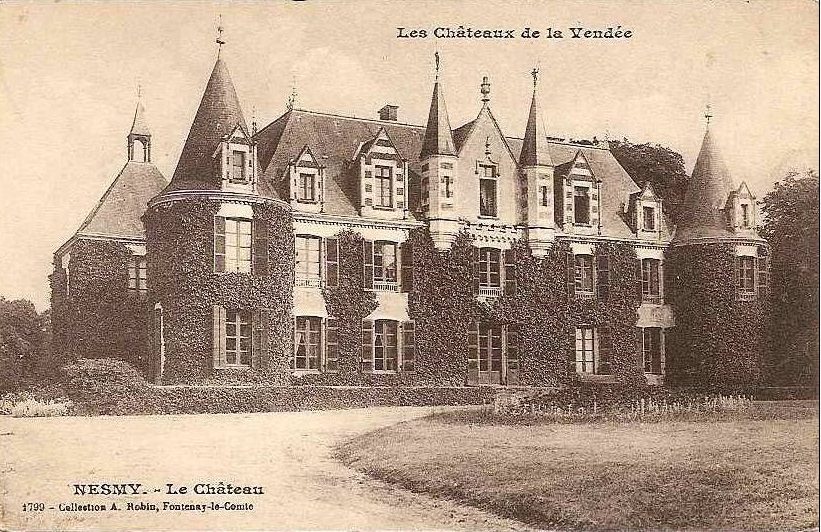
The Château de Nesmy is a historic château located in the commune of Nesmy, in the Vendée department of the Pays de la Loire region in western France, near La Roche-sur-Yon.
The seigneurie of Nesmy, which held rights of high and low justice, has extremely ancient origins. The oldest elements of the site date back to the 11th century, when the castle was built on the foundations of a very old domain belonging to the Ascelin family. The lords of Nesmy are frequently mentioned in the cartulary of Sainte-Croix de Talmont (68 of the 536 charters between 1049 and 1254 concern them). The earliest known lord is Ascelin de Nesmy, succeeded by his son Ponce in 1060 and later by Jean, Hugues and others.
Remarkably, the estate has remained within the same extended family for nearly a thousand years. Ownership passed through successive generations (often from uncle to nephew or niece, or from father-in-law to son-in-law). It was sold only once, in 1596, and that sale was internal to the family (to a cousin, Isaac Chabot). Later owners included the Chabot and Mauclerc families; in the 19th century it belonged to the de Tinguy de Nesmy family. The present owners, André and Élisabeth Chapelle, inherited the property around 2003–2005.
The château stands on a rocky promontory overlooking a 16th-century terrace and the site of an ancient pond. It was rebuilt at the end of the 18th century as a typical Vendéen logis. Major works began in 1842 under Charles and Mathilde de Tinguy: the architect François Léon Liberge added round towers to the façade, raised the roofs and built neo-classical Italianate outbuildings. Further modernisation took place around 1860 under the architect Guillerot.
At the same time a 47-hectare landscaped park was created in 1842 by the Angers landscape architect and nurseryman André Leroy and later enlarged by the Bühler brothers. It features carefully designed vistas converging on the château, a hydraulic system of five interconnected ponds, and a belt of rare and mature trees (bald cypresses, sequoias, Lebanese cedars, Virginia tulip trees and others). Several ornamental structures (fabriques) complete the ensemble.
The façades and roofs of the château, the platform, the outbuildings and the park (with its walls and fabriques) were partially inscribed as a Monument historique on 8 December 2008. The château remains a private family residence; the park is open to visitors in summer and on special occasions such as the European Heritage Days.
Take Mobile History with you
You are reading this text for free. Premium adds what matters on the road: descriptions read aloud, sites found through your camera, whole regions taken offline.
- Every description, including the ~17,700 Premium sites
- Audio guide: have descriptions read to you on location
- AR finder: see sites through your camera, with distance and bearing
- Unlimited saved sites
14 days free, then from €2.99 a month. Cancel anytime.
Source: Wikipedia · Licence: CC BY-SA 4.0 · Image: Collection A. Robin, Fontenay-le-Comte · Wikimedia Commons · Public domain
This description draws on the facts documented in the linked Wikipedia article; Wikipedia content is licensed under CC BY-SA 4.0. Wording and editing: Mobile History.
Location: 46.5958, -1.4046