The remains of the Castle can be visited
CastleRauzan
Château de Rauzan
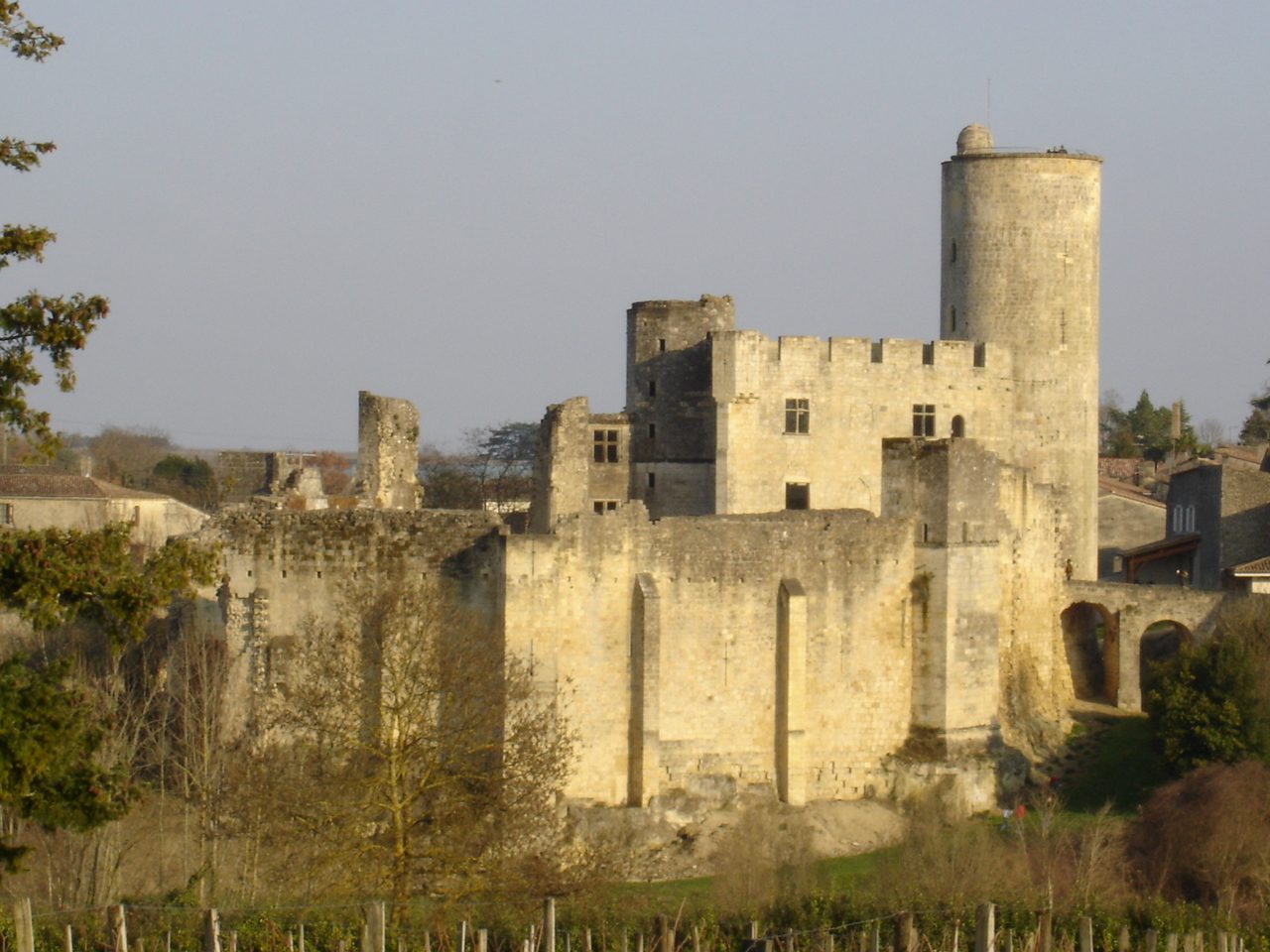
Château de Rauzan is a castle in the French commune of Rauzan, in the Gironde département of France. Built by John Lackland, Duke of Normandy (1199–1204), Duke of Guyenne (1199–1216) and King of England (1199–1216), the castle was built on a rock occupied since ancient times. During the Hundred Years' War (1337–1453), the castle was captured twice by the French. It has been listed since 1862 as a monument historique by the French Ministry of Culture. From 1970, the commune of Rauzan, owner since 1900, and lovers of medieval architecture, have undertaken work of clearing and restoration.
History+
The castle at Rauzan was erected in the 13th century by John, King of England. It then became the property of Rudel of Bergerac (1223–1320), then of Guillaume-Raymond of Madaillan (1320–1391) who fought at the side of the Black Prince, governor of Guyenne of 1356 to 1370, at the Battle of Poitiers in 1356 and at the imprisonment of the King of France, John II ("John the Good"). In October 1370, Bertrand of Guesclin returned to France where he was made constable to Charles V and began his big venture to expel the English from France. Contrary to the habits of the French chivalry, he did not proceed to the great mountains with the entire French army, but preferred to methodically reconquer whole provinces, besieging castle after castle. He would chase the English from Normandy, Guyenne, Saintonge and Poitou. The castle in Rauzan was captured in 1377. Rauzan was then the subject of a law suit between Henri IV (1367–1413) and Jeanne of Armagnac, great-granddaughter of Saint Louis and wife of Guillaume-Amanieu of Madaillan (1375–1414), the last male representative of that branch, whose wife had a daughter named Agnès, who died young. At the death of her husband, she won the right to remarry a Frenchman on condition of giving up the castle. Rauzan then fell to Bernard Angevin (1437–1480), whose opportunistic attitude pointed the English camp to the French camp in accordance to his interests. At the end of the Hundred Years' War, he sided with the crown of France and retained all of his property. As the troubles of the war passed, he refurbished the castle little by little as it evolved from a fortified castle into a residential château. Rauzan then passed into the hands of Durfort of Duras who gradually abandoned it. Bordeaux quarrymen extracted stones of the building (for cutting tombstones) and blocks of rock on which it was based, which caused the northern part of the château to fall. The ruins became, in 1819, the property of Chastellux before the town acquired it in 1900.
Building description+
The building secured three main functions that characterised medieval castles: defence, housing and reflection of the power of the family.
The castle entrance+
The entrance was protected by several defensive elements. A barbican controlled the drawbridge and access to the castle. There was another drawbridge that has disappeared. The door was protected by a portcullis with a watch tower and the keep to the left.
Source: Wikipedia · Licence: CC BY-SA 4.0 · Image: Xabi Rome-Hérault · Wikimedia Commons · CC BY 3.0
This description is an excerpt from the linked Wikipedia article and was written by its authors. Like the original it is licensed under CC BY-SA 4.0 and may be reused under the same terms.
Location: 44.7806, -0.1267