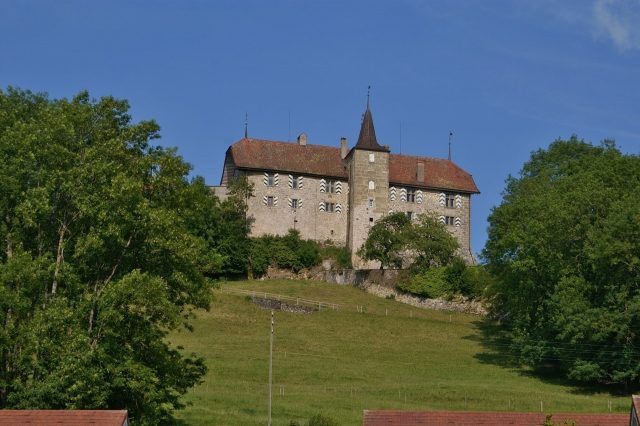
CastleRue

Château de Rue

Château de Rue

To be privately owned

The village of Rue stands on a molasse elevation on the eastern flank of the upper Broye Valley. As the old path leading from Lake Geneva to Moudon and Avenches passed nearby, and a road transitioned towards the Glâne Valley, it gained significant importance in the Middle Ages – hence the need for a fortified position.

In documents, Rue first appears in 1155 in the possession of the vassals of the Counts of Geneva. The probable date of the work is in the 12th century, based on the enormous and solid quadrangular watchtower on the northeast side, which had to defend access to the rocky cape. In front of the tower, the moat was crossed by a drawbridge. The molasse hill on the steep slopes was in turn protected by an enclosure wall and, to the west, by a defensive tower, which still stands today. The castle area was occupied by residential and service annexes. However, the original structure remains hidden.

In the 13th century, the modest castle of Rue was involved in the struggles that took place in the north of Lake Geneva by the House of Savoy. It was damaged twice, most severely in 1237, but each time it was rebuilt without hesitation. Presumably, at this time, the level of the courtyard was raised by rubble.

After the Savoyard invasion, the lords of Rue continued to reside in their ancestors' fortress, but this time as ministerials of the House of Savoy. Best known is the Savoyard Count, Pierre II, to whom the founding of the small village of Rue is attributed, built below the castle on the south side, but still within its enclosure walls. Built during the Savoyard period were the five extensive cellars of the buildings. The vaulted arches were partly dug into the rock. The building itself, erected at the end of the rocky spur, was only built in the 17th century.

Characterized by a massive stair tower with a quadrangular footprint, it is a very beautiful building from the late Renaissance. After Fribourg had seized Rue during the Burgundian Wars, Fribourg definitively took possession of it in 1536. Fribourg had some of the most important masonry of the work rebuilt after 1618, especially those that became the seat of the bailiff, the barn adjacent to the tower, and the gate.

For its part, the enclosure wall was reinforced by some baroque turrets. These constructions, along with the fountain, which was only built in 1735, and several medieval elements characterize the architecture and style of the current work.

In the possession of the Canton of Fribourg for approximately 3 centuries, Rue Castle passed into private hands in the 19th century.

Take Mobile History with you

You are reading this text for free. Premium adds what matters on the road: descriptions read aloud, sites found through your camera, whole regions taken offline.

  • Every description, including the ~17,700 Premium sites
  • Audio guide: have descriptions read to you on location
  • AR finder: see sites through your camera, with distance and bearing
  • Unlimited saved sites

14 days free, then from €2.99 a month. Cancel anytime.

Location: 46.6201, 6.8223