To be privately owned
CastleSainte-Hermine
Château de Sainte-Hermine
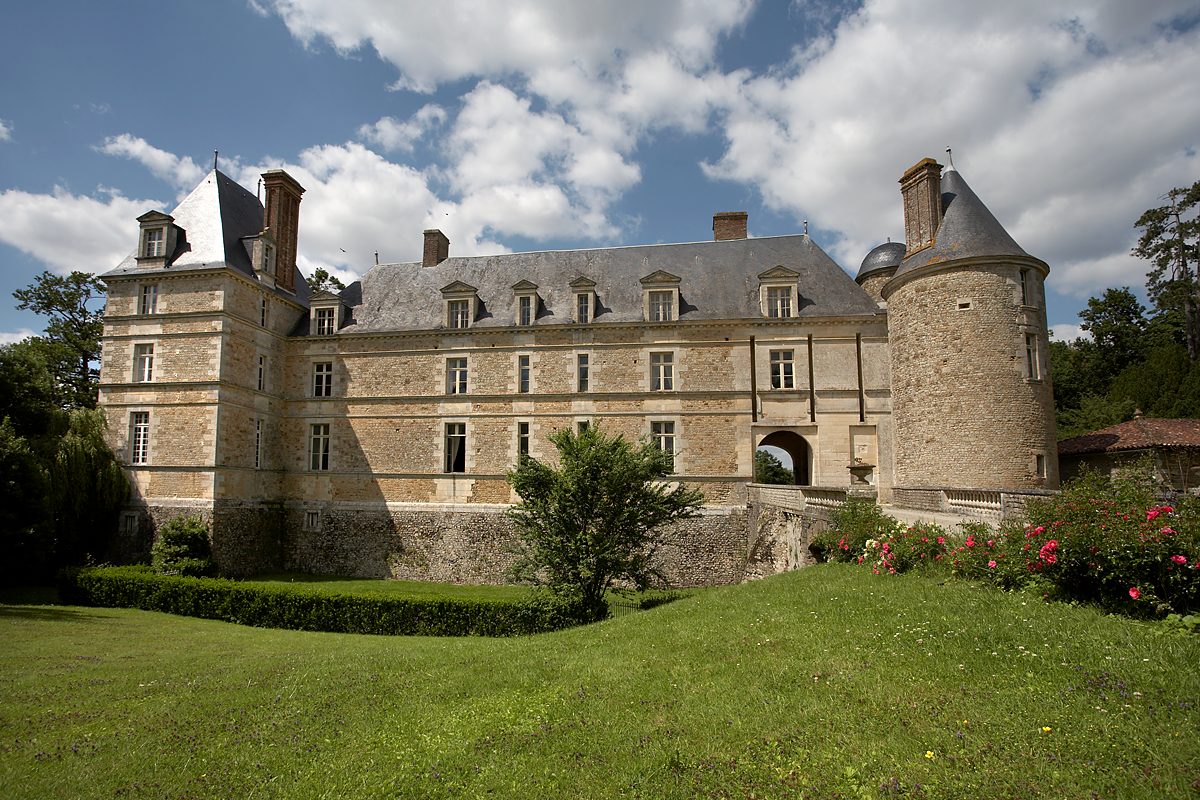
The Château de Sainte-Hermine is a historic residence located in the town of Sainte-Hermine, in the Vendée department of the Pays de la Loire region in western France.
The seigneury is attested from the 12th century and was linked to the foundation of the Priory of Saint-Hermand and its church around 1120. A primitive tower was built on a tongue of land naturally protected by the river and reinforced by a water-filled trench. Originally known as the Tour de Saint-Hermand, the site became the Château de Sainte-Hermine in the 14th century, taking its name from the castle chapel dedicated to Saint Irmine (Hermine).
The late-13th-century spur tower, known as the Tour à Bernard, still stands. The medieval fortress of the 14th–15th centuries passed in 1389 to Marie de Sully and then remained for nearly two centuries in the powerful La Trémoïlle family; Georges de La Trémoïlle strengthened its defences. King Philip III the Bold visited in 1272. During the Wars of Religion the castle was unsuccessfully besieged by Huguenot forces in 1568.
In 1598 Charlotte-Catherine de La Trémoïlle sold the barony to the Protestant gentlemen François des Nouhes (companion of Henri IV, lieutenant-general and later governor of Fontenay-le-Comte) and Louis Suriette. Henri IV stayed at the château in 1589 and 1598. Encouraged by Philippe Duplessis-Mornay (who expressed the wish to be buried at Sainte-Hermine), Jacques des Nouhes rebuilt the residence on the medieval ruins between 1612 and 1620–1622. The master-mason Mathurin Bernard of Fontenay-le-Comte directed the works. The new château, sober in style and reflecting Reformed taste, was inaugurated or visited by Louis XIII in 1622. The barony later passed to the Courcillon family, marquises of Dangeau.
Despite 19th-century alterations carried out by the Comte de La Poëze and later by Armand Landois (mayor of Sainte-Hermine) with the architect Paul-Joseph Guillerot, the interior still preserves early-17th-century fireplaces and painted decoration. The estate was acquired in 1877 by the Michelon-Landois-Buet family and remained with the Landois descendants until the mid-1970s. It was later purchased in 1998 by Laurent Poultier du Mesnil. During the Wars of the Vendée in 1793 the château served as a meeting place for Vendéen generals.
The entire château, including the late-13th-century spur tower, was inscribed as a Monument historique on 17 February 2005. It remains private property.
Take Mobile History with you
You are reading this text for free. Premium adds what matters on the road: descriptions read aloud, sites found through your camera, whole regions taken offline.
- Every description, including the ~17,700 Premium sites
- Audio guide: have descriptions read to you on location
- AR finder: see sites through your camera, with distance and bearing
- Unlimited saved sites
14 days free, then from €2.99 a month. Cancel anytime.
Source: Wikipedia · Licence: CC BY-SA 4.0 · Image: LPM1366 · Wikimedia Commons · CC BY-SA 3.0
This description draws on the facts documented in the linked Wikipedia article; Wikipedia content is licensed under CC BY-SA 4.0. Wording and editing: Mobile History.
Location: 46.5583, -1.0569