The Castle can be visited
CastleSigournais
Château de Sigournais
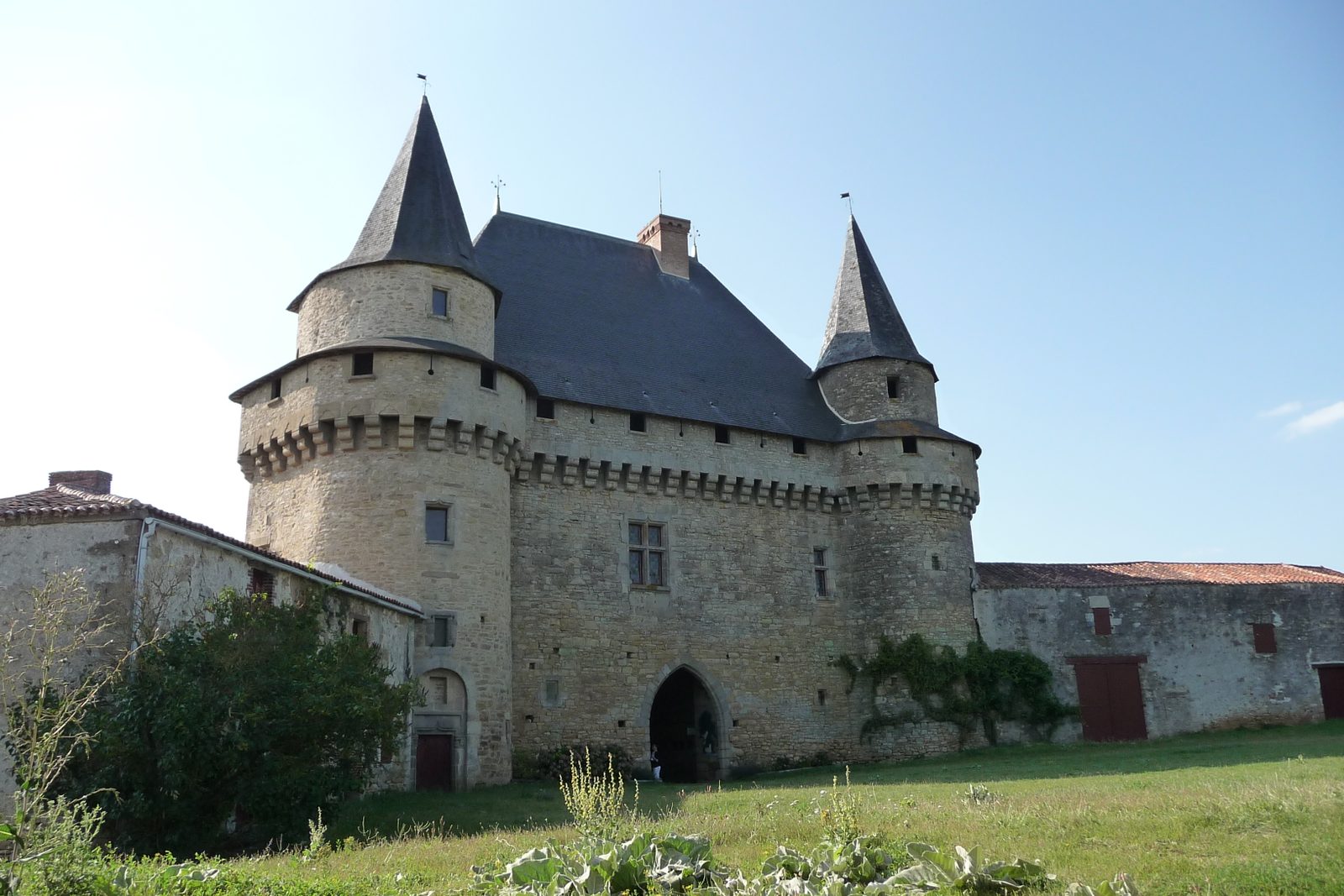
The Château de Sigournais is a medieval fortress located in the commune of Sigournais, near Chantonnay, in the Vendée department of the Pays de la Loire region in western France. It is widely regarded as one of the finest surviving examples of medieval military architecture in the Vendée.
The seigneury is attested from at least 1050 under the name “Seguracium”. It belonged to Zacharie de Pouzauges, a vassal of the Vicomtes de Thouars. In the 12th century a priory dedicated to Saint Saturnin was built inside the enclosure of the earlier castellum; tensions with the castle inhabitants led to its relocation outside the walls, which made possible the construction of the present château. Nothing visible remains of the 12th-century fortress; its foundations lie a little further north and are partly covered by the later building.
The castle as it stands today was erected in the late 15th century by Guyard de Sainte-Flayve. It has an almost pentagonal fortified enclosure formed of curtain walls flanked by seven to nine round towers and a massive gatehouse-keep (donjon-porche). A dry moat cut into the limestone surrounds the whole. The keep is unique in the Vendée: a rectangular châtelet flanked by two round towers, rising on three levels, crowned by a fully covered wall-walk (chemin de ronde) resting on machicolations. It retains typical combined arrow-loops and gunports (archères-canonnières), original “chevrons-formant-fermes” roof framing, and latrines. Two drawbridges (one for carts, one for pedestrians) originally gave access. Part of the structure was damaged by fire during the Wars of the Vendée in 1793–1794.
The keep was classified as a Monument historique on 28 January 1946; the archaeological remains of the earlier castle were inscribed in 1987; and the 15th-century castle together with its former moats were classified on 24 January 1992.
Today the privately owned château is open to the public in summer. The seigneurial rooms recreate the atmosphere of the late 15th century with furniture, armour and mannequins. It is especially renowned for an exceptional collection of 700–800 territorial coats of arms displayed on the walls (Ancien Régime provinces, French departments and their capitals, communes of the Vendée, and European provinces and capitals). Temporary exhibitions, treasure hunts, heraldic workshops and occasional sound-and-light shows complete the visit. From the covered wall-walk visitors enjoy a remarkable panoramic view over the Vendée bocage.
Take Mobile History with you
You are reading this text for free. Premium adds what matters on the road: descriptions read aloud, sites found through your camera, whole regions taken offline.
- Every description, including the ~17,700 Premium sites
- Audio guide: have descriptions read to you on location
- AR finder: see sites through your camera, with distance and bearing
- Unlimited saved sites
14 days free, then from €2.99 a month. Cancel anytime.
Source: Wikipedia · Licence: CC BY-SA 4.0 · Image: GardienAncestral · Wikimedia Commons · CC BY-SA 3.0
This description draws on the facts documented in the linked Wikipedia article; Wikipedia content is licensed under CC BY-SA 4.0. Wording and editing: Mobile History.
Location: 46.7040, -0.9854