Municipal offices
CastleSiorac-en-Périgord
Château de Siorac
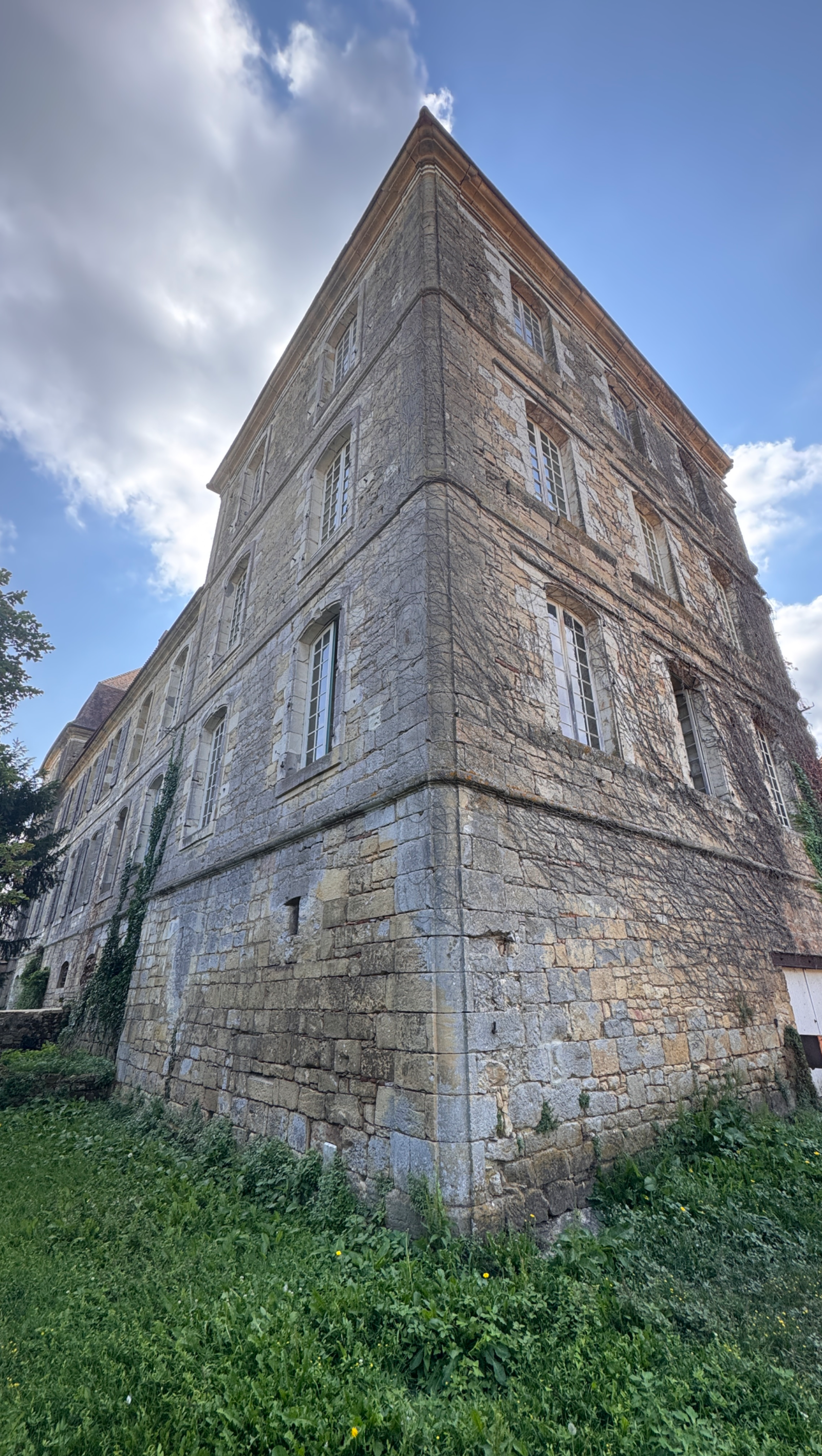
Siorac Castle is a French castle located in Siorac-en-Périgord, in the Dordogne department, in the Nouvelle-Aquitaine region. Siorac Castle is a castle located in the Périgord Noir, north of the commune of Siorac-en-Périgord.
History+
The lordship of Siorac was divided among several co-lords in the Middle Ages.
The Siorac estate owned by Sarlat Abbey+
A bull from Pope Eugene III to Sarlat Abbey in 1153 mentions among the parishes dependent on the abbey the curtes of Ciourac'. Before May 1288, the English founded a bastide there, at a place called "Castel-Réal". This realization led to a lawsuit before the Parliament of Paris, which caused great difficulties, recorded in the court records of 1268 and 1291.
Siorac during the Hundred Years' War+
In the Middle Ages, a fortress occupied by the English existed. In May 1373, Gilbert de Domme, Pons de Beynac, Lord of Commarque, and the town of Sarlat attacked Siorac Castle. The English left the place. However, English mercenary troops reoccupied Siorac. Adémar d'Abzac (†1414), co-lord of Siorac, was Lord of La Douze, Montastruc, Bellegarde, La Cropte, Beauregard and owner of the noble house of Abzac in Périgueux, married in 1373 to Guillemette de Boniface. His son, Bertrand d'Abzac, was co-lord of Siorac, Lord of Montastruc and Domme. He was a company captain in the service of the English. In 1414, he apparently entered the service of the King of France. He then married Jeanne de Beynac, daughter of Pons de Beynac, Lord of Beynac and Commarque, and sister of Pons de Beynac, Seneschal of Périgord. As the latter could not pay his sister's dowry, he handed over the town and castle of Domme-Vieille to her. But in 1417, Bertrand d'Abzac, governor of Domme for the King of France, was surprised by Bertrand Suran, an English captain. He then declared himself again in favor of the English and received the government of Domme as a reward. In November 1421, French troops besieged Domme, took the bastide, but failed to capture Domme-Vieille Castle. In 1422, he managed to retake the bastide. In 1438, Jean de Carbonnières, bastard of Pelvézy, managed to take Domme and capture Bertrand d'Abzac, his brother Archambaud, and his wife. His sons, Jean and Gantonet, who held the town of Domme, promised to return it under the terms of the Treaty of Gourdon signed on September 15, 1438. Bertrand d'Abzac was handed over to the King and executed in Limoges on March 11, 1439. In 1440, the region was affected by a plague epidemic, so the consuls of Sarlat decided to buy the sufferte (ransom for peace) of the English garrisons of Cuzorn, Belvès, Montferrand, Berbiguières, Castelnaud and Siorac. A noble residence was built on the medieval fortress, which was burned down during the Wars of Religion.
The co-lordship of Siorac, from the d'Abzac family to the de Sireuil family, then du Lion+
Jean d'Abzac, called Pochi (died after 1490 and before 1501), son of Bertrand d'Abzac, co-lord of Siorac, married Hélène de Montferrand in 1460. His son Jean II d'Abzac (1474-1546), called the Younger, co-lord of Siorac, married Gabrielle Cothet in 1516. This marriage produced two sons: François d'Abzac, co-lord of Siorac, and Gaston d'Abzac, founder of the branch of the Lords of La Serre. François d'Abzac married Marie de Laurière de Lanmary in 1546, who died childless at the end of 1552, and married Marquèze d'Abzac de Bellegarde in 1554. The latter, widowed and without male descendants, sold the estates of the noble house of Montastruc, including the estates in Siorac, to Jean de Sireuil (1535-1608) in 1585 for 40,000 livres. The latter was married to Françoise d'Abzac de La Douze. Captain Jean de Sireuil was the son of François de Sireuil, brother of Jean de Sireuil, co-lord of Siorac, and of Béatrix du Pech, unmarried. He received letters of legitimation from the King in December 1583. Marie de Sireuil, daughter of Jean de Sireuil, co-lord of Siorac, gave a quarter of the lordship of Siorac to her cousin, Captain Jean de Sireuil. This captain participated in the Amiens conspiracy in 1597 to retake the city. The conspiracy was surprised by the Spanish commander Hernand Teillo, he was exchanged for Spanish prisoners. The Spanish garrison of Amiens capitulated on September 19, 1597. After the Peace of Vervins, Captain Jean de Sireuil returned to Siorac. The King kept him as a paid captain of the Picardy regiment. In 1612, he received letters patent from King Louis XIII for the establishment of two fairs per year and markets every Wednesday in Siorac. Captain Jean de Sireuil died according to his will of 1616. Marie de Sireuil married Pons du Lion, Baron of Belcastel, in 1598. From the marriage of Pons du Lion and Marie de Sireuil came Jean du Lion, Baron of Belcastel, who married Damaris de Vivans (1627-1696) in 1657, a descendant of Geoffroy de Vivans.
The Lordship of Siorac to the de Vivans family, then de Laverrie de Vivans+
On June 9, 1697, Judith-Louise du Lion, Mademoiselle de Belcastel, daughter of Jean du Lion and Damaris de Vivans, married Barthélemy de Laverrie (or La Verrie), Lord of Sainte-Radegonde (Saint-Denis-lès-Martel) and Saint-Marcel. The estates of Jean du Lion were awarded to Barthélemy de Laverrie in 1705 by a decision of the Parliament of Bordeaux. He took possession of them on May 17 and 18, 1706, and became co-lord of Siorac for the three parts. Judith-Louise du Lion transferred her rights to the estates, name, and coat of arms of the House of Vivans to her son, Paul de Laverrie (1700-1754), on July 30, 1720. Paul de Laverrie married Jeanne de Vincens (1712-1767) in 1732. After a long trial, the Laverrie family was allowed in 1745 to add the name Vivans to their name. The Laverrie then added the name of Vivans and the title of Count of Vivans to their name. Their son, François-Antoine de Laverrie de Vivans (1742-1798), married to Jeanne de Bouilhac de Bourzac, had Siorac Castle built between 1760 and 1780. In an investigation into the town of Siorac in 1838, Father Robert Laguionie wrote: "Siorac has two castles, one is modern, as it is only 61 years old. The Lord of Siorac had it built on another old castle, which once belonged to the family of Henry IV and is said to have been given to the Lords of Vivans for services rendered." The construction of the castle is therefore said to have been completed in 1777. François-Antoine de Laverrie de Vivans died in his castle of Doyssac on 11 Messidor of year VI (June 29, 1798). Joseph de Laverrie de Vivans, eldest son of François-Antoine de Laverrie de Vivans, had emigrated in 1793, his father was arrested and imprisoned in Belvès prison, as were two of his sisters. They were released in 1794. An inventory of Siorac Castle was carried out in February-March 1794. On 26 Ventôse of year II (March 16, 1794), the Belvès district requisitioned the furniture of Siorac Castle, when Joseph Lakanal was in Belvès. Joseph de Laverrie de Vivans returned to France in 1803. He was amnestied in 1804 and carried out a provisional division of property with his siblings, which became final in 1817. He settled in Siorac Castle and married Marie-Émilie de Franihac in 1815, cousin of his brother-in-law Achille de Boysson (1778-1855), who had married Judith-Damaris de Laverrie de Vivans in 1801.
After the Revolution+
Joseph de Laverrie de Vivans sold part of the castle (west wing) to Mademoiselle Damaris de Constantin in 1818. She was asked by the commune of Siorac in 1825 to establish the presbytery there. Barthélemy de Laverrie and Damaris de Constantin sold part of the castle to Marie-Madeleine and Marguerite-Joséphine de Vielcastel in 1820. The de Laverrie de Vivans sold the entire castle in the 19th century. A museum of culinary arts and table culture was established there. The town hall of Siorac occupies the western part of the castle.
Description+
The castle consists of a central two-story dwelling between two asymmetrical three-story pavilions, with the west pavilion being shorter than the east pavilion.
Protection+
The castle was listed as a historical monument on May 23, 2013.
Take Mobile History with you
You are reading this text for free. Premium adds what matters on the road: descriptions read aloud, sites found through your camera, whole regions taken offline.
- Every description, including the ~17,700 Premium sites
- Audio guide: have descriptions read to you on location
- AR finder: see sites through your camera, with distance and bearing
- Unlimited saved sites
14 days free, then from €2.99 a month. Cancel anytime.
Source: Wikipedia · Licence: CC BY-SA 4.0 · Image: Mobile Geschichte
This description is a machine translation of an excerpt from the linked Wikipedia article. The source text was written by its authors, the translation is by Mobile History; like the original it is licensed under CC BY-SA 4.0.
Location: 44.8218, 0.9870