To be privately owned
Château de Vaulruz

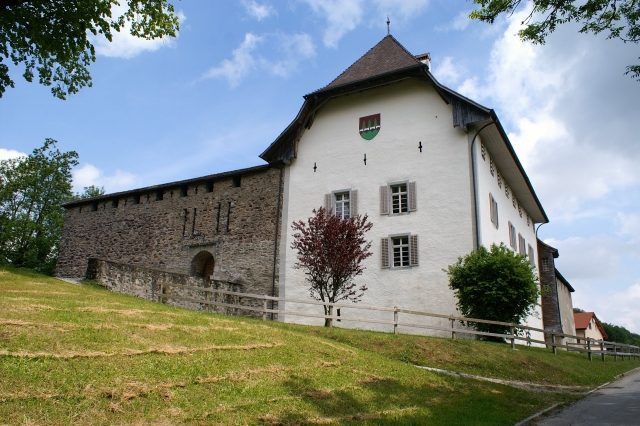
At the western entrance of the Bulle Valley, one can see Vaulruz Castle. This proud work comprises several parts and is the result of a long development. The squat, square keep, located in the northeast corner, and some other elements, such as the circular path and the bridge providing access to the castle, date from 1910. However, they were rebuilt according to old plans.
In the Middle Ages, this tower undoubtedly served as a watchtower. It certainly still stood upright when, at the beginning of the 14th century, the Lords of Blonay handed over the property to the Prince of Savoy.
The village, built in 1316 in the immediate vicinity of the defensive work, was one of the last town foundations undertaken by the Counts of Savoy. Surrounded by a wall, this small town received a charter of liberties in 1321, and its inhabitants became "free citizens." It was intended not only to defend the Vaud territory occupied by the Counts of Savoy from the northeast side but also to form a belt with the villages of Vuippens, Corbières, and temporarily Montsalvens (also protected by the Savoyards) around the Small Lordship of Bulle, where the Bishop of Lausanne was the ruler.
Vaulruz was unable to fulfill its important task for long. Certainly, the village initially experienced a pleasant boom thanks to a market and very active craftsmanship. In 1387, it was devastated by fire, but the decline had already begun in 1349/50 when a terrible plague epidemic decimated the population and caused serious damage to the economy; it was unable to recover. Later, Savoy sold the lordship to the Champion family, originally from Saint-Michel-de-Maurienne. Under the regime of these nobles, who lacked entrepreneurial courage, Vaulruz lost its urban character and soon became merely a modest rural agglomeration. It was damaged during the Burgundian Wars but spared during the Bernese invasion in 1536 thanks to a clever maneuver by the Lords of Champion, who turned to the Fribourgeois in time and sold them the castle and four of the associated localities.
Although the village has long since disappeared - it is difficult to discover its traces - the castle has preserved some important elements of the constructions that were renewed after 1387: the enclosure walls to the north, east, and west, as well as the central tower, which was restored in 1910.
The residential building erected in the 16th century in the southwest area of the work undoubtedly replaced an earlier dwelling. With its half-hipped roof, it formerly served the Fribourgeois as a bailiff's seat and still characterizes the work today. The area and layout of the castle were probably estimated in Savoyard feet in 1316. Since these units of measurement do not correspond to those of the square keep, it can be assumed that the latter was built after this date.
Take Mobile History with you
You are reading this text for free. Premium adds what matters on the road: descriptions read aloud, sites found through your camera, whole regions taken offline.
- Every description, including the ~17,700 Premium sites
- Audio guide: have descriptions read to you on location
- AR finder: see sites through your camera, with distance and bearing
- Unlimited saved sites
14 days free, then from €2.99 a month. Cancel anytime.
Location: 46.6248, 6.9945