CastleMonthou-sur-Cher

Château du Gué-Péan
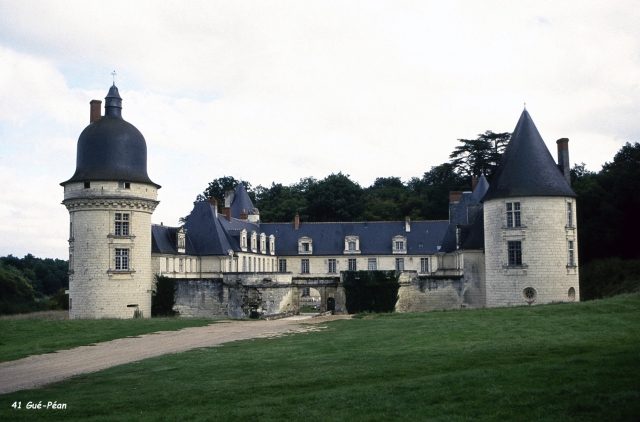
Château du Gué-Péan

To be privately owned

The Château du Gué-Péan is located in the French commune of Monthou-sur-Cher in the department of Loir-et-Cher. Since October 10, 1980, it has been protected as a Monument historique.

The castle was built – probably incorporating parts of a medieval castle – in the 16th century and was repeatedly modernized until the mid-17th century. Construction was begun by Nicolas Alamand from Angers, a financier under Francis I. He was accused, along with the Superintendent of Finances, Jacques de Beaune, of embezzling state funds.

Despite these accusations against his father, who died in 1527, his son François Allamand held high offices, and in 1543, the fiefdom of Gué Péan was established as a castle lordship for him. He was the most important builder for the complex, even if further construction work was carried out after his death in 1555; the front tower, for example, bears the year 1581 in its upper section.

In 1649, Charlotte Allamand inherited the property and sold it in 1676. During the French Revolution, the property, which at that time belonged to the Amelot family, was confiscated and sold. The descendants of the original owners reacquired the property, only to sell it to the Cassin family in 1832.

Architecture+

The rectangular inner courtyard of the castle is U-shaped, surrounded by three wings. The fourth side is enclosed by a wall with the entrance portal framed by two flattened round towers. Four more round towers stand at the corners of the complex. The entire complex is surrounded by a dry moat, over which a stone bridge leads to the entrance.

The tallest tower with its bell-shaped dome is probably the only one that was completed. The side wings and pavilions are articulated by open arcades and have mansard roofs. The main wing at the back of the courtyard is framed by the two rear round towers with conical roofs.

Interiors+

Visitors can see several rooms in the castle, equipped with fireplaces and furnished in Louis XV and Louis XVI styles. Over the centuries, the castle hosted numerous kings and famous personalities such as La Fayette and Honoré de Balzac. Particularly noteworthy are the Guard Room (French: salle des gardes), the chapel, the salon, and the library, which contains a rich collection of copies of handwritten letters and other historical memorabilia. The mighty fireplace of the Grand Salon was created by Germain Pilon, one of the main masters of French Renaissance sculpture.

Take Mobile History with you

You are reading this text for free. Premium adds what matters on the road: descriptions read aloud, sites found through your camera, whole regions taken offline.

  • Every description, including the ~17,700 Premium sites
  • Audio guide: have descriptions read to you on location
  • AR finder: see sites through your camera, with distance and bearing
  • Unlimited saved sites

14 days free, then from €2.99 a month. Cancel anytime.

Source: Wikipedia · Licence: CC BY-SA 4.0 · Image: Hervé Rebours

This description draws on the facts documented in the linked Wikipedia article; Wikipedia content is licensed under CC BY-SA 4.0. Wording and editing: Mobile History.

Location: 47.3500, 1.3188