To be privately owned
CastleAnse
Château du Jonchay
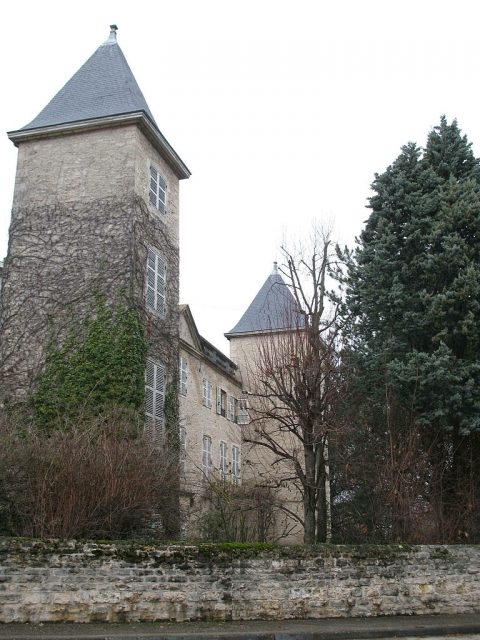
The Château du Jonchay is located in the Saône valley, west of the village of Anse, in the Rhône department.
Architecture+
The current castle, which succeeded a much older construction, dates from the 17th century. It comprises a rectangular building, oriented to the South-East, flanked by two projecting square turrets. The walls, built of rubble, were re-plastered in the 19th century. The gabled tile roof is concealed by an attic balustrade; the pavilion roofs of the turrets are covered with slate. The main facade is punctuated by seven regular bays of rectangular openings, with a main floor and an attic floor. The central bay is crowned with a small triangular pediment.
The farm buildings are adjacent and define an inner courtyard to the North and West. To the South-West stands a dovecote, a quadrangular pavilion, covered with scale tiles.
History+
The Jonchay estate was originally probably covered with reeds and marshes, hence its name, as the Brienne spring gushes out at this spot. In 1240, it was attached to the fief of Brienne under the following terms: viam de Graves usque ad junchetum de Brionna. In 1319, the obediencier of Anse received homage for the fief of Jonchet. The first known lord of the place was Jean Richard de Saint-Priest in 1326. In 1381, Offroy de Lanay, a squire, held Jonchet in fief. Then came Mathieu de Vauzelles, lord of Jonchay, who married Françoise de Guilhens in 1584. Antoine de Raymondis, who bought the castle in 1701 and married Marguerite Deschamps de Messimieux in 1704, left Jonchay to his daughter, wife of Philippe de Paradis.
In 1782, Dieudonné Sarton, a widower, acquired the estate, as well as French nationality. He took the name of the Jonchay estate.
Source: Wikipedia · Licence: CC BY-SA 4.0 · Image: http://commons.wikimedia.org/wiki/File:Ch%C3%A2teau_du_Jonchay_1.JPG?uselang=fr
This description draws on the facts documented in the linked Wikipedia article; Wikipedia content is licensed under CC BY-SA 4.0. Wording and editing: Mobile History.
Location: 45.9321, 4.7123