CastleFontenay-Trésigny

Château royal du Vivier
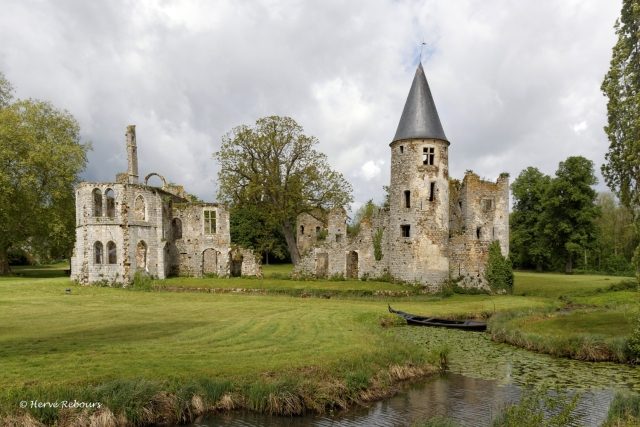
Château royal du Vivier

The remains of the Castle can be visited

The Château du Vivier is located in Fontenay-Trésigny in the department of Seine-et-Marne.

The land on which the castle was built belonged to the Seigneury of Tournan-en-Brie and was owned by the Garlande family in the 13th century. Jean II de Garlande, Seigneur de Tournan, sold the property in May 1293 to Pierre de Chambly, the executor of King Philip III and chamberlain of King Philip IV. Pierre de Chambly in turn ceded the lordship of Tournan in October of the same year to Charles de Valois, who was able to expand the property through purchases and gifts from his brother Philip IV.

The castle dates back to Charles de Valois, although a manor house (Hôtel seigneurial) was already mentioned here in 1260. The court painter Évrard d’Orléans designed the halls and galleries (Salles et galeries) of Le Vivier in 1308. Philip IV stayed here several times, his son Philip V in 1319 and 1320, where he issued the ordinances for the Cour des comptes and the Parlement.

In 1316, Pope John XXII approved the construction of a chapel dedicated to Thomas Becket through a Papal Bull. King Philip VI, the eldest son of Charles de Valois, added a chapel dedicated to Saint Louis. In 1352, the wedding of Jeanne de France, daughter of King John II, to Charles II of Navarre was celebrated in Le Vivier; the chapel was elevated to a collegiate church on this occasion. In 1368, King Charles V entrusted a relic of the True Cross to the collegiate church for safekeeping, thereby making the collegiate church a Sainte-Chapelle. Presumably, the castle's gate tower, which appears to be older than that of Vincennes Castle, was also built during this period.

King Charles VI came to Le Vivier in 1380 and 1381, and was then brought here more frequently after the onset of his illness in 1392. With Charles's death, the great era of Le Vivier Castle ended; the estate merely served to supply carp for the Louvre. In 1471, Louis XI passed Le Vivier on to the canons of the Sainte-Chapelle. Francis I was finally the last king to visit Le Vivier in 1546, but he stayed in the canons' house, as the royal lodging had already become uninhabitable due to neglect. In 1694, the condition of the Sainte-Chapelle was described as indecent, the castle as a ruin. Louis XIV then decided to subordinate the Sainte-Chapelle of Le Vivier to the Sainte-Chapelle of Vincennes. Louis XV finally abolished the Sainte-Chapelle of Le Vivier definitively in 1734.

In 1791, Le Vivier was sold as national property for 25,000 livres to Lemaître de Courtigny. The remaining buildings were now used for agriculture, the castle became a farm, the chapel a barn, the rest was sold as building material. In 1830, the Parisian lawyer Jean-Baptiste-Nicolas Parquin, who had bought Le Vivier, had a new castle built and an English garden laid out. In 1854, Le Vivier was then sold for 60,000 francs to Minister Raymond Sabatier, who in turn sold the castle to the Vicomte de Perthuis, whose family held the property until the end of the 1940s. In 1958, the Parisian industrialist Cousin acquired the castle and had extensive restoration work carried out. Since 2006, Le Vivier has been marketed by a new owner as a backdrop for weddings, seminars, etc.

Take Mobile History with you

You are reading this text for free. Premium adds what matters on the road: descriptions read aloud, sites found through your camera, whole regions taken offline.

  • Every description, including the ~17,700 Premium sites
  • Audio guide: have descriptions read to you on location
  • AR finder: see sites through your camera, with distance and bearing
  • Unlimited saved sites

14 days free, then from €2.99 a month. Cancel anytime.

Source: Wikipedia · Licence: CC BY-SA 4.0 · Image: Hervé Rebours

This description draws on the facts documented in the linked Wikipedia article; Wikipedia content is licensed under CC BY-SA 4.0. Wording and editing: Mobile History.

Location: 48.6862, 2.8488