ChurchDresden-Wilschdorf

Christophorus Church
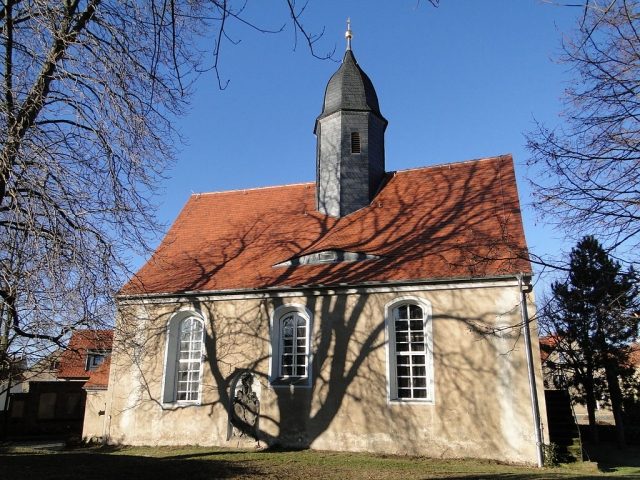
Christophorus Church

The church can be visited

The Christophoruskirche (St. Christopher's Church) is an Evangelical village church in the Wilschdorf district of Dresden. The listed sacred building is considered the oldest church in the city.

The origins of the Christophoruskirche date back to the 11th century. A red consecration cross on a Gothic fresco inside the church has been dated to the time of the first settlers, making the church the oldest in the current Dresden city area. The baptismal font dated from around 1200 and was destroyed in 1945. The church was first mentioned in a document in 1243, and the oldest surviving bell of the church, from 1250, is also the oldest surviving bell in Dresden.

The earliest known alterations to the church took place in the first half of the 15th century. The interior of the church also received frescoes at this time, which were only uncovered and restored between 1972 and 1985. In the course of the Reformation in 1539, the Christophoruskirche became Evangelical. The church's altar was created between 1570 and 1580. The oldest surviving church accounts date from 1595 and concerned repairs to the church tower finial.

In 1637, Swedish troops, who also plundered through Wilschdorf, robbed the church's poor box, which has been back in use since 1967. In the 18th century, the sacred building was damaged by lightning and restored with alterations, receiving galleries inside. The church's roof turret dates from 1725. From 1927 to 1928, the pulpit and altar were restored, with further preservation measures taking place in 1956 and 1967. In 1986, the village church was named Christophoruskirche after the rediscovered depiction of Saint Christopher on one of the frescoes. Since 1995, the Wilschdorf church has owned an organ from the Wegscheider organ workshop.

Building Description+

Exterior

The plastered building is designed as a simple, rectangular hall church with a narthex located in the west. The sacristy adjoins to the northeast, and a staircase leads to the church tower in the north. At its core, the church is Romanesque. Alterations in the first half of the 15th century led to its current rectangular shape.

The church has a steep gable roof. The sacred building differs from the surrounding farmsteads of the former street village of Wilschdorf mainly by its centrally located, octagonal roof turret with a curved dome. It was built in 1725 and is covered with slate. The approximately 25-meter-high church was last externally restored in 1967.

Interior

The interior of the church is "very primitive" in design and offers space for around 120 worshippers. The simple wooden ceiling has no artistic embellishments and is raised higher at the western organ gallery. On the west and north sides, there is a continuous simple gallery, which was installed in 1770 during the restoration of the church after damage in the 18th century. The galleries are divided into individual fields by pilasters but appear "very crude and artisanal." The balustrade fields are painted and adorned with sayings in gold letters. According to art historian Cornelius Gurlitt, the interior furnishings, in terms of their forms, date from the second half of the 17th century.

The windows on the south side are basket-arch windows with deep reveals. The windows on the east side were originally probably from the Romanesque period and designed as a three-window group. Today, these have been altered into simple rectangular windows with a door; the door leads to the bell chamber.

Altar

The altar is carved from wood and is a "crude artisanal work." It is 200 centimeters wide and 250 centimeters high. On the continuous, flat plinth, the words "Come to me!" can be read. The altar structure is relatively high compared to the plinth. Above the plinth, Doric columns adjoin laterally on pedestals, which entablature. To the sides of the columns, scrollwork volutes, made from cut-out boards, complete the superstructure. A broken triangular pediment forms the upper conclusion, which also features scrollwork on the sides.

Between the columns is an altarpiece depicting the Last Supper in a genre-like manner. It was created between 1570 and 1580 and probably comes from the workshop of Hans Schroer from Liège. Above the painting, in the pediment field, the inscription "Jesus Christ, yesterday and today and the same also forever" can be read.

Pulpit

The hexagonal pulpit was created around 1600. Like the altar, it is made of wood. In the balustrade, the four Evangelists with their attributes are painted in distemper. The pulpit is enclosed on four sides of the hexagon and, apart from the painting, is kept simple. The soundboard is also hexagonal. It was created in 1680 by H. Christoph Zormehlen.

Baptismal Font

The first baptismal font was created around 1200 and was probably made of granite. It had a diameter of 104 centimeters and was 85 centimeters high. The base was already broken off at a height of 20 centimeters around 1900. The bowl walls were articulated by flutes, in whose upper semicircular terminations relief depictions of lilies and pecking birds seemed to alternate. Several of the reliefs were already unrecognizable and broken off at the edge around 1900. Around 1900, the baptismal font was owned by the Royal Saxon Antiquities Association. During the Second World War, it was stored in the Palais im Großen Garten, where it was destroyed during the bombing of the building.

Today, the Christophoruskirche possesses a simple wooden baptismal font.

Church Decorations

In 1971, large-scale Gothic frescoes were discovered during the interior renovation of the church. They were created around 1425 in limewash, when the rough plaster of the church was covered with smooth plaster, and are the oldest Gothic frescoes in Dresden. They were painted over shortly after the Reformation and uncovered between 1972 and 1985, with parts of the frescoes being covered by the galleries installed around 1770. The frescoes are considered "a rarity of medieval art in sacred spaces."

The frescoes on the north wall show a 370-centimeter-high depiction of Saint Christopher and, next to it, in two layers, six depictions from the Passion of Christ: In the upper part, Christ with Pontius Pilate, the Kiss of Judas, and the sleeping disciples on the Mount of Olives are depicted, while the lower row shows the Flagellation of Jesus, the Crowning with Thorns, and Jesus carrying the cross. A second fresco on the south wall, only partially preserved, shows the Adoration of the Magi and, in the area of the pulpit, a depiction of a dragon. The frescoes are framed by friezes, with the figures standing against a "tapestry-like ground with blossoms."

Organ+

Around 1900, the Christophoruskirche possessed an organ from the 19th century. In 1928, the church received a pneumatic Jahn organ, which was played until 1995. By this time, the sound of the instrument had become unsatisfactory. Individual metal pipes were so severely deformed that the organ could only be tuned with difficulty. It was considered unrestorable, which is why the congregation decided to purchase a new organ.

With the help of the Dussmann Foundation, a new organ from the Wegscheider organ workshop could be acquired; organ builder Kristian Wegscheider works in neighboring Rähnitz. The festive organ consecration took place on October 22, 1995.

A special feature of the organ is that one can choose between two tuning systems: meantone temperament and well temperament. At the time of the organ consecration, the Wilschdorf organ, alongside the organ of Stanford University in California, was the only such instrument worldwide.

Bells+

The Christophoruskirche has three bells of different ages. The small bell was cast around 1250 and is the oldest bell in the Dresden city area. During the Second World War, the bells were removed and stored in the Hamburg Bell Cemetery but not melted down. In 1948, they were returned to Wilschdorf, but by then, they already had damage to their crowns. The bells were therefore repaired from February to June 2008 at the welding plant in Nördlingen.

Large Bell 15th century 58 cm high, 66 cm lower diameter at the neck nine reliefs of the resurrected Christ, a tenth relief on the mantle Medium Bell 1348/49 51 cm high, 54 cm lower diameter with two thread-like cords at the neck Small Bell 1250 40 cm high, 46 cm lower diameter wide striking motion

The Churchyard+

The churchyard of the Christophoruskirche can be entered through a round-arch and a basket-arch gate. It is elevated and surrounded by a fieldstone wall. With approximately 1200 square meters, the churchyard is one of the smallest cemeteries in the city of Dresden. The churchyard has been used as a cemetery since the church's existence and was closed in 1893.

Only a few graves have been preserved, including the Baroque sandstone epitaph of Pastor Johann Friedrich Gerhardt and his wife Eleonore Sophie on the southern church wall. Gerhardt served as parish priest in Wilschdorf from 1768 to 1781. His epitaph is 100 centimeters wide and 220 centimeters high. On a plinth-like substructure are two cartouches with illegible text. Above a faint cornice, two more, larger and strongly modeled cartouches are visible, created symmetrically to each other. Above both, an angelic figure stands centrally, appearing to hold both cartouches. Behind the figure, an obelisk with a baldachin-like finial is recognizable. The inscriptions on the upper cartouches indicate the death dates of the couple.

Also preserved is a wall tomb of the Schmiedgen family, created around 1915. The sandstone tomb is in a Neo-Baroque style and shows a relief of Christ knocking on a door in an aedicule. Between pilasters, there is a relief of Mary with her child.

Adjoining the churchyard is the rectory garden with the rectory. In the rectory garden, there is the remnant of a round-arch gate from 1612. An associated seating niche portal, also created around 1612, was inserted into the southern rectory garden wall in the 18th century.

Take Mobile History with you

You are reading this text for free. Premium adds what matters on the road: descriptions read aloud, sites found through your camera, whole regions taken offline.

  • Every description, including the ~17,700 Premium sites
  • Audio guide: have descriptions read to you on location
  • AR finder: see sites through your camera, with distance and bearing
  • Unlimited saved sites

14 days free, then from €2.99 a month. Cancel anytime.

Source: Wikipedia · Licence: CC BY-SA 4.0 · Image: http://de.wikipedia.org/wiki/Datei:Christophoruskirche_Dresden-Wilschdorf.JPG

This description draws on the facts documented in the linked Wikipedia article; Wikipedia content is licensed under CC BY-SA 4.0. Wording and editing: Mobile History.

Location: 51.1222, 13.7220