CastleNürnberg-Mögeldorf

Cnopfsches Castle
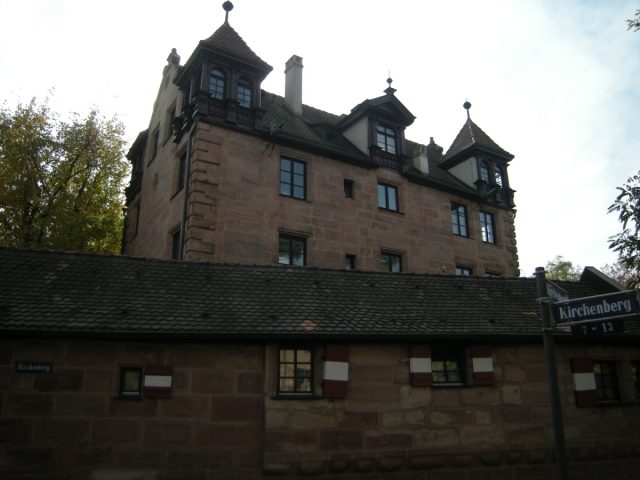
Cnopfsches Castle

To be privately owned

The manor house appears to have emerged in the early 16th century from a farmstead whose history has not yet been clarified and which may have been related to the immediately adjacent medieval castle. This farm "opposite the church" was sold in 1510 by the Minderle family to the Nuremberg citizen's widow Margaretha Gaiswurgel. Together with her son Michael Gaiswurgel, the buyer began a new construction, which the council stopped when it became clear that a representative manor house was to be built. After some back and forth, a second upper floor was finally approved, after the son renounced the also planned four corner turrets. In 1517, Michael Gaiswurgel granted the imperial city the right of entry in case of war. The number 1519 on the east gable apparently indicates the year of completion. In 1531, the Nuremberg Peter Grätz acquired the manor house. Around the middle of the 16th century, he passed it on to Wolf Haller, from whom it came to his daughter Maria Kötzler in 1571. The property is said to have survived the Second Margrave War without significant damage.

Maria Kötzler sold the seat in 1580 to Paulus Rottengatter. The Nuremberg merchant bequeathed it around 1615 to his children, a son of the same name and two daughters. They sold the inheritance in 1615 to their brother-in-law Georg Groe. In 1676, a Heinrich Barmeyer was recorded as owner, then in 1682 Eitel Heinrich Barmeyer. Through his heirs, the seat passed in 1699 to Euphrosina Rosina von Schoener and the following year to Benedict Monroe. From the estate, it was sold in 1720 to Tobias Magnus Fetzer. From 1733 to 1753, the seat was owned by the trumpet maker Wolf Wilhelm Haas, who in the 1730s took in a Baron von Pettendorf, an officer, as a tenant. For his needs, additional ovens were installed in previously unheated rooms, including on the ground floor. In 1752, Haas sold to Johann Sigmund Meyern, then from 1785 to 1787 Georg Daniel Winter followed.

In 1788, the pharmacist Johann Jakob Christoph Cnopf finally acquired the property and had it renovated, although the garden hall, the pleasure house, and several outbuildings were demolished. In 1808, Johann Konrad Cnopf took over the estate and bequeathed it in 1823 to his son Georg Karl. In 1878, his son, district court judge Dr. jur. Adolf Cnopf, took over the small castle. He owned a large Norica collection, which also included the "Cnopf Sketchbook" named after him, which contains numerous valuable views of Nuremberg and its surroundings from around 1612/14 (today in the Hallerarchiv). He died in 1896, his widow not until 1932. In 1936, the manufacturer Carolus Linck bought the residence from the heirs.

The manor house, a three-story sandstone ashlar building, was rebuilt several times in the 17th and early 18th centuries, with inscriptions on the west gable pointing to the years 1669, 1699, and 1733. From 1878 to around 1880, it was fundamentally modernized in a historicizing manner. During this time, the building received its characteristic wooden corner turrets and dormers. The southern enclosure is characterized by a profiled round arch portal adorned with Tuscan half-columns and a triangular gable. In 1936 and 1977/78, a comprehensive renovation of the building took place. To the north, the seat is enclosed by a retaining and defensive wall built against the steep slope, to which a single-story half-timbered house is attached on the inside. This massive construction supports the remains of a battlement and appears to still show medieval sections and/or spolia.

Take Mobile History with you

You are reading this text for free. Premium adds what matters on the road: descriptions read aloud, sites found through your camera, whole regions taken offline.

  • Every description, including the ~17,700 Premium sites
  • Audio guide: have descriptions read to you on location
  • AR finder: see sites through your camera, with distance and bearing
  • Unlimited saved sites

14 days free, then from €2.99 a month. Cancel anytime.

Source: Wikipedia · Licence: CC BY-SA 4.0 · Image: http://schloesserrundschau.de/bayern/schloesser01/nuernberg13.html

This description draws on the facts documented in the linked Wikipedia article; Wikipedia content is licensed under CC BY-SA 4.0. Wording and editing: Mobile History.

Location: 49.4618, 11.1323