State Academy for Teacher Training
CastleSchwäbisch Hall
Comburg Castle
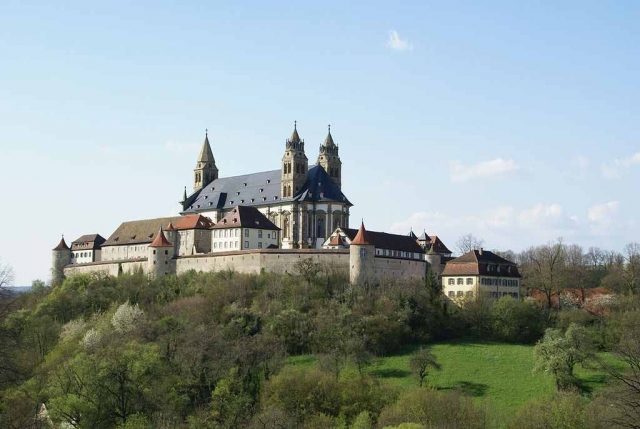
The Comburg, also known as Großcomburg, is a castle complex situated on a meander spur in the Kocher Valley. Originally a castle, it later became a Benedictine monastery and today shapes the landscape southeast of Schwäbisch Hall in Baden-Württemberg.
History+
The origins of the Comburg date back to 1078, when the Counts of Comburg-Rothenburg founded a Benedictine monastery on the site of their castle. One of the founders, Count Burkhard, himself entered the monastery as a monk. The first monks came from Brauweiler, but under an abbot from Hirsau, appointed between 1086 and 1088, the Comburg joined the Hirsau Reform. Despite a flourishing period in the 12th century, the monastery experienced a decline in the 13th century, culminating in an economic collapse in 1326. After a period of recovery in the 14th century, which, however, was accompanied by a relaxation of monastic rules, the monastery was converted into a collegiate church for noble canons in 1488. In the 16th century, the collegiate church experienced a new golden age under Provost Erasmus Neustetter. Following secularization in 1803 by Württemberg, the Comburg served as a garrison for the Corps of Disabled Veterans from 1817 to 1909 and later as a folk high school. During the Nazi era, it was used for various purposes, including as a building trade school and a prisoner-of-war camp.
Source: Wikipedia · Licence: CC BY-SA 4.0
This description draws on the facts documented in the linked Wikipedia article; Wikipedia content is licensed under CC BY-SA 4.0. Wording and editing: Mobile History.
Location: 49.1002, 9.7499