The Castle can be visited
CastleDenbigh
Denbigh Castle
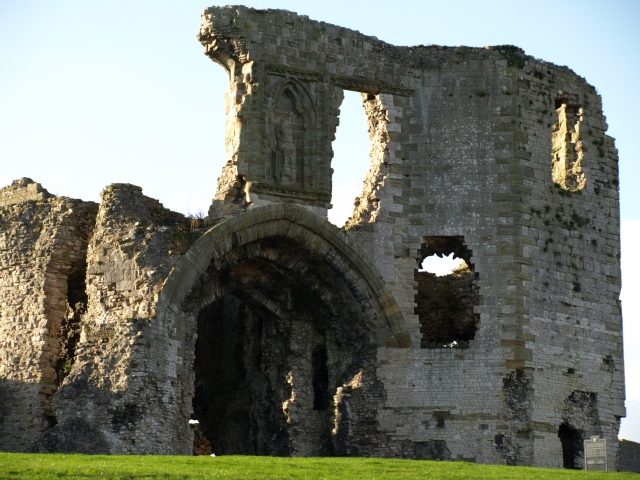
Denbigh Castle (Castell Dinbych) was a fortress built following the 13th-century conquest of Wales by Edward I.
The castle, which stands on a rocky promontory above the Welsh market town of Denbigh, Denbighshire, was built upon an earlier Welsh stronghold. It was defended by a unique triple-towered gateway. A planned town (bastide) was laid out at the same time as the castle. The Anglo-Norman borough was an attempt by Edward I to pacify the Welsh.
Construction+
Denbigh Castle, which was built during two phases, was based on designs attributed to Master James of St George. In the first period, commencing 1282, parts of the outer ward were constructed. These outer defences included the southern and western walls and the eastern towers. Later work on the inner ward began including parts of the curtain wall and the castle's main gatehouse. The borough's new town walls were also began during this period.
But in 1294 Denbigh was attacked and taken during the revolt of Madog ap Llywelyn halting the work on the incomplete town and castle. Following its recapture a year later, Henry de Lacy substantially revised the plans in the second phase of building work. This time the inner ward's curtain wall were refortified with thicker and higher walls.
The main gatehouse was heavily buttressed with a three octagonal towers and a drawbridge: two towers faced outwards and a third interior tower, (the Badnes Tower), inside the main gateway. This three-towered triangular gatehouse now created a heavily defended passageway that had murder-holes, portcullises in series, two wooden doors, and enfilading arrowslits. One gatehouse tower contained the porter's lodgings while the other served as the prison.
During the same period, the Great hall and the eastern domestic ranges including the kitchen tower, the pantry and the postern gate were completed. When the town walls were enlarged, the eastern section was defended by several large D-shaped towers such as the Countess Tower and Goblin Tower.
De Lacy died in 1311 before building work ceased on the town and castle defences. The new English borough eventually removed all traces of the original Welsh fortifications.
The current Denbigh Castle was built on the site of a former Welsh stronghold held by Dafydd ap Gruffydd, the brother of Llywelyn the Last. The Welsh castle originally belonged to Llywelyn the Great. In 1230, an Abbot from England visited Llywelyn the Great at his new castle in Denbigh.
The current stone castle was begun by Henry de Lacy, 3rd Earl of Lincoln in the Lordship of Denbigh given to him by Edward I after the defeat of the last Welsh prince, Dafydd ap Gruffudd in 1282. The Welsh castle was then torn down and work began on a new English fortress. At the same time, De Lacy was also granted a Royal Charter to create a new English borough and town.
Source: Wikipedia · Licence: CC BY-SA 4.0
This description draws on the facts documented in the linked Wikipedia article; Wikipedia content is licensed under CC BY-SA 4.0. Wording and editing: Mobile History.
Location: 53.1806, -3.4208