CastleFreiburg im Breisgau

Deutschordenshaus Castle
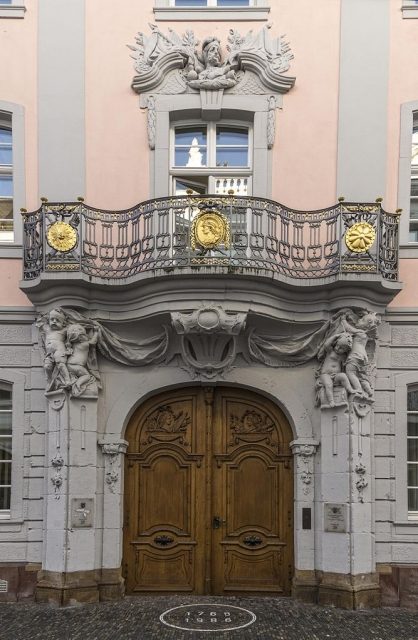
Deutschordenshaus Castle

Local Authorities

The Teutonic Commandery of Freiburg was a settlement of the Order of Brothers of the German House of Saint Mary in Jerusalem in Freiburg im Breisgau, first mentioned in a document in 1258, which belonged to the Teutonic Bailiwick of Swabia-Alsace-Burgundy. Through secularization, the commandery was incorporated into the Electorate of Baden in 1806, which also took over its possessions.

A document from 1258 already mentions the Teutonic Order in Freiburg, although it remains unclear whether a commandery already existed. In 1263, Count Konrad I of Freiburg donated a plot of land in the city near the Mönchstor to the Order. Between 1272 and 1485, the Order acquired the church patronage of a number of Breisgau villages (Kappel, Pfaffenweiler, Ballrechten, Bötzingen, Buchheim, Denzlingen, Glottertal, Herdern, Ihringen, Malterdingen, Merdingen, Oberhausen, Wasenweiler). In 1292, a serious conflict arose between the Order and the citizens of the city. The Order had brought two citizens before its own jurisdiction and had them blinded by judgment. The citizens then destroyed the commandery and expelled the Order from the city. However, the city was forced by the Empire to compensate the Order and rebuild the commandery at its own expense.

After the Reformation, the commanderies of the Teutonic Order increasingly became "welfare institutions for the Catholic lower nobility."

After the conquest of Freiburg by the French in 1677, Vauban fortified Freiburg, during which, among other things, the Neuburg suburb - and thus also the commandery located there - was demolished. The Order then settled in the city center near the Augustinian monastery in 1684. When the city again had to pay high contributions to the French occupation in 1713, the Teutonic Order helped with a loan, for which it had its privileges secured and acquired inner-city properties.

The commandery was considered wealthy in the 18th century. In addition to numerous estates and rights in many Breisgau villages, the commandery held local sovereignty in Wasenweiler, Littenweiler (half), and Merdingen (two-thirds). It exerted political influence through its seat on the prelates' bench of the Breisgau estates. After the Breisgau was awarded to the Electorate of Baden at the Peace of Pressburg at the end of 1805, the secularization of the Freiburg commandery also took place in 1806.

Order House+

In 1744, the Order House was damaged by French artillery fire. Although the damage was soon repaired, at the instigation of Landkomtur Christian Moritz von Königsegg-Rothenfels, the construction of a new city palace began in 1768 according to plans by Franz Anton Bagnato and was completed in 1774. Joseph Hörr also worked on the facade decoration.

Bagnato's Baroque palace was destroyed on November 27, 1944, during an air raid. In 1986, a palace of justice was built on the site, which today belongs to the Freiburg Regional Court, with the Baroque facade of the former Teutonic Order House being reconstructed.

Take Mobile History with you

You are reading this text for free. Premium adds what matters on the road: descriptions read aloud, sites found through your camera, whole regions taken offline.

  • Every description, including the ~17,700 Premium sites
  • Audio guide: have descriptions read to you on location
  • AR finder: see sites through your camera, with distance and bearing
  • Unlimited saved sites

14 days free, then from €2.99 a month. Cancel anytime.

Source: Wikipedia · Licence: CC BY-SA 4.0 · Image: http://de.wikipedia.org/wiki/Datei:Deutschordenhaus_%28Freiburg_im_Breisgau%29_jm14137.jpg

This description draws on the facts documented in the linked Wikipedia article; Wikipedia content is licensed under CC BY-SA 4.0. Wording and editing: Mobile History.

Location: 47.9942, 7.8520