To be privately owned
Deutschordenskomturei
The Teutonic Order Commandery in ...+
History+
The Teutonic Order Commandery was presumably built in 1694 by Antonio Petrini. The owner was the Teutonic Order.
From the beginnings to the secularization
The Teutonic Order, a spiritual knightly order, acquired the estate in the 13th century. The exact date of the first building is not known, but it is believed that a predecessor building already existed in the Middle Ages.
The current building, a baroque complex, was built at the end of the 17th century. It served as the administrative and economic center of the Teutonic Order in the region.
In the course of the secularization at the beginning of the 19th century, the commandery was dissolved and passed into state ownership.
Later use
After the secularization, the building was used for various purposes. For a time, it served as a courthouse and prison. Later, parts of the complex were used as residential buildings.
In the 20th century, the building housed a museum that presented the history of the Teutonic Order and the region.
Architecture+
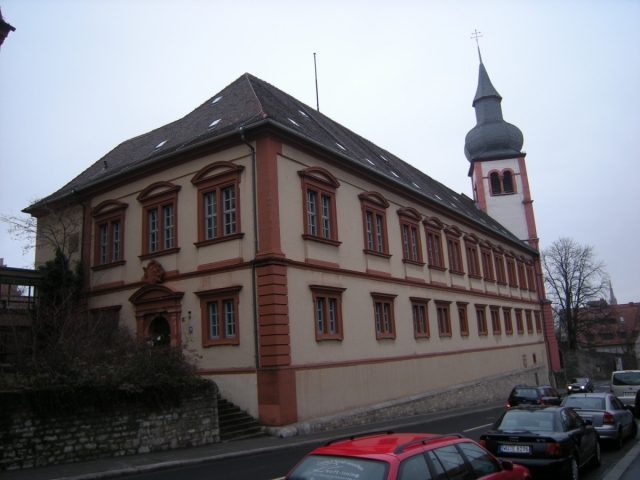
The commandery is a magnificent baroque building with a representative facade and an imposing courtyard.
Exterior
The main building is a two-story plastered building with a mansard roof. The facade is structured by pilasters and cornices. The central portal is framed by columns and crowned by a balcony.
The complex also includes several outbuildings, including a barn and stables, which are grouped around the courtyard.
Interior
The interior of the commandery is characterized by spacious rooms and richly decorated stucco ceilings. Particularly noteworthy is the former chapter house, which served as a meeting room for the knights of the order.
Some rooms still have historical wall paintings and valuable furnishings from the baroque period.
Current situation and use+
Today, the Teutonic Order Commandery is a listed building and is considered an important cultural monument of the region.
After extensive renovation work in recent years, the building is now used for cultural events, exhibitions and concerts. Parts of the complex also house a restaurant and a hotel.
The commandery is open to the public and offers visitors the opportunity to immerse themselves in the history of the Teutonic Order and admire the impressive baroque architecture.
Take Mobile History with you
You are reading this text for free. Premium adds what matters on the road: descriptions read aloud, sites found through your camera, whole regions taken offline.
- Every description, including the ~17,700 Premium sites
- Audio guide: have descriptions read to you on location
- AR finder: see sites through your camera, with distance and bearing
- Unlimited saved sites
14 days free, then from €2.99 a month. Cancel anytime.
Source: Wikipedia · Licence: CC BY-SA 4.0 · Image: http://schloesserrundschau.de/bayern/schloesser01/wuerzburg20.html
This description draws on the facts documented in the linked Wikipedia article; Wikipedia content is licensed under CC BY-SA 4.0. Wording and editing: Mobile History.
Location: 49.7944, 9.9214