CastleBad Mergentheim

Mergentheim Castle
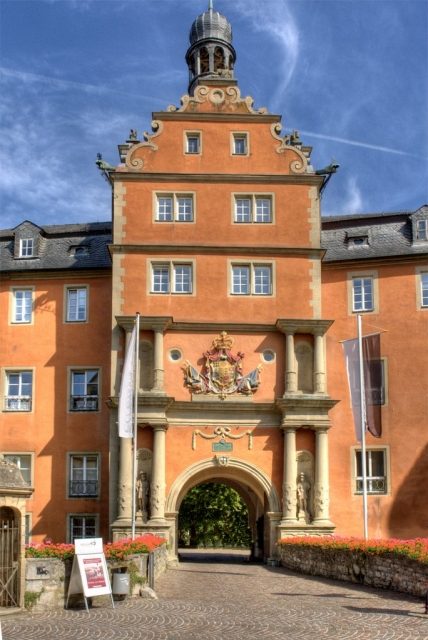
Mergentheim Castle

Museum

Mergentheim Castle, originally a fortress in what is now Bad Mergentheim, was initially the center of a county in the Tauber region. In 1219, it became a commandery of the Teutonic Order. From 1527, the castle served as the seat of the Deutschmeister and a few years later also of the Grand Master of the Teutonic Order. Thus, until the end of the Holy Roman Empire, it was the seat of the Order's leadership. At the same time, it was the center of the Mergentheim Mastership as the secular possession of the Deutschmeister and Grand Masters.

In 1219, the three brothers Heinrich, Andreas, and Friedrich von Hohenlohe, returning from a crusade, donated their moated castle and possessions in Mergentheim to the newly founded Teutonic Order. The castle subsequently developed into the preferred residence of the Deutschmeister. After the Reformation, in 1525, the castle even became the main seat of the Grand and Deutschmeister, and thus the headquarters of the Teutonic Order. Important guests such as the Emperor and influential princes were received here.

Layout+

The layout of the castle still shows traces of the original medieval moated castle: the circular arrangement of the buildings, curved walls of the north wing, as well as fortifications and moats. With its function as the main seat, the castle was increasingly expanded in the mid-16th century, and over time, a representative Renaissance complex was erected. The famous spiral staircase by master builder Blasius Berwart was created.

Since 1626, the Outer Castle has adjoined the core of the castle complex. This includes, among other things, the main portal building, the bridge over the moat, and the chancellery and archive building. In the 18th century, extensive renovations took place, giving the castle its present appearance. The castle church was renewed with the participation of Balthasar Neumann, the magnificent princely apartment and the chapter house were built, and the castle park was newly laid out. A Rococo garden festival house was built on the south wing according to plans by the Munich court architect François de Cuvilliés. Only a few garden figures from this building remain and are now exhibited in the Teutonic Order Museum.

With the secularization and the dissolution of the Teutonic Order under Napoleon in 1809, after 300 years, the courtly splendor of the residence of the Grand and Deutschmeister in Mergentheim came to an end. Subsequently, Mergentheim was incorporated into the Kingdom of Württemberg.

Current Use+

Mergentheim Castle is one of the state-owned monuments managed by the State Castles and Gardens of Baden-Württemberg institution. Since 1996, after extensive renovation measures, the castle has been fully accessible to the public again as the Teutonic Order Museum. The history of the Teutonic Order from its beginnings in 1190 to the present day is presented with texts, images, and objects.

Take Mobile History with you

You are reading this text for free. Premium adds what matters on the road: descriptions read aloud, sites found through your camera, whole regions taken offline.

  • Every description, including the ~17,700 Premium sites
  • Audio guide: have descriptions read to you on location
  • AR finder: see sites through your camera, with distance and bearing
  • Unlimited saved sites

14 days free, then from €2.99 a month. Cancel anytime.

Source: Wikipedia · Licence: CC BY-SA 4.0 · Image: Dr. Gebhard Gaukler

This description draws on the facts documented in the linked Wikipedia article; Wikipedia content is licensed under CC BY-SA 4.0. Wording and editing: Mobile History.

Location: 49.4912, 9.7758