ResidenceRegensburg

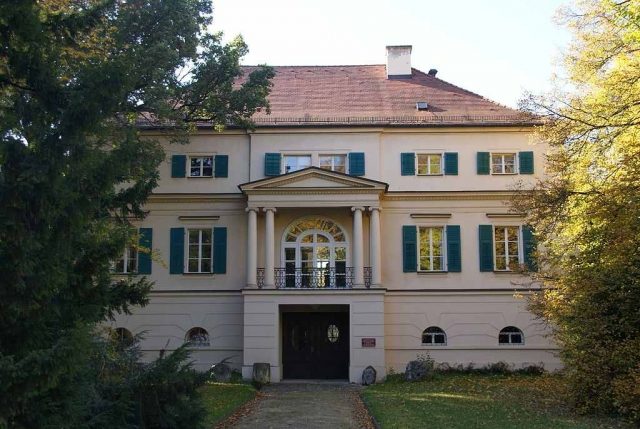
Dörnberg Palace

Dörnberg Palace

To be privately owned

Dörnbergpark is a 7.4-hectare park located a few meters west of Regensburg's Old Town and is a significant monument of 19th-century garden art.

The Jewish banker and court factor to the Princes of Thurn und Taxis, Philipp Reichenberger, commissioned Emanuel Herigoyen to build a suburban villa (today's Dörnberg Palais) and an approximately 1.9-hectare park here from 1804 to 1806. In 1832, the property was acquired by Baron Ernst Friedrich von Dörnberg (1801-1878), general administrator for the Princes of Thurn und Taxis from 1828 to 1871. He expanded the park to its current size and had it redesigned into an English landscape park by the Royal Bavarian Court Gardener Carl von Effner between 1864 and 1867. The park buildings still existing today (Swiss House, Society House, Gardener's and Greenhouse) as well as the buildings that have since disappeared (Engine House, Horse Stable and Coach House, Bark Hut, Pavilion) date from this period.

Since the death of the heirless Ernst von Dörnberg (1836-1897) in 1897, the villa and park have been managed by the Gräflich von Dörnberg'sche Waisenfonds-Stiftung (Count von Dörnberg Orphanage Fund Foundation). Initially closed (according to the will), the park was made accessible to the public from 1921 to 1926 and again since 1938. A custody agreement from 1956 between the foundation and the city of Regensburg regulates the opening and maintenance of the park to this day. In 1947, the Palais, buildings, and park were placed under monument protection.

The 7.4-hectare park has an east-west extension of 375 meters and a north-south extension of 270 meters. It is located on average at an altitude of 340 meters above sea level. Of the approximately 1400 trees, about 30% are older than 100 years and thus originate from the original stock of the 19th century. Characteristic of the 63 tree species (37 deciduous tree species, 26 coniferous tree species) in the park are common beech (clump beeches), Norway maple groves, and often exotic solitary trees (copper beech, black walnut, horse chestnut).

Around 26 bird species and the noctule bat species are native to the park.

Take Mobile History with you

You are reading this text for free. Premium adds what matters on the road: descriptions read aloud, sites found through your camera, whole regions taken offline.

  • Every description, including the ~17,700 Premium sites
  • Audio guide: have descriptions read to you on location
  • AR finder: see sites through your camera, with distance and bearing
  • Unlimited saved sites

14 days free, then from €2.99 a month. Cancel anytime.

Source: Wikipedia · Licence: CC BY-SA 4.0

This description draws on the facts documented in the linked Wikipedia article; Wikipedia content is licensed under CC BY-SA 4.0. Wording and editing: Mobile History.

Location: 49.0155, 12.0882