The church can be visited
ChurchElbląg (Elbing)
Elbing Abbey
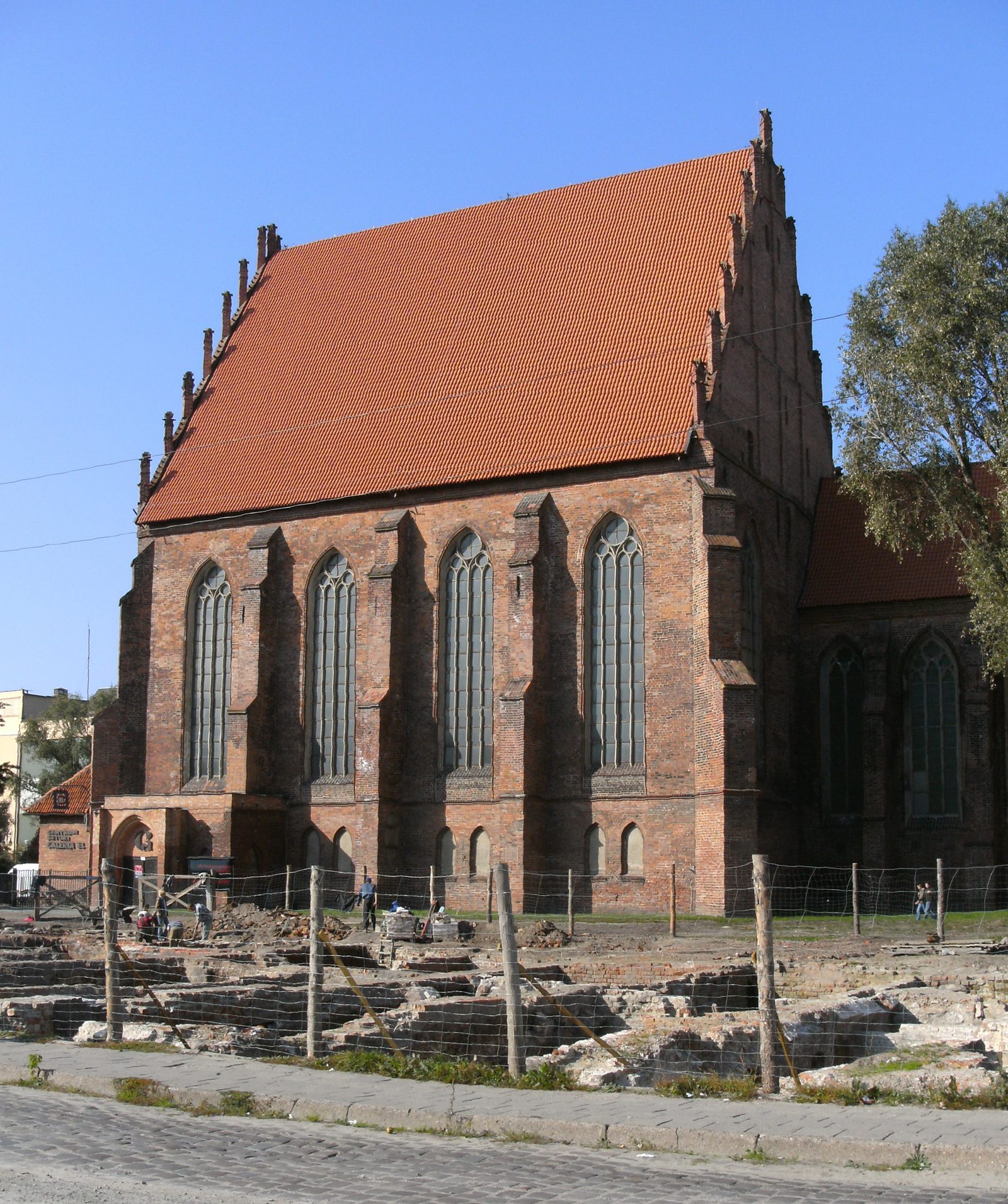
The Monastery of S. Dominici was a Dominican settlement in Elbing, today Elbląg, in Prussia from 1239 to 1542.
Location+
The monastery was located at St. Mary's Church in the northwest of the medieval city on the city wall. Remains of the original church are preserved.
History+
On January 13, 1239, the Landmeister Hermann von Balk granted the monks of the Dominican Order permission to settle in Elbing and assigned them a place. This was one of the first settlements of the order in Prussia. In 1242, the legate Wilhelm von Modena confirmed the foundation. In 1246, the Grand Master Heinrich von Hohenlohe granted permission to build a church and outbuildings. The convent belonged to the Polish province of the order. In the following centuries, the monastery received numerous endowments and donations from citizens and the city council. The guilds of bakers, brewers, maltsters and others had altars in the monastery church. A papal indulgence letter has been preserved, which was intended to support the monks in begging. The monastery probably owned plots of land, as indicated by the later field name Mönchswiese. In 1504, the church and parts of the buildings burned down, with many books being lost. Around 1516, the church was reconsecrated. Names of priors and monks have been handed down, some bearing Prussian family names, which indicates their native origin. Simon Grunau was a monk in Elbing from 1470 to 1506, the last years as a lector. In 1542, the last two monks handed over the monastery with its possessions and rights to the city council. The church became an important center of the Protestant community. In 1945, it was severely damaged and rebuilt in the 1960s to 1980s. Today, it houses an art gallery.
Church+
Building History+
The building, erected until the beginning of the 14th century, was a simple hall church with a low choir and nave. The two-aisled layout of the nave corresponds to the building traditions of the mendicant orders in the Prussian Order State. After a city fire in 1288, the church was expanded during reconstruction into a two-aisled hall church with a raised choir. The pilasters still show the height of the original building. The current choir gable and the higher nave also date from this phase. After the fire in 1504, the southern side aisle was raised, the nave was vaulted with a net vault, and the west gable was built. The use of a Gothic bond in the upper masonry reflects this late Gothic reconstruction. The church was largely preserved and restored between 1927 and 1935. Severely damaged in World War II, the building was restored from 1960 to 1982, but without vaults.
Architecture+
The church is an asymmetrical, two-aisled hall church with a vaulted rectangular choir and buttresses on the outer walls. The vaulted rectangular choir is structured by buttresses. The large east window was already raised in the Middle Ages. The southern wall has four axes with profiled windows and closely spaced buttresses. The choir shows stylistic parallels to Frauenburg Cathedral, especially in the gable design and the position of the buttresses. The south facade of the nave is divided into four sections, each with a pointed arch window. A cloister was added to the north side. The vaulted sacristy is attached to the east wall of the choir and consists of three bay sections and a separate western bay. The choir gable is a triangular gable with pointed arch and circular blind arches. The west gable of the nave is also a triangular gable, divided by cornices into three horizontal zones, richly decorated with pointed arch blind arches.
Take Mobile History with you
You are reading this text for free. Premium adds what matters on the road: descriptions read aloud, sites found through your camera, whole regions taken offline.
- Every description, including the ~17,700 Premium sites
- Audio guide: have descriptions read to you on location
- AR finder: see sites through your camera, with distance and bearing
- Unlimited saved sites
14 days free, then from €2.99 a month. Cancel anytime.
Source: Wikipedia · Licence: CC BY-SA 4.0 · Image: Ziegenspeck at German Wikipedia · Wikimedia Commons · Public domain
This description is a machine translation of an excerpt from the linked Wikipedia article. The source text was written by its authors, the translation is by Mobile History; like the original it is licensed under CC BY-SA 4.0.
Location: 54.1606, 19.3942