The church can be visited
ChurchSchenkenberg - Baumgarten
Baumgarten Church
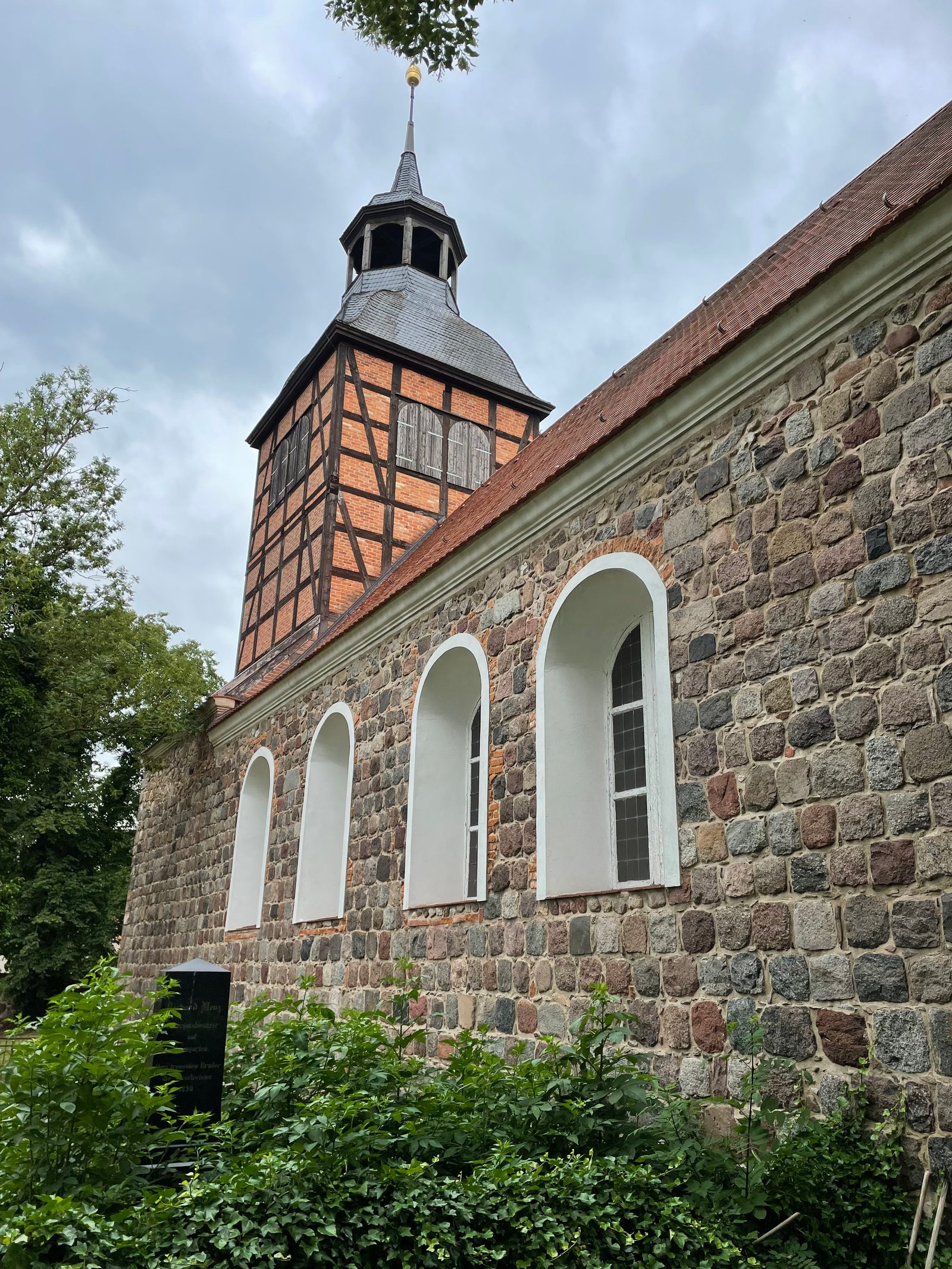
The Protestant village church of Baumgarten is a fieldstone church in Baumgarten, a district of the municipality of Schenkenberg in the Uckermark district in Brandenburg. The parish belongs to the Uckermark church district of the Evangelical Church Berlin-Brandenburg-Silesian Upper Lusatia.
Location+
State road 26 runs from west to east through the village. From it, Baumgarten road branches off to the south, among other directions. The building stands southeast of the intersection on a property with a church cemetery, which is enclosed by a listed wall made of undressed and unlayered fieldstones.
History+
The village was first documented in 1240 as Bomgarde and was owned by the Diocese of Cammin. In this context, the building was first documented in 1262. The church patronage was initially held by the Sabinenkloster in Prenzlau from 1262 to 1667, but during this time it also partially passed to the von Arnim family from Schönermark. During this period, four parish hides are already documented in 1375. The rectory was desolate in 1543/1544, as well as in 1600. In the latter year, the pastor lived in Prenzlau and had leased his hides. In 1613, the von Ramin family still owed the pastor the tithe grain from 23 hides. In 1628, the von Arnim family refused to return the pastor's four parish hides. During the Thirty Years' War and in 1675, the predecessor building was destroyed and rebuilt. During the Baroque period, the windows were widened and in 1709 a tower structure with a dome and lantern was added. After the fall of the Berlin Wall, extensive restoration took place in 1994/1995.
Building Description+
The building was essentially constructed from fieldstones, which were predominantly hewn and laid in layers. The choir is straight and not recessed. At the choir end there are two large round-arched windows, whose reveals are plastered and partly framed with reddish brick. In the middle is a narrow and also round-arched recess, which was part of a three-window group in an earlier period and is now designed as a blind arch. In the gable, also built of fieldstones, there is an oculus in the middle. The nave essentially has a rectangular floor plan. On the long wall there are three large and also round-arched windows with plastered reveals. Below the eastern and western windows respectively, there is a portal, which probably dates from the construction period. A small sacristy adjoins the northeast side, which can be entered from the east through a wooden portal. On the south side there are four large, round-arched windows. The transversely rectangular west tower occupies the full width of the nave on the lower floor. In the otherwise windowless floor, there is a triple-stepped portal on the west side, which also probably dates from the construction period. Above, the tower shaft tapers and transitions into a square superstructure from 1709, which was built of half-timbering. On each side there are two round-arched sound arcades, above which is a curved tower helmet with an open lantern, which is topped with a finial and weather vane.
Furnishings+
The church furnishings uniformly date from the mid-18th century. This includes a wooden pulpit altar with side staircases, which is decorated with rich carved decor and sculptures of Jesus Christ and Moses. Two allegories are attached to the pulpit itself; on the soundboard an angel cloud with a halo. The patron, pastor, and congregational pews were articulated with blind arches and decorated with Tuscan columns. The canopies of the patron and pastor's chairs also received carved rocaille decor. The furnishings are in white-yellowish hues and are described in the Dehio-Handbuch as "very atmospheric". The interior of the building has a beamed ceiling. In the west there is an organ gallery, which projects in the middle part and could be of more recent date. Further furnishings include a wooden baptismal angel, presumably created by Johann Georg Glume in 1742. It is 1.50 m tall and was "amateurishly reworked" from 1995 to 1997, according to the assessment of the Brandenburg State Office for Monument Preservation and Archaeological State Museum (BLDAM). The BLDAM considers a restoration necessary, as this reworking diminished its quality and historical authenticity. Instead of the original shell, the angel holds a simple wooden bowl in its right hand.
Take Mobile History with you
You are reading this text for free. Premium adds what matters on the road: descriptions read aloud, sites found through your camera, whole regions taken offline.
- Every description, including the ~17,700 Premium sites
- Audio guide: have descriptions read to you on location
- AR finder: see sites through your camera, with distance and bearing
- Unlimited saved sites
14 days free, then from €2.99 a month. Cancel anytime.
Source: Wikipedia · Licence: CC BY-SA 4.0 · Image: Assenmacher · Wikimedia Commons · CC BY-SA 4.0
This description is a machine translation of an excerpt from the linked Wikipedia article. The source text was written by its authors, the translation is by Mobile History; like the original it is licensed under CC BY-SA 4.0.
Location: 53.3457, 13.9480