The church can be visited
ChurchHohenfinow
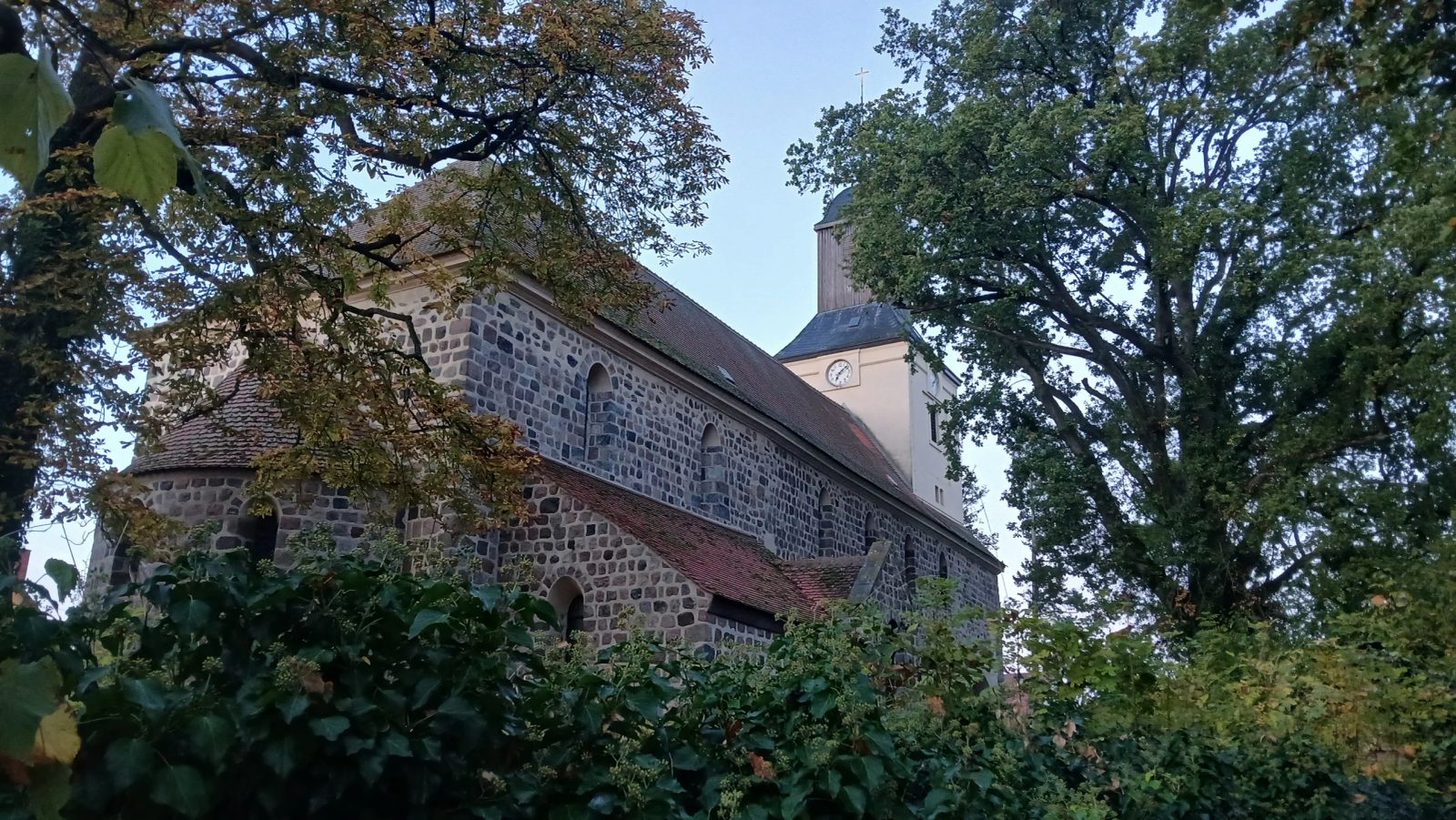
Hohenfinow Church
More pictures
The Protestant village church of Hohenfinow is an early Gothic fieldstone church in Hohenfinow in the Barnim district of Brandenburg. It belongs to the Falkenberg parish in the Barnim church district of the Evangelical Church Berlin-Brandenburg-Silesian Upper Lusatia.
History and Architecture+
The church is an elaborate fieldstone building from the middle of the 13th century. It was originally a three-aisled basilica in the style of town churches with a single-aisled choir, north sacristy and apse, as well as a three-part western transept. After its destruction in the Thirty Years' War, a reduced renovation of the church took place towards the end of the 17th century. The side aisles, the side parts of the western building and the apse were demolished, as in the village church of Niederlandin. The plastered tower superstructure with boarded lantern and dome dates from 1741. Between 1906 and 1910, a Neo-Romanesque renovation was carried out by the Lindenberg company from Frankfurt/Main, during which the apse was rebuilt. A restoration took place between 2001 and 2009 with the support of the German Foundation for Monument Protection. During this time, the church was completely restored inside and out and equipped with a new heating system. In the west, a two-tiered pointed arch portal with a circular window above opens into the church. The pointed arch choir south portal in a limestone frame with a relief vine frieze was created shortly after the middle of the 13th century, the inserted columns between 1906 and 1910. The walled-up pointed arch arcades of the nave on rectangular piers with chamfered imposts are visible from the outside; small, paired round arch windows from the time of the Neo-Romanesque renovation are arranged under the arches. The clerestory windows and the lancet windows on the choir correspond to the original state. The interior is characterized by the redesign of 1906 to 1910: the pointed arch triumphal arch has been renewed, the apse is vaulted by a semicircular pointed dome vault. A painted coffered ceiling with large-figure depictions of the Pantocrator with angels closes off the space. The fixtures and fittings were provided in a version adapted to the style of the respective piece. Stained glass windows are designed with figural (apse) and heraldic depictions (choir) as well as ornamental grisaille-like panes in the nave.
Furnishings+
The Neo-Romanesque sandstone altar dates from 1910, the polygonal wooden pulpit with a crown-shaped soundboard and access from 1753. The classicist wooden baptismal font was created in the middle of the 19th century. In 1727, the patron's box was built on the north wall of the choir with Corinthian pilasters. The horseshoe gallery on Tuscan columns was renewed in 1910. The former altar retable from 1727 was converted into an organ case. A wooden epitaph with trophy decoration dates from 1687. The sacristy door with wrought-iron fittings was created in the 15th century. The organ is a work by Wilhelm Remler from 1887 with 15 registers on two manuals and pedal, which was restored in 2009 by the Eberswalder Orgelbauwerkstatt.
Trivia+
On May 14, 1914, the funeral service for Martha von Bethmann Hollweg took place in the church; among the mourners were Detlev von Bülow, Johann von Dallwitz and Arnold Wahnschaffe.
Take Mobile History with you
You are reading this text for free. Premium adds what matters on the road: descriptions read aloud, sites found through your camera, whole regions taken offline.
- Every description, including the ~17,700 Premium sites
- Audio guide: have descriptions read to you on location
- AR finder: see sites through your camera, with distance and bearing
- Unlimited saved sites
14 days free, then from €2.99 a month. Cancel anytime.
Source: Wikipedia · Licence: CC BY-SA 4.0 · Image: Foto: Jörg Heldt (Community)
This description is a machine translation of an excerpt from the linked Wikipedia article. The source text was written by its authors, the translation is by Mobile History; like the original it is licensed under CC BY-SA 4.0.
Location: 52.8106, 13.9247