Church visitable
ChurchSchenkenberg - Kleptow
Kleptow Church
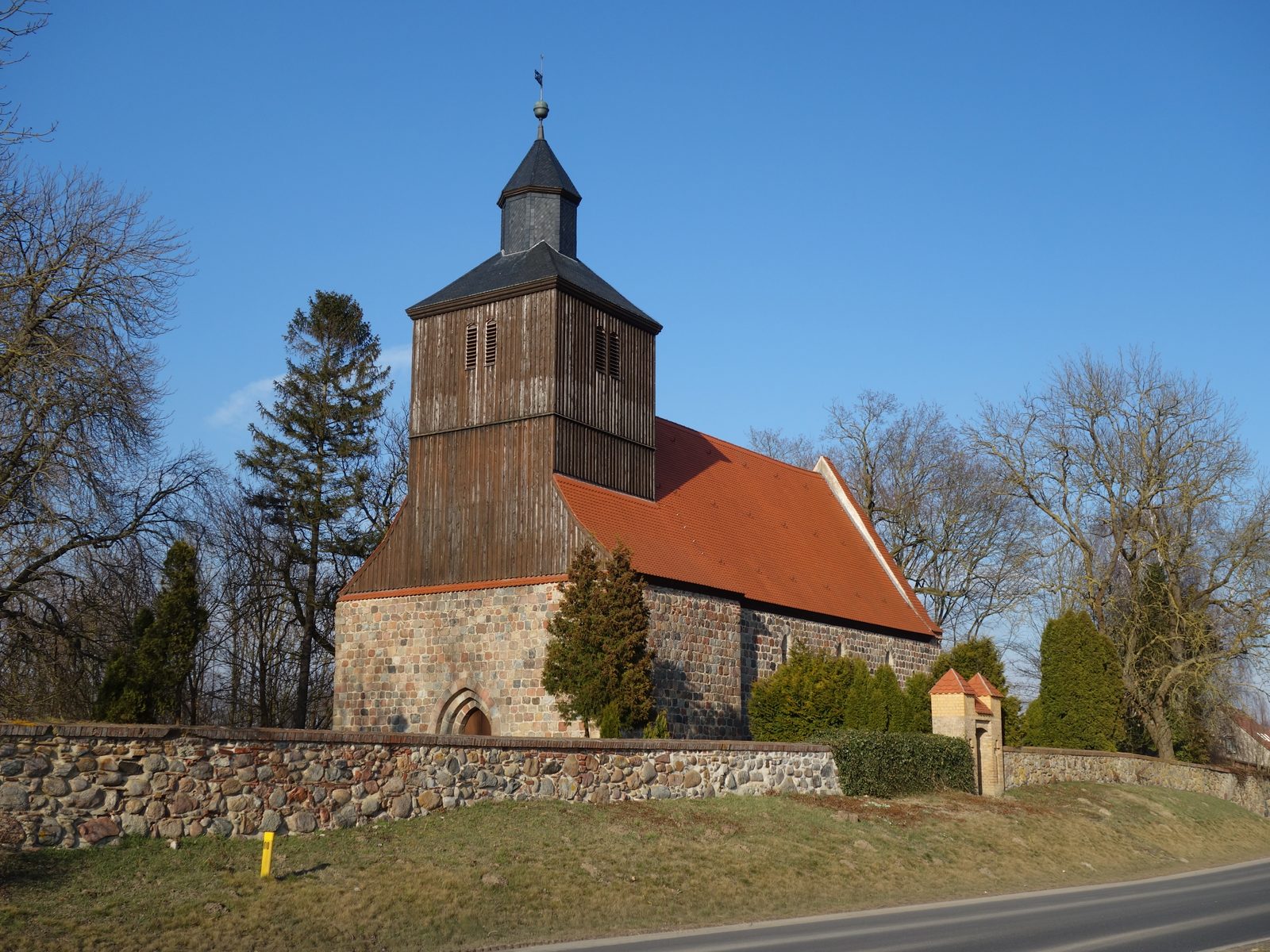
The Protestant village church of Kleptow is an early Gothic hall church in the Kleptow district of Schenkenberg in the Uckermark district of Brandenburg. It belongs to the Schönfeld parish in the Uckermark church district of the Evangelical Church Berlin-Brandenburg-Silesian Upper Lusatia.
History and Architecture+
The stately fieldstone hall church with a wider west tower was built in the second half of the 13th century. The boarded square tower superstructure with lantern and dome dates from the middle of the 18th century. Stepped pointed arch portals open up the building from the west and south. The interior is illuminated by lancet windows, which were provided with plaster frames and emphasized keystone in the 18th century; in the east, a three-window group in a rectangular, formerly plastered brick blind from the beginning of the 19th century is arranged, with three lancet blinds in the gable. The interior is completed by a beamed ceiling. The large pointed arch to the tower was partially bricked up. A brick portal with a wide round arch opening from the 18th century is built into the churchyard wall. After extensive renovation work in 1998/99, the church was re-consecrated in 2000.
Furnishings+
The main piece of the furnishings is a wooden altarpiece from the beginning of the 17th century with rich strapwork decoration. It consists of a column-articulated structure with a pierced triangular gable, a depiction of the Last Supper in the predella and a crucifixion relief in the main part; in the side niches framed by aedicules are sculptures of evangelists; the crowning angel and the cross were probably created at the beginning of the 19th century. The wooden pulpit with soundboard rests on a twisted column with vine leaves; round arch blinds between flat pilasters are attached to the basket and staircase, the whole dates from the second half of the 18th century, as do the west gallery, the patron's and community pews. The organ case dates from around 1820. The organ is a work by Georg Liedtcke from 1886 with three stops on one manual with an attached pedal. A pewter chandelier was acquired in 1843. Two cast steel bells were cast in 1956 at the bell foundry in Apolda. The irreparable former bronze bell from around 1300 is now in the bell museum in Apolda.
Take Mobile History with you
You are reading this text for free. Premium adds what matters on the road: descriptions read aloud, sites found through your camera, whole regions taken offline.
- Every description, including the ~17,700 Premium sites
- Audio guide: have descriptions read to you on location
- AR finder: see sites through your camera, with distance and bearing
- Unlimited saved sites
14 days free, then from €2.99 a month. Cancel anytime.
Source: Wikipedia · Licence: CC BY-SA 4.0 · Image: Hans G. Oberlack · Wikimedia Commons · CC BY-SA 4.0
This description is a machine translation of an excerpt from the linked Wikipedia article. The source text was written by its authors, the translation is by Mobile History; like the original it is licensed under CC BY-SA 4.0.
Location: 53.3657, 13.9974