The church can be visited
ChurchBrüssow - Wollschow-Menkin
Menkin Church
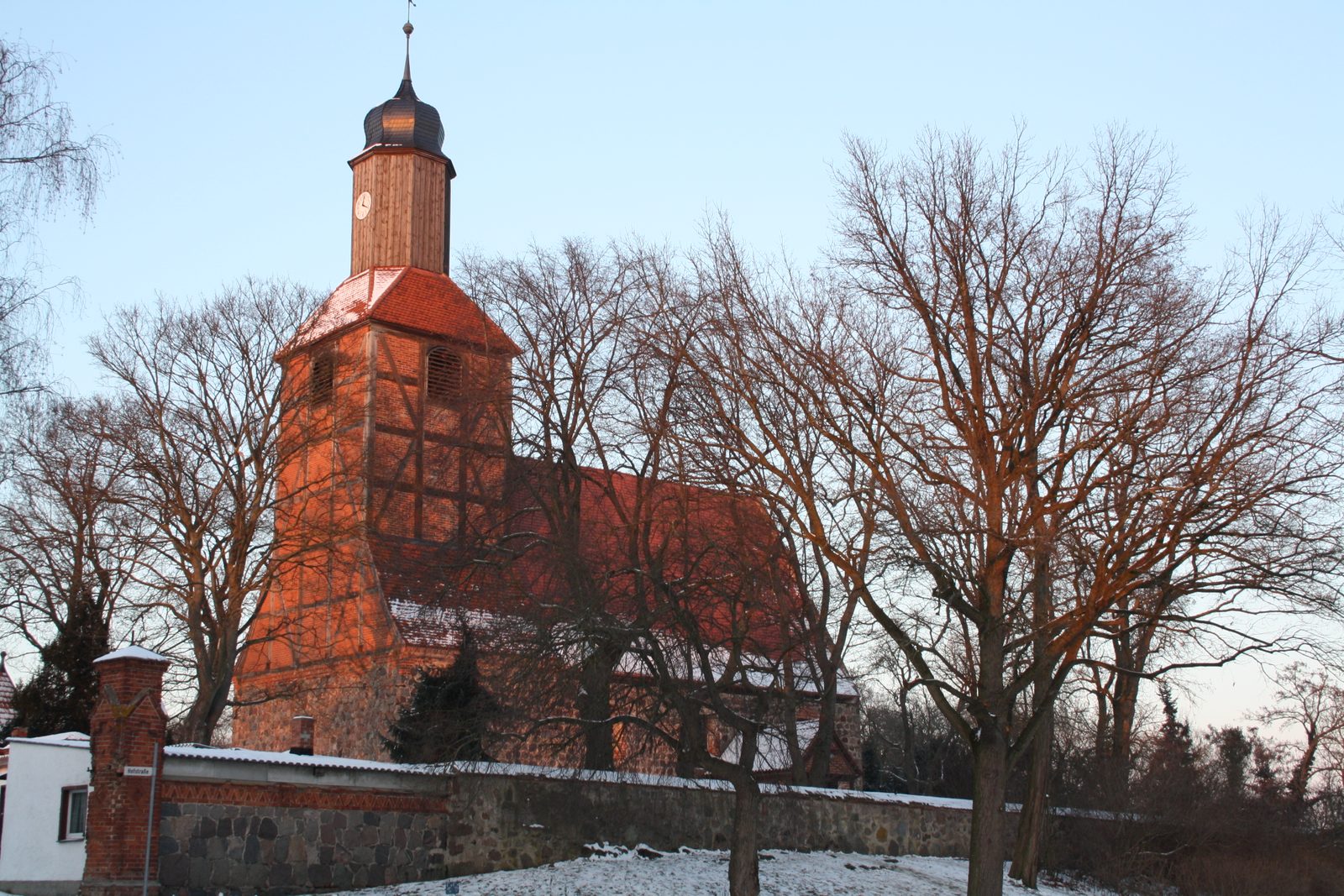
The Protestant village church of Menkin is a medieval hall church in Menkin, in the Wollschow district of Brüssow in Brandenburg. It belongs to the Brüssow parish in the Pasewalk church district of the Pomeranian Evangelical Church and can be visited by appointment.
History and Architecture+
The church was built in the second half of the 13th century from layered granite ashlar. The tower was designed to be as wide as the nave. The painted beamed ceiling dates from the 17th century, as does a segmental arched sacrament niche in the south wall. The door leaf of the south portal from 1703 has wrought-iron fittings in the shape of a knight figure. A brass chandelier with a knight figure dates from 1727. In 1731, the south porch and the half-timbered tower attachment with a closed lantern and a slate-covered dome were built. The west gable was also renewed. The bell from 1767 is by Johann Heinrich Scheel from Stettin. On the walls of the gallery, as well as on the north and south walls, there are 32 children's death shields from the 17th and 18th centuries. From 1995 to 1998, the church was restored. The building predominantly has rectangular windows; only in the south wall are there pointed arched windows and in the east gable slightly staggered round arched windows. From 1995 to 1999, structural repairs were carried out on the tower and the nave, supported by the German Foundation for Monument Protection. With the support of a Hamburg benefactress, the altar and pulpit, the patron's gallery, the south porch, and the organ could also be renovated. During a church renovation from 1926 to 1930, wall paintings from the 14th and 16th centuries were rediscovered and uncovered in 1927. Consecration crosses on the east and south walls also date from the 14th century. In 1580, the following inscription was written on the south wall of the church, based on the Lübeck Cathedral saying:
Parish+
Until 1974, the Menkin parish belonged to the Brüssow church district of the Church Province of Mark Brandenburg or the Evangelical Church in Berlin-Brandenburg, and subsequently to the Pasewalk church district of the Pomeranian Evangelical Church. Since May 2012, it has been part of the Brüssow parish in the Pasewalk provostry of the Pomeranian Evangelical Church District of the Mecklenburg and Pomerania Sprengel (seat of the Sprengel bishop in Greifswald) of the Evangelical Lutheran Church in Northern Germany.
Furnishings+
The Late Renaissance altarpiece was donated in 1599 by the village owner Ursula von Blanckenburg. Three portraits of her hang above the pastor's pew from 1638. The altar has a colorful architectural structure with much ornamentation. In the round-arched, closed central niche framed by projecting columns, there is a multi-figured crucifixion relief, in side niches allegorical figures and saints, and in the predella a Last Supper relief. To the left and right of the predella are two angels showing the elements of the Last Supper, the host and the chalice with wine. Above that, in the central part, the crucifixion of Jesus is depicted, above that the resurrected Christ with the banner of victory, and at the top of the altar, the pelican feeding its young with its own blood. The pulpit with sounding board and the lectern with strapwork also date from this period. The richly decorated pulpit basket shows, among other things, the four evangelists in round-arched niches between corner columns and painted cardinal virtues on the stairs. The sacristan's pew below the pulpit dates from around 1600. It is structured by columns on high pedestals and shows apostle images in diamond-faceted blind arcades. From 1623 to 1642, a comprehensive renovation took place after Swedish troops twice devastated Menkin and its church during the Thirty Years' War. Among other things, the windows were changed. The church pews have remained unchanged since 1637.
Lord's Box and Crypt+
In 1637, a two-story box extension measuring approximately 6.5 m × 5 m was built on the north side of the church for a lord's gallery and a crypt for the hereditary burials of the von Winterfeldt family. The von Winterfeldt family resided in Menkin from 1623 to 1945 and was also the patron of the church. The donors of the extension were Adam von Winterfeld and his wife Anna von Roebel. A patron's box with four stove plates depicting biblical scenes and the Brunswick coat of arms from the Ilsenburg foundry, glazed with plate glass, was installed in front of the basket-arch opening to the north extension. On the inside of the crypt door is the saying: "Were I as wise as Solomon and as beautiful as Absalom and had the great Alexander's empire, I would still have to become like death Anno 1637". In 1900, an inventory, organization, and cleaning of the crypt were carried out on behalf of the Winterfeldt family. Adam Winterfeldt's tin coffin, like the other coffins, had been violently opened and plundered. The restoration of the tin coffin was carried out in Berlin. During a renovation of the crypt from autumn 2005 to 2006, the coffins of the Winterfeldt family were cleaned and examined. The individually and elaborately designed coffins are mostly made of wood, partly painted and fitted with rich fittings; only Adam Winterfeldt's coffin is made of tin. The interior decoration is also richly and elaborately executed with fabric, filling material, and cushions. The buried dead were consistently clothed and adorned with bonnets or death crowns, similar to those in the lord's box inside the church. Due to the good ventilation of the crypt, the dead were well preserved and mummified. The youngest coffins are made of oak wood and date from the second half of the 18th century.
Organ+
In 1917, an organ, opus 740, was installed by Barnim Grüneberg from Stettin. The instrument was destroyed at the end of World War II in 1945. It featured a three-part prospectus in Neo-Renaissance forms. In 2005, the organ was restored by organ builder Andreas Arnold of the company Mecklenburger Orgelbau/Wolfgang Nußbücker. During this process, the existing parts were cleaned and treated with wood preservative, and the organ case was restored and reconstructed. Also restored were the bellows system with the connection of an electric wind generator, the wind chests of the playing mechanism, the pneumatic wind chests of the tone and register actions, as well as the wooden pipes and all metal pipes. The organ has the following disposition:
Couplers: I/I Superoctave coupler, II/I, I/P Playing aids: Mezzoforte, Tutti, Release, Calcant, Swell pedal
Take Mobile History with you
You are reading this text for free. Premium adds what matters on the road: descriptions read aloud, sites found through your camera, whole regions taken offline.
- Every description, including the ~17,700 Premium sites
- Audio guide: have descriptions read to you on location
- AR finder: see sites through your camera, with distance and bearing
- Unlimited saved sites
14 days free, then from €2.99 a month. Cancel anytime.
Source: Wikipedia · Licence: CC BY-SA 4.0 · Image: Skinfaxi121 · Wikimedia Commons · CC BY-SA 3.0 de
This description is a machine translation of an excerpt from the linked Wikipedia article. The source text was written by its authors, the translation is by Mobile History; like the original it is licensed under CC BY-SA 4.0.
Location: 53.4140, 14.1976