To be privately owned
ManorLimavady
Drenagh House
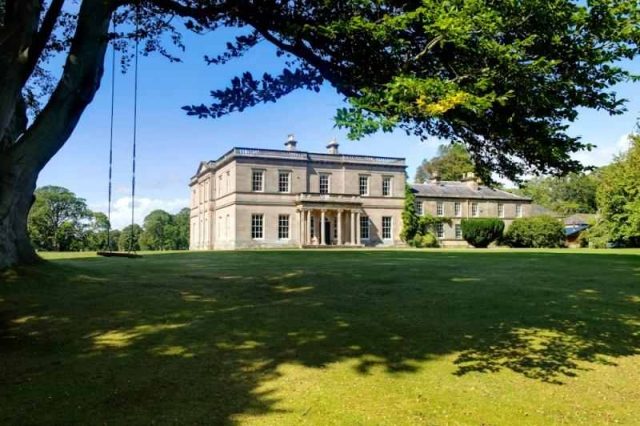
Drenagh is a 19th-century house and gardens in Limavady, County Londonderry, Northern Ireland. Drenagh has been the home of the McCausland family since 1729, and the present house was built in 1835 (1835). It was the first major work by Charles Lanyon, known for his work in Belfast. The gardens include features from the 18th century, as well as an extensive 19th-century Italian garden and elements added in the 1960s. The house is a Grade A listed building.
History+
The Drenagh estate, then known as Fruithill, was acquired from the Bishopric of Derry by William Conolly (1662–1729), a wealthy self-made man and speaker of the Irish Parliament. By his will he left his interest in the property to his agent Robert McCausland “as an acknowledgment for the faithful service he has done me”, and the bequest allowed the McCauslands to establish themselves as county gentry. McCausland was the grandson of Baron Alexander McAuslane who had settled in the Strabane area in the 1540s, and he named his first son (by his wife Hannah, née Moore) Conolly McCausland for his employer. In the 1730s Robert McCausland built the first house at Fruithill, located to the south-east of the present building, and in the 1790s this house was extended. Nothing remains of this house, though a walled garden remains from this period as well as elements of the demesne landscape. Conolly McCausland married the heiress Elizabeth Gage and had a son, also Conolly McCausland, who married Theodosia Mahon from Strokestown, County Roscommon. This second Conolly McCausland approached architect John Hargrave to design a new house, but only the gate lodge was built prior to the deaths of McCausland and Hargrave. In 1836 their son, Marcus McCausland (1787–1862), commissioned Sir Charles Lanyon to build the present house. Marcus and his wife, Marianne (née Tyndall) produced an heir, Conolly Thomas McCausland (1828–1902). Conolly Thomas McCausland was High Sheriff of County Londonderry in 1866. He married Laura St John, daughter of the 15th Baron St John of Bletso. Their son, Maurice Marcus McCausland (1872–1938), lived through the Irish Land Acts, whereby the Government compulsorily purchased 75% of the estate.
Source: Wikipedia · Licence: CC BY-SA 4.0
This description is an excerpt from the linked Wikipedia article and was written by its authors. Like the original it is licensed under CC BY-SA 4.0 and may be reused under the same terms.
Location: 55.0553, -6.9222