CastleBad Kreuznach - Bad Münster am Stein-Ebernburg

Ebernburg Castle
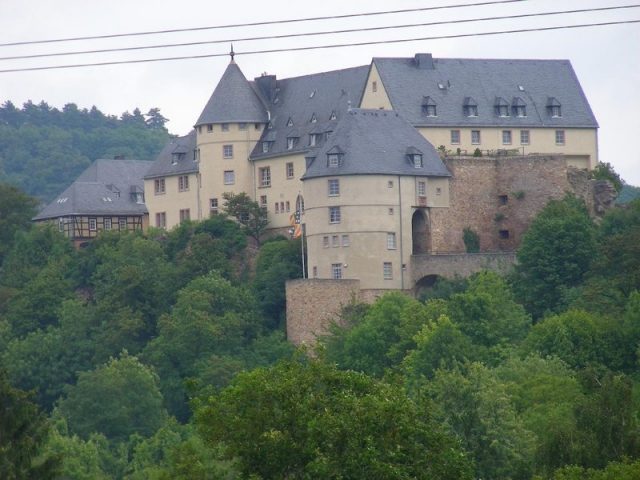
Ebernburg Castle

Ebernburg Association e.V.

Ebernburg Castle (French: Ebrebourg) gives its name to Ebernburg in the Bad Münster am Stein-Ebernburg district of Bad Kreuznach in the Nahetal region of Rhineland-Palatinate. It is located on the southeastern outskirts of the town on a mountain spur above the Nahe valley.

A first hilltop castle and a settlement may have originally been located at a different spot, namely in the area around the Protestant Old St. John's Church (so-called fortified church) in Ebernburg.

The first documented mentions of the name "Ebernburc" date from 1206, although according to Böcher it is not clear whether the mention refers to the castle or the town. Böcher, however, considers it unlikely that the town is older than the castle. In 1338 - this is certain - Raugraf Ruprecht and Count Johann von Sponheim-Kreuznach built the castle.

In 1448, the entire lordship of Ebernburg came into the pledge, later feudal, possession of the Sickingens, who only ceded it back to the Electoral Palatinate in 1750 and 1771. Under Schweickhardt von Sickingen and his son Franz von Sickingen, an expansion and armament with artillery took place in 1482, in particular, several heavy guns, the "Scharfmetzen", were present there.

In 1523, the castle was burned down as a result of the Trier Feud, rebuilt in 1542, razed again in 1697 during the Palatinate War of Succession, and used as a quarry in the following years (spolia are located in the village below). In 1838, the castle came into the possession of the estate owner and mayor of Feilbingert, Karl Günther, who had it rebuilt in the old style and erected a residential building, farm buildings, and a restaurant. From 1849, it also served as an excursion destination. In 1914, the Günther family sold the castle with all its inventory to the newly founded Ebernburg Foundation, which leased the castle to the Ebernburg-Verein e. V. The purchase was essentially made possible by a donation from the leather manufacturer and Kommerzienrat Theodor Wilhelm Simon (1861–1940) from Kirn.

After the Second World War, the castle was expanded into its present form.

Layout+

At the foot of the castle is the Hutten-Sickingen Monument, executed in bronze in 1889 according to the designs of the sculptor Carl Cauer from Bad Kreuznach by his sons Robert and Ludwig in the Historicist style. It depicts Ulrich von Hutten and Franz von Sickingen.

The Legend of Ebernburg+

According to a legend, the Ebernburg was fought over in the Middle Ages. The castle inhabitants were to be starved out. The enemies had therefore begun a siege at some distance from the castle.

As supplies ran low, the lord of the castle had the last boar dragged into the courtyard daily and thrown on its back, as if it were being slaughtered. Of course, the boar roared in mortal fear each time. When the besiegers heard this, they withdrew, thinking there was enough food available. That is why, according to the legend, the castle is called Ebernburg today.

Sickingen and the "Inn of Justice"+

It was given the nickname "Inn of Justice" by the humanist Ulrich von Hutten, a friend of Franz von Sickingen, in a polemic against Pope Leo X's papal bull Exsurge Domine against the reformer Martin Luther. This indirectly referred to Franz von Sickingen having offered asylum to Luther, who was on his way to the Diet of Worms (1521), at Ebernburg. However, Luther did not accept the offer, but fled, declared an outlaw by the Diet of Worms on May 16, 1521, under the pseudonym Junker Jörg to Wartburg Castle. Other reformers, however, who were also persecuted as followers of Luther or had lost their positions, accepted Sickingen's offer. These were:

  • Martin Bucer
  • Johannes Oecolampadius
  • Johann Schwebel
  • Kaspar Aquila

Johannes Oecolampadius was at Ebernburg in the summer of 1522. As castle chaplain, he reformed the divine service there. In June, he began to read the text of the Gospels and Epistles in the daily mass in German instead of Latin. Although he omitted none of the usual ceremonies, the innovation caused a stir and the archiepiscopal authority in Mainz asked him for a statement. Also in June, the Lord's Supper was celebrated at Ebernburg in both kinds. "Thus the divine service at Ebernburg became the first evangelical divine service." In November 1522, Oecolampadius went to Basel, where he found a new sphere of activity.

Take Mobile History with you

You are reading this text for free. Premium adds what matters on the road: descriptions read aloud, sites found through your camera, whole regions taken offline.

  • Every description, including the ~17,700 Premium sites
  • Audio guide: have descriptions read to you on location
  • AR finder: see sites through your camera, with distance and bearing
  • Unlimited saved sites

14 days free, then from €2.99 a month. Cancel anytime.

Source: Wikipedia · Licence: CC BY-SA 4.0 · Image: http://www.wehrbauten.de/thread.php?threadid=1340

This description draws on the facts documented in the linked Wikipedia article; Wikipedia content is licensed under CC BY-SA 4.0. Wording and editing: Mobile History.

Location: 49.8070, 7.8386