The church can be visited
ChurchJena - Ziegenhain
Marien Church Ziegenhain
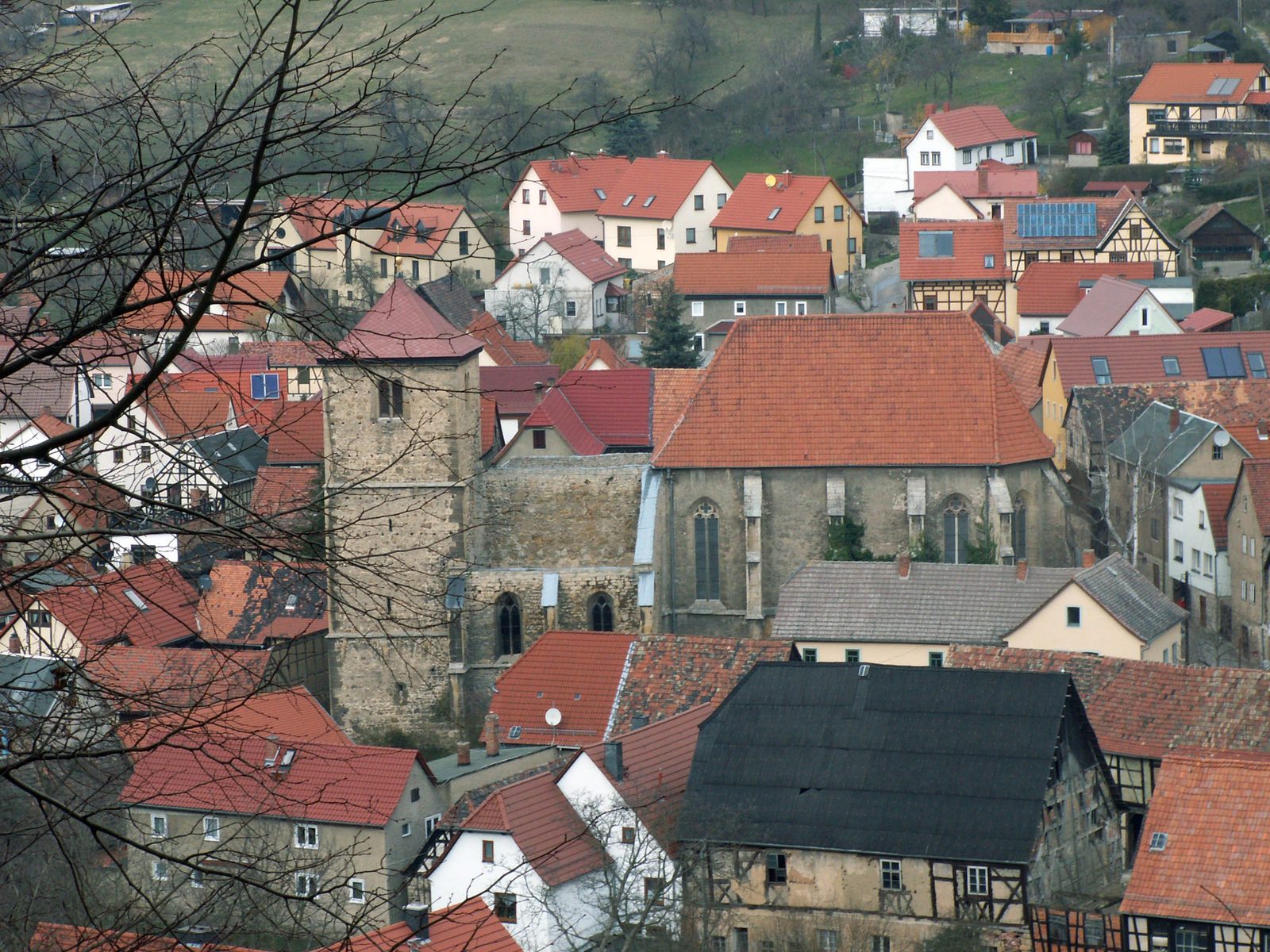
St. Mary's Church, in its current form built in the 15th century, is located in the Ziegenhain district of the city of Jena in Thuringia. The house of worship has been a protected monument since the 1990s. The patron saint of the church is the Virgin Mary. The parish belongs to the Weningenjena deanery.
The church is located on the eastern edge of the city of Jena, between two mountain ridges at the end of the Ziegenhain valley in the rural surroundings. It is surrounded on all sides by residential buildings.
History+
In the 14th century, pilgrimages to the image of Mary in St. Mary's Chapel increased, so Albrecht III, Burgrave of Kirchberg, commissioned the construction of a worthy larger church around 1422 as an elongated octagonal building with two choir polygons. The image of Mary is mentioned in the foundation charter of December 6, 1424, but is no longer present in the Ziegenhain church. It is presumed that the image of Mary mentioned in the foundation charter is the Jena Vesperbild displayed in the Jena City Museum. Around 1465, the chapel was extended by a three-aisled, two-bay hall nave and the tower by the Jena master builder Peter Heierliß. A fresco on the north wall of the choir, dating from the 1420s, depicts the procession of the Three Magi, patrons of pilgrims, against the backdrop of the local landscape of the Hausberg castles. An octagonal Romanesque baptismal font and a winged altar, which now stands at the back wall of the nave, also date from the construction period. The central image of the winged altar, repainted between 1550 and 1590, depicts the Crucifixion of Jesus. The first panel from the left shows the Old Testament story of the Brazen Serpent erected by Moses. The second panel shows the Sacrifice of Isaac. The right panels are dedicated to the Resurrection of Jesus Christ and the Last Judgment. Between 1591 and 1939, students of Jena University carved their names and the date of their visit on the winged altar. St. Mary's Church Ziegenhain remained unfinished as a pilgrimage church and has been used as the Ziegenhain church by the inhabitants of the valley since 1424. The high choir was built during the heyday of Gothic architecture. The fortified tower in the west was built at the end of the 15th century. Both during the Saxon Fratricidal War and the Reformation, interest declined and the decay of the house of worship began. In the 17th century, from 1636, the choir was therefore separated from the three-aisled nave and a makeshift ceiling was installed. With the former chapel, the people of Ziegenhain once again had a church. The nave became a ruin. The Baroque pyramid pulpit altar, dating from 1693/1694, has some art-historical peculiarities: there are only two instead of the usual four palm columns; the pulpit basket is located under the pyramid canopy; the pulpit was placed above the altar only 90 years later. In the First World War, the community had to hand over two of the three bronze bells as a metal donation from the German people for the production of war equipment. In later years, the parish had steel chimes installed in their place. At the beginning of the 2010s, the desire arose to have two new bronze bells cast to once again create a full, beautiful sound. The necessary sum was raised and they are expected to be ceremoniously hung at the 2025 Thanksgiving festival.
New Beginning+
Between 1988 and 1994, extensive renovation work was carried out, particularly in the interior of the church and in the ruined section. The choir, which served as the church space, was restored. Below the organ loft, there is now a room that serves as a winter church. The unfinished space of the church was cleared for the first time in the history of the building. Events such as choir concerts, open-air events, etc., now take place there. The grounds are also integrated into church activities, thus serving as a meeting place. Further repairs and embellishments were carried out in preparation for the church anniversary (2023/2024).
Gerhard Organ+
The organ by Justinus Ehrenfried Gerhard, first consecrated in Ziegenhain in 1764, had previously stood in another church and dates from around 1739. It had been unplayable for the last 15 years. The purely mechanical slider chest instrument was meticulously restored and solemnly reconsecrated on August 26, 2001.
Coupler: Man/P Effect registers and playing aids: Tremulant, Calcantenruf Tuning: Pitch a1 = 464 Hz Temperament: Silbermann Sorge
Artworks+
Today, the church possesses few artworks, including a fresco with the three Jena Hausberg castles. The depictions of Mary created by artists for the 600th anniversary celebration are now donated to the church.
Miscellaneous+
The dendrochronological examination in May 2021 revealed: The fir wood from which the church roof truss was built came from trees that began to grow in 1353 and were felled in 1422.
Take Mobile History with you
You are reading this text for free. Premium adds what matters on the road: descriptions read aloud, sites found through your camera, whole regions taken offline.
- Every description, including the ~17,700 Premium sites
- Audio guide: have descriptions read to you on location
- AR finder: see sites through your camera, with distance and bearing
- Unlimited saved sites
14 days free, then from €2.99 a month. Cancel anytime.
Source: Wikipedia · Licence: CC BY-SA 4.0 · Image: "froutes"/Michael Mertens ( www.froutes.de ) · Wikimedia Commons · CC BY-SA 2.0
This description is a machine translation of an excerpt from the linked Wikipedia article. The source text was written by its authors, the translation is by Mobile History; like the original it is licensed under CC BY-SA 4.0.
Location: 50.9210, 11.6252