The church can be visited
MonasteryKitzingen
Former Capuchin Monastery
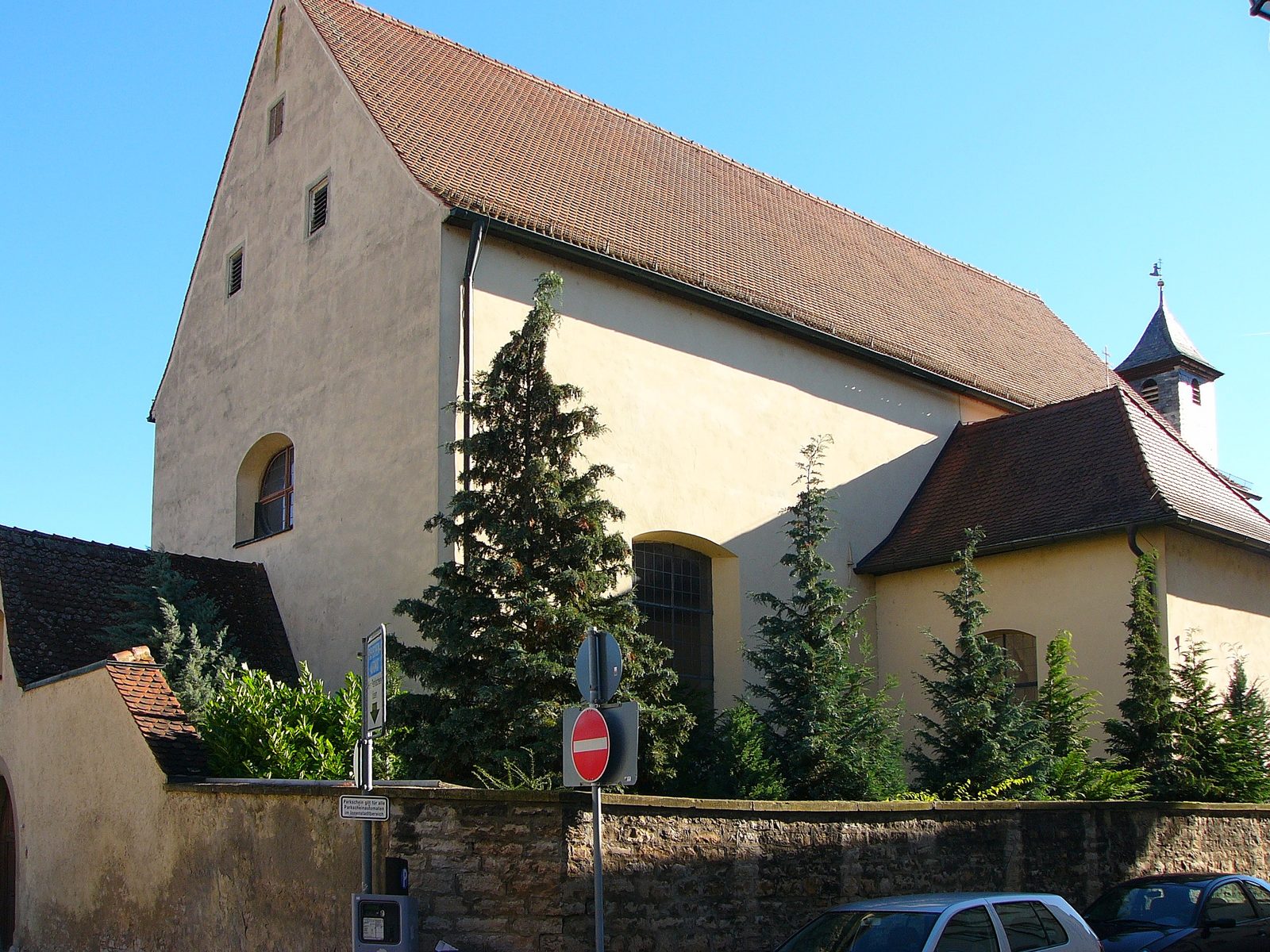
The Capuchin Monastery Kitzingen is a former monastery of the Capuchins in Kitzingen, Bavaria, in the Diocese of Würzburg.
History+
The monastery was founded in 1630 by Philipp Adolf von Ehrenberg, Bishop of Würzburg, and the foundation stone for the monastery buildings was laid the following year. During the Thirty Years' War, when Kitzingen was briefly under Swedish administration, the Capuchins were expelled and could only return in 1649. In 1652, the simple church, typical for the mendicant order, was finally consecrated. The monastery was dissolved in 1828, and from 1831 to 1902 it served as a hospital. After the end of the Second World War, the Protestant community of Kitzingen temporarily held its services in the church, as the city church had been damaged by bombs. In 1983, most of the former monastery buildings were demolished and replaced by the Caritas senior citizens' home St. Elisabeth; only the church and part of the western wall remained. The church is now used by the Catholic parish of St. Johannes as a filial church, and services are held regularly.
Monastery Church+
The church is dedicated to the Assumption of Mary and Saint Francis Seraphicus. It is oriented to the south and presents itself as a simple hall building with a recessed rectangular choir, above which the small roof turret with a pyramid helmet rises. In the roof turret hangs a four-part peal of bronze and cast steel bells, two of which – curiously – are tuned to the same note C#3. On the west side, a chapel extension protrudes from the line of the nave wall. The nave is cross-vaulted, and the choir area is spanned by a barrel vault. The interior today features one of the best-preserved 17th-century furnishings in the Main-Franconian region. In addition to the high altar, which occupies the entire width of the choir and separates the sacristy from the church space, the side altars and the large-format Baroque Stations of the Cross paintings on the walls also deserve special attention. The high altar painting with the motif of the Assumption of Mary was created in 1679 by the Flemish painter Oswald Onghers. In the church's antechamber is the weathered original of a Gothic wayside shrine. A copy was placed at its former location in front of the south wall of the city parish church of St. Johannes. Except for services, the church is usually not publicly accessible and can therefore only be visited by appointment.
Take Mobile History with you
You are reading this text for free. Premium adds what matters on the road: descriptions read aloud, sites found through your camera, whole regions taken offline.
- Every description, including the ~17,700 Premium sites
- Audio guide: have descriptions read to you on location
- AR finder: see sites through your camera, with distance and bearing
- Unlimited saved sites
14 days free, then from €2.99 a month. Cancel anytime.
Source: Wikipedia · Licence: CC BY-SA 4.0 · Image: Gliwi · Wikimedia Commons · CC BY-SA 3.0
This description draws on the facts documented in the linked Wikipedia article; Wikipedia content is licensed under CC BY-SA 4.0. Wording and editing: Mobile History.
Location: 49.7362, 10.1626