therapeutic children's residential group, branch church
MonasteryDorfen
Schloss Moosen
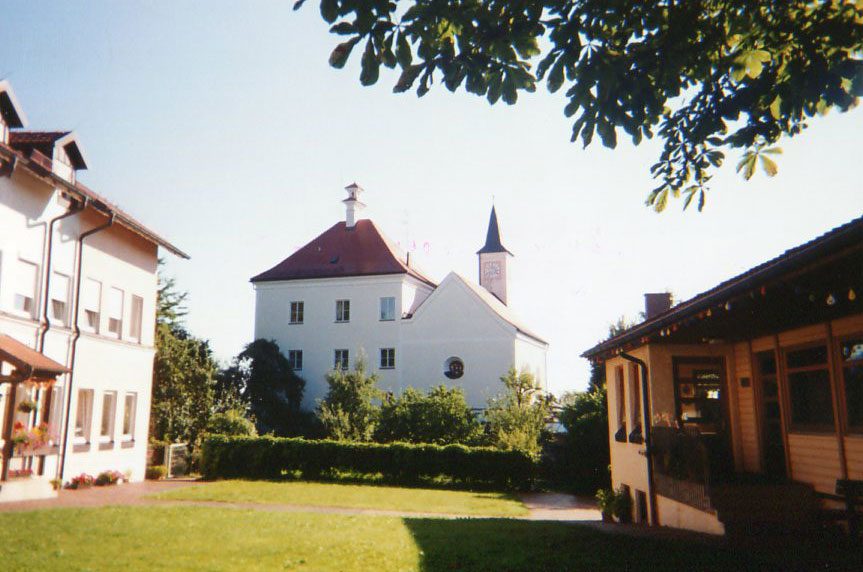
The former Hofmarkschloss Moosen, now known as Moosen Monastery, is a significant architectural monument in Bavaria. Located in the town of Dorfen in the district of Erding, it forms a protected ensemble with the branch church of St. Katharina. The property is characterized by its long and varied history, ranging from aristocratic ownership to its use as a charitable institution.
History+
The first documented mention of the noble seat of Moosen dates back to 1212, when Hartlieb von Moosen was named as its owner. Over the centuries, the property changed hands several times, including the Haslanger and Hampersdorfer families, and the noble Preysinger lineage. Around 1500, the Edlen von Westacher acquired the castle, under whose patronage the current building was constructed in the transitional style from Mannerism to early Baroque. After the Westacher line died out in 1722, ownership passed to Baron Karl Josef von Dichtl, who sold it three years later to the Imperial Counts of Morawitzky. They held the castle until 1813. In 1856, Anton Schmitter, the parish priest of Dorfen, acquired the property and established a rescue home for neglected children, initially managed by the Franciscan Sisters and later by the Poor School Sisters. In the late 19th century, new functional buildings were erected in place of the former farm buildings to accommodate this use. After the girls' boarding school closed during World War II, a home for infants and toddlers was founded in 1945. Until the 2010s, the property served as a children's and youth home and a daycare center.
Location+
The former castle and current Moosen Monastery is situated in the Upper Bavarian town of Dorfen, within the district of Erding in Bavaria, Germany.
On site+
Since early 2018, the SLW Foundation has been operating a therapeutic residential group for children on the upper floors of the former children's home building. The monastery itself has been closed, and the sisters have left the premises. A new use for the castle and the adjacent former monastery building has not yet been determined. The castle chapel can be visited by arrangement with the sacristan, but is otherwise permanently closed. The four-story, cubic, tower-like building with a hip roof was constructed around 1620. The large castle chapel, attached to the south side of the main building, has served as a branch church of the Schwindkirchen parish since the 19th century and underwent extensive renovation in the mid-2010s. The chapel is predominantly furnished in the early Neoclassical style, featuring a spacious nave and a short chancel. The high altar, designed in the late Rococo style, already shows early Neoclassical elements and features an altarpiece depicting the martyrdom of Saint Catherine.
Nearby+
- Armstorf Castle (castle, approx. 1938 m away)
- Schwindegg Castle (castle, approx. 6165 m away)
- Kalling Castle (castle, approx. 6241 m away)
- Taufkirchen Castle (castle, approx. 9160 m away)
Take Mobile History with you
You are reading this text for free. Premium adds what matters on the road: descriptions read aloud, sites found through your camera, whole regions taken offline.
- Every description, including the ~17,700 Premium sites
- Audio guide: have descriptions read to you on location
- AR finder: see sites through your camera, with distance and bearing
- Unlimited saved sites
14 days free, then from €2.99 a month. Cancel anytime.
Location: 48.2670, 12.1744