The remains of the Cathedral can be visited
ChurchElgin
Elgin Cathedral
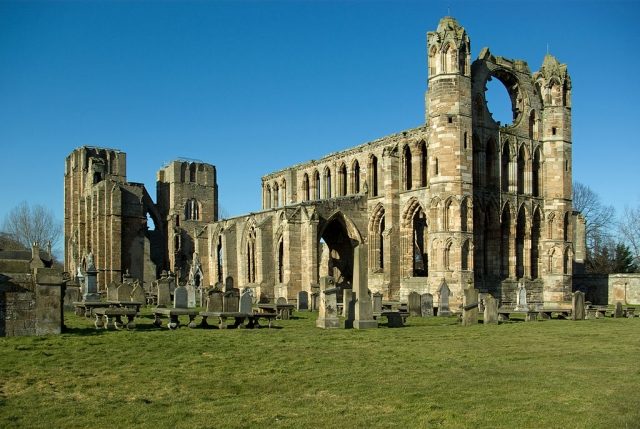
Elgin Cathedral, dedicated to the Holy Trinity, sometimes referred to as The Lantern of the North is a historic ruin in Elgin, Moray, north-east Scotland. It was established in 1224 on an area of ground granted by Alexander II that was close to the River Lossie and outside of the burgh of Elgin. Before its transfer to its present position the cathedral was located at Spynie, 3 km to the north, and was served by a chapter of eight clerics. The new cathedral, much larger than before, was staffed accordingly with the number of canons increased to 18 in 1226 and then again to 23 by 1242. A fire in 1270 damaged the cathedral significantly initiating a major rebuilding programme that substantially increased the size of the edifice. It was unaffected by the Wars of Independence but was again badly damaged by burning in 1390 following an attack by Robert III's brother Alexander Stewart, Earl of Buchan, also known as the Wolf of Badenoch. In 1402 the cathedral precinct again suffered an incendiary attack by the followers of the Lord of the Isles. The number of clerics required to staff the cathedral grew steadily as did the quantity of craftsmen needed to maintain the buildings and surrounds. The number of canons had increased to 25 by the time of the Reformation in 1560 when the cathedral was abandoned and the services transferred to Elgin's parish church of St Giles. After the removal of the lead from the roof in 1567, the cathedral fell steadily into decay which was only arrested in the 19th century when it was in a substantially ruinous condition.
Today, the walls of the cathedral are at full height in places and at foundation level in others but with the cruciform shape of the cathedral still discernible. The two towers of the west front are mostly complete and are from the first phase of building. The cathedral went through periods of enlargement and renovation following the fires of 1270 and 1390 that included the doubling in length of the choir, the provision of additional aisles in the north and south of the nave, and external aisles to the north and south walls of the choir. A mostly intact octagonal chapter house dates to the period of the major enlargement after the fire of 1270. The gable wall above the double door entrance that links the west towers is nearly complete and was rebuilt following the destructive fire of 1390. It accommodates a large window opening that now contains only stub tracery work but fragments of a large rose window are visible. Recessed and chest tombs in both transepts and in the south aisle of the choir contain effigies of bishops and knights while large flat slabs in the now grass covered floor of the cathedral mark the positions of graves. The manses of the dignitaries and canons stood in the chanonry and were destroyed by fire on three occasions—in 1270, 1390 and 1402. Only the precenter's manse substantially remains while two others have been incorporated into private buildings. A protective wall of massive proportions surrounded the cathedral precinct but only a small section has survived. The wall had four access gates, one of which—the Pans Port—still exists.
Early cathedral churches of Moray+
The northern dioceses of Moray, Ross and Caithness were regional in form while bishoprics such as St Andrews derived from a more ancient monastic Celtic church held possessions that geographically were scattered in nature. Unlike other Scottish cathedrals, Elgin's played no part in the foundation of the burgh—by 1224 when the cathedral was finally established at Elgin, the burgh with its parish church were already in existence having been established by David I (Dabíd mac Maíl Choluim) between 1130 and 1153.
It is possible that there may have been bishops of Moray before c.1120 but this is not certain. After the suppression of Óengus of Moray's rebellion in 1130 David I must have regarded the continued presence of bishops in Moray as essential to the stability of the province. The first known bishop of the diocese—possibly later translated to Dunkeld—was Gregory (or Gregoir) and probably bishop in name only with the first resident diocesan being Richard of Lincoln. Gregory was a signatory to the foundation charter of Scone Priory, issued by Alexander I (Alaxandair mac Maíl Choluim) between December 1123 and April 1124, and again in a charter defining the legal rights of the same monastery. He is recorded for the last time when he witnessed a charter by David I to Dunfermline Abbey in c.1128.
The early bishops did not have a settled location for their cathedral and sited it successively at Birnie, Kinneddar and Spynie. Pope Innocent III issued an apostolic bull on 7 April 1206 that allowed bishop Bricius de Douglas to fix his cathedral church at Spynie with its inauguration between spring 1207 and summer 1208. A chapter of five dignitaries and three ordinary canons for the day-to-day running of the cathedral was authorised and based its constitution on that of Lincoln Cathedral. Elgin became the lay centre of the province under David I who probably established the first castle in the town and it may have been this castle with its promise of better security that prompted Bricius, before July 1216, to petition the pope to move the seat from Spynie.
Cathedral church at Elgin+
Despite Bricius's earlier appeal, it was not until Andreas de Moravia's episcopate that Pope Honorius III issued his bull on 10 April 1224 authorising his legates Gilbert de Moravia, Bishop of Caithness, Robert, Abbot of Kinloss and Henry, dean of Ross to examine the suitability of transferring the cathedra to Elgin. The Bishop of Caithness and the dean of Ross performed the translation ceremony on 19 July 1224. Before that, on 10 July, Alexander II (Alaxandair mac Uilliam) agreed to the transference in an edict that referred to his having given the land previously for this purpose. The land-grant predated the Papal mandate and there is evidence that the building had started in around 1215. Completion was after 1242 but the chronicler John of Fordun recorded without explanation that in 1270 the cathedral church and the canons’ houses had burned down. The cathedral was rebuilt in a larger and grander style to form the greater part of the structure that is now visible. The enlargement is supposed to have been completed by the outbreak of the Wars of Independence in 1296 and although Edward I of England took an army to Elgin in 1296 and again in 1303 the cathedral was left unscathed, as it was by his grandson Edward III during his assault on Moray in 1336.
Bishop David de Moravia (1299–1326) was the uncle of Andrew Moray who, together with William Wallace, defeated the English at the Battle of Stirling Bridge in 1297 and where Moray was mortally wounded. In August 1306 Edward I ordered the arrest of Bishop David for complicity in the murder of John Comyn, Lord of Badenoch and had him excommunicated—he took refuge on Norwegian soil in Orkney. In 1325 he gave the lands of Grisy-Suisnes, outside Paris which formed the founding endowment of the Collège des Écossais. Soon after his election to the see in 1362–3, Bishop Alexander Bur requested funds from Pope Urban V for repairs to the cathedral citing neglect and hostile attacks. In August 1370 Bur began protection payments to Alexander Stewart, son of Robert the Steward, lord of Badenoch who would soon become King Robert II. Alexander, Earl of Buchan from 1382, and Bur had many disputes culminating in Buchan's excommunication in February 1390 and the bishop turning to Thomas Dunbar, son of the Earl of Moray, to provide the protection service.
These acts by the bishop and any frustrations Buchan may have had by the re-appointment of his brother Robert Stewart, Earl of Fife as guardian of Scotland may have caused him to react defiantly—in May, he descended from his island castle on Lochindorb and burned the town of Forres and followed this up in June by burning Elgin and the cathedral with its manses. It is believed that he also burned Pluscarden Priory at this time, which was officially under the Bishop's protection. Bur wrote to Robert III seeking reparation for his brother's actions in a letter stating:
—my church was the particular ornament of the fatherland, the glory of the kingdom, the joy of strangers and incoming guests, the object of praise and exaltation in other kingdoms because of its decoration, by which it is believed that God was properly worshipped; not to mention its high bell towers, its venerable furnishings and uncountable jewels.
Robert III granted Bur an annuity of £20 for the period of the bishop’s lifetime, and the pope provided income from the Scottish Church during the following decade. In 1400, Bur wrote to the Abbot of Arbroath complaining that the abbot's prebendary churches in the Moray diocese had not paid their dues towards the cathedral restoration. In the same year Bur wrote to the rector of Aberchirder church telling him that he now owed three years arrears for the subsidy that had been imposed on non-prebendary churches in 1397. Again, on 3 July 1402, the burgh and cathedral precinct were attacked, this time by Alexander of Lochaber, brother of Domhnall of Islay, Lord of the Isles. He spared the cathedral but burned the manses and for this act Lochaber and his captains were excommunicated prompting his return in September to give reparation and gain absolution. In 1408, the money saved during a vacancy was diverted to the rebuilding process and in 1413 a grant from the customs of Inverness was provided. Increasingly, the appropriation of the parish church revenues led in many cases to churches becoming dilapidated and unable to attract educated priests—by the later Middle Ages, the standard of pastoral care outside of the main burghs was totally inadequate.
Bishop John Innes (1407–14) contributed greatly to the rebuilding of the cathedral evidenced by the inscription on his tomb praising his efforts. When he died, the chapter met secretly— 'in quadam camera secreta in campanili ecclesie Moraviensis' —and agreed that should one of their number be elected to the see that the bishop would grant one third of the income of the bishopric annually until the re-building was finished. The major alterations to the west front were completed before 1435 and contain the arms of Bishop Columba de Dunbar (1422–35) and it is presumed that both the north and south aisles of the choir were finished before 1460 as the south aisle contains the tomb of John de Winchester (1435–60). Probably the last important rebuilding feature was the major restructuring of the chapter house between 1482 and 1501 and contains the arms of Bishop Andrew Stewart.
Diocesan organisation
In cathedrals the dignitaries and canons constituted the chapter and had the primary role of aiding the bishop in the governance of the diocese. Often the bishop was the titular head of the chapter only and was excluded from its decision-making processes, the chapter being led by the dean as its superior—as the diocese of Moray based its constitution on that of Lincoln Cathedral the bishop was allowed to participate within the chapter but only as an ordinary canon. Moray was not unique in this, the bishops of Aberdeen, Brechin, Caithness, Orkney and Ross were also canons in their own chapters. Each morning, the canons held a meeting in the chapter house where a chapter from the canonical rule book of St Benedict was read before the business of the day was discussed.
Bishop Bricius's chapter of eight clerics consisted of the dean, precentor, treasurer, chancellor, archdeacon and three ordinary canons. His successor, Bishop Andreas de Moravia greatly expanded the chapter to cater for the much enlarged establishment by creating two additional hierarchical posts (succentor and subdean) and added 16 more prebendaries. In total, 23 prebendaries had been created by the time of Andreas' death, and a further two were added just before the Reformation (see table below for details). Prebendary churches were at the bestowal of the bishop as the churches were either within the diocesan lands or had been granted to the bishop by a landowner as patronage. In the case of Elgin Cathedral the family of de Moravia, of which Bishop Andreas was a member, are noted as having the patronage of many churches given as prebends—quite often appropriation of the parsonage and vicarage earnings to the prebend were also appended.
Rural deans known as deans of Christianity in the Scottish Church, supervised the priests in the deaneries and implemented the bishop's edicts. In the Moray diocese, there were four deaneries—Elgin, Inverness, Strathbogie and Strathspey—which provided the income not only for the cathedral and chapter but also for other religious houses within and outside the diocese. Many churches were allocated to support designated canons while a small number were held in common—the bishop received mensal[disambiguation needed] and prebendary income in his separate positions as prelate and canon. Arbroath Abbey in the diocese of St Andrews received the income from the church of Inverness, Beauly Priory had that of Abertarf and Conveth while Pluscarden Priory had Daviot and Dores.
The government of the diocese affecting both clergy and laity was vested entirely in the bishop who appointed officers for the ecclesastical, criminal and civil courts. The bishop assisted by his chapter produced the church laws and regulations for the bishopric and were enforced at occasional diocesan synods by the bishop or, in his absence, the dean. Appointed officials adjudicated at consistorial courts looking at matters affecting tithes, marriages, divorces, widows, orphans, wills etc.—in Moray, the consistory courts were held in Elgin and Inverness. The Bishop of Moray by 1452 held all his lands in one regality and had Courts of Regality presided over by Bailiffs and Deputies to ensure the payment of revenues from his estates.
Cathedral offices
Large cathedrals such as Elgin had many chapel altars and daily services required to be suitably staffed with canons assisted by a plentiful number of chaplains and vicars. Bishop Andreas allowed for the canons to be aided by 17 vicars made up of seven priests, five deacons and five sub-deacons—later the number of vicars was increased to twenty five. In 1350 the vicars at Elgin could not live on their stipends and Bishop John of Pilmuir provided them with the income from two churches and the patronage of another from Thomas Randolph, 2nd Earl of Moray. By 1489 one vicar had a stipend of 12 marks; six more, 10 marks; one, 8 marks; three, 7 marks, and six received 5 marks—each vicar was employed directly by a canon who was required to provide four months notice in the event of his employment being terminated. The vicars were of two kinds, the vicars-choral who worked chiefly in the choir and took the main services and the chantry chaplains whose primary function was to perform services at the individual lesser foundation altars, but there was some overlap between them. Although the chapter followed the constitution of Lincoln, the form of divine service was that of Salisbury Cathedral. It is recorded that Elgin's vicars-choral were subject to disciplinary correction for shortcomings in the performance of the services resulting in fines. More serious offences could end in corporal punishment and would take place in the chapter house, administered by the sub-dean and witnessed by the chapter. King Alexander II founded a chaplaincy for the soul of King Duncan I who died in battle with Macbeth near Elgin while the chapel most frequently referred to in records was that of St Thomas the Martyr in the north transept—it had five chaplains. Other chaplaincies mentioned are those of the Holy Rood, St Catherine, St Duthac, St Lawrence, St Mary Magdalene, St Mary the Virgin and St Michael. By the time of Bishop Bur's episcopate (1362–1397), the cathedral had 15 canons (excluding dignitaries), 22 vicars-choral and about the same number of chaplains.
Despite these numbers, all of the clergy were not present at the services—absence was an enduring fact of life in all cathedrals in a period when careerist clerics would accept positions in other cathedrals. This is not to say that the time spent away from the chanonry was without permission—some canons were appointed to be always present while others were allowed to attend on a part-time basis. The dean was permanently in attendance while the precentor, chancellor, and treasurer, were available for half the year; the non-permanent canons had to attend continuously for three months. The chapter decided in 1240 to penalise persistently absent canons who broke the terms of their attendance by removing one seventh of their income. In the Diocese of Aberdeen and it is assumed in other bishoprics also, when important decisions of the chapter had to be taken, an absentee canon had to appoint a procurator to act on his behalf—this was usually one of the dignitaries who had a higher likelihood of being present. At Elgin in 1488, many canons were not abiding by the terms of their leave of absence and resulted in each of them receiving a formal warning and a summons—despite this, ten canons refused to attend and had a seventh of their prebendary income deducted. The bulk of the workload fell to the vicars and a smaller number of permanent canons who were responsible for celebrating high mass and for leading and arranging sermons and feast day processions. Seven services were held daily, most of which were solely for the clergy and took place behind the rood screen which separated the high alter and choir from lay worshipers. Only cathedrals, collegiate churches and large burgh churches were resourced to perform the more elaborate services while the services in the parish churches were more basic and unsatisfactory.
The clergy were augmented by an unknown number of lay lawyers and clerks as well as masons, carpenters, glaziers, plumbers, and gardeners—Master Gregory the mason and Master Richard the glazier are mentioned in the chartulary of the cathedral.
Chanonry and burgh
The chanonry, referred to in the cathedral's chartulary as the college of the chanonry or simply as the college, was the collection of the canons' manses that were grouped around the cathedral. A substantial wall, over 3.5m high, 2m thick and around 820m in length, enclosed the cathedral and manses and separated the church community from the laity—only the manse of Rhynie lay outside the west wall. The houses of 17 vicars and the many chaplains were also situated outside the west wall. The wall had four gates, the West Port giving access to the burgh, the North Port provided access to the road to the bishop's palace of Spynie, the South Port opening opposite the hospital of Maison Dieu and the surviving East or Panns Port allowing access to the meadowland called Le Pannis—this gate shows that the gate-houses contained portcullis defences . Each canon or dignitary was responsible for providing his own manse and was built to reflect his status within the chapter. The castle having become unsuitable, Edward I of England stayed at the manse of Duffus on 10 and 11 September 1303 as did James II in 1455. In 1489, nearly a century after the incendiary attacks on the cathedral and precinct by the Wolf of Badenoch in 1390 and then by Alexander of Lochaber and the Isles in 1402, the cathedral records show a chanonry still lacking many of its manses—the chapter ordered that 13 canons which included the succentor and the archdeacon should immediately 'erect, construct, build, and duly repair their manses, and the enclosures of their gardens within the college of Moray'. The manse of the precentor, erroneously called the Bishop's House, is partially ruined and is dated 1557 while vestiges of the Dean's Manse and the Archdeacon's Manse are now part of private buildings.
The hospital of Maison Dieu, dedicated to St Mary, situated close to the cathedral precinct but outside of the chanonry was established by Bishop Andreas before 1237 for the aid of the poor.
Source: Wikipedia · Licence: CC BY-SA 4.0
This description draws on the facts documented in the linked Wikipedia article; Wikipedia content is licensed under CC BY-SA 4.0. Wording and editing: Mobile History.
Location: 57.6506, -3.3055