The Fortress can be visited
FortressOslo
Akershus Fortress
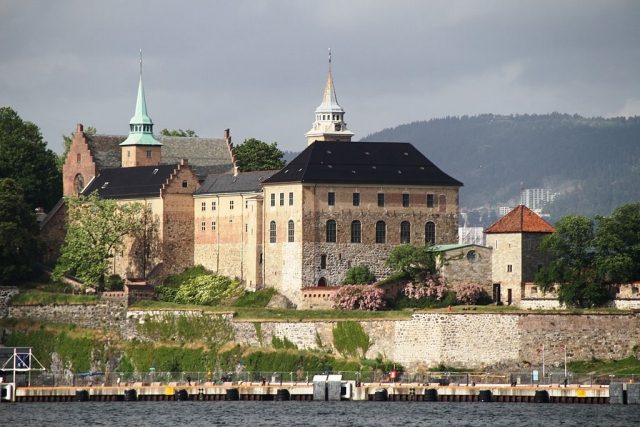
Akershus Fortress stands on the Akersnes peninsula on the eastern side of the Oslo Fjord in Oslo. It is an example of medieval defensive architecture and later transformations.
History+
Construction of Akershus Fortress began between 1299 and 1304 under King Håkon V. By 1308, it had proven its resilience by successfully withstanding a siege by Swedish troops under Duke Erik. Construction continued under Duke Erik Magnusson and was completed under Håkon VI. Christian II made initial modifications between 1506 and 1512, during his time as regent. A fire destroyed the northern part in 1527, yet the fortress resisted another siege by Christian II in 1531. After reconstruction, another unsuccessful Swedish siege occurred in 1567, which highlighted the need for modernization. Between 1593 and 1604, and again from 1616 to 1646, Akershus was reinforced according to Italian fortress design principles. Under Christian IV, the medieval castle was transformed into a Renaissance palace and served as a royal residence. From 1661, parliamentary assemblies were held here. For a long time, Akershus was used as a prison. In the late 19th century, the fortress fell into disrepair, leading to resistance against demolition plans. The painter Christian Krohg documented its condition, after which military use and prison function, along with expansion and restoration measures, were decided upon. German architects Wilhelm von Hanno and Heinrich Ernst Schirmer led the works from 1858 to 1870. Around the turn of the century, architect Peter Andreas Blix, based on studies by Professor Gustav Storm, initiated a renovation. Art historian Harry Fett contributed with studies for a conservation concept. In 1896, the Norwegian Parliament decided on further expansion and restoration under Blix. Architects such as Holger Sinding-Larsen, Arnstein Arneberg, and Johan Adolf Gerhard Fischer continued the work until approximately 1960. During World War II, Akershus served as a prison for political prisoners and an execution site. After the war, it was used for state festivities, and its restoration was completed in 1962. The last renovation took place in 2010.
Location+
Akershus Fortress is located in Oslo, the capital of Norway, in the district of Oslo within the Østlandet region. It stands at an elevation of approximately 20 meters above sea level.
On site+
Parts of the complex continue to be used for military purposes, housing, among others, the Norwegian Ministry of Defence. Visitors can also find the Norwegian Armed Forces Museum and the Norwegian Resistance Museum here. The crypt of the castle church serves as the burial site for modern Norwegian monarchs.
Take Mobile History with you
You are reading this text for free. Premium adds what matters on the road: descriptions read aloud, sites found through your camera, whole regions taken offline.
- Every description, including the ~17,700 Premium sites
- Audio guide: have descriptions read to you on location
- AR finder: see sites through your camera, with distance and bearing
- Unlimited saved sites
14 days free, then from €2.99 a month. Cancel anytime.
Source: Wikipedia · Licence: CC BY-SA 4.0
This description draws on the facts documented in the linked Wikipedia article; Wikipedia content is licensed under CC BY-SA 4.0. Wording and editing: Mobile History.
Location: 59.9066, 10.7362