FortressWillebroek

Fortress Antwerp-Fort Breendonk
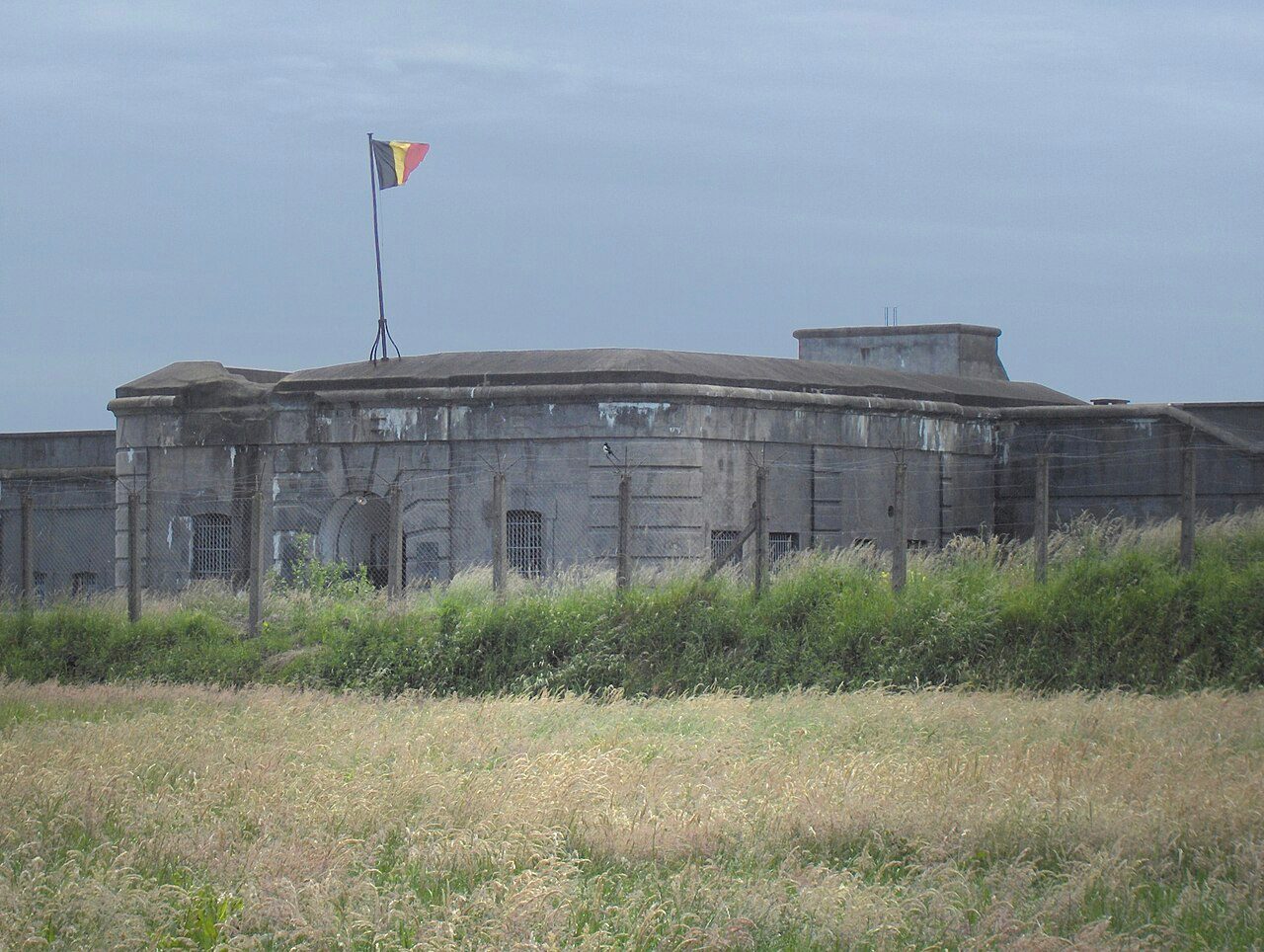
Fortress Antwerp-Fort Breendonk

The Fort can be visited

Fort Breendonk is a fortification built in 1906 as part of the second ring of defenses of the Réduit national around the city of Antwerp, Belgium. Originally one in a chain of fortresses constructed to defend Belgium against a German attack, Breendonk was near the town of the same name, about 12 miles southwest of Antwerp. It was covered by a five metre thick layer of soil for defense against bombings, a water-filled moat and measured 656 by 984 feet. The fort was used as a prison camp by the German occupiers during World War II. Today, the site is a national memorial (Nationaal Gedenkteken Fort van Breendonk in Dutch) and can be visited.

World War I+

Belgium was invaded in August 1914 by the German army after refusing its request of unhindered passage to northern France.

The invasion began on August 4, 1914. Eager to reach Paris as soon as possible, the German army concentrated all its efforts towards the south, ignoring Antwerp.

Continued Belgian resistance from the north forced German command to attack Antwerp. On September 9, General Beseler was ordered to attack Antwerp. Siege artillery was sent north, having precipitated the fall of Namur and Maubeuge.

Fort Breendonk was first attacked on October 1, 1914 by howitzers located 5 to 6 km out of range of the fort's own guns. The Germans breached Belgian lines in Lier. The German army could attack Antwerp while avoiding Fort Breendonk. On October 9, Fort Breendonk surrendered after the fall of Antwerp.

World War II+

The German army invaded and occupied Belgium in 1940. Fort Breendonk was obsolete and was no answer to mechanized warfare. The fort was briefly the headquarters of the Belgian command during the first weeks following the invasion, but was abandoned in the face of German advances.

The Nazis transformed Fort Breendonk into a prison camp. On September 20, 1940, the first prisoners arrived. Initially prisoners were petty criminals, people deemed anti-social, or trespassers of the new race laws. Later on, resistance fighters, political prisoners and innocent hostages were detained as well. Another section was used as a transit camp for Jews being sent to death camps such as Auschwitz.

German as well as Flemish SS units guarded this camp. Of the 300 prisoners that died in the camp, 185 prisoners were executed. Many of the rest died of torture or exposure. Most of those that did survive were transported to concentration camps. The execution poles and gallows are still there, as is a gruesome SS torture chamber. Contrary to popular belief, there were never any gas chambers at Fort Breendonk.

3,500 prisoners were incarcerated in Breendonk during its existence, of whom 1,733 died before liberation. Most of the non-Jewish prisoners were leftist members of the Belgian resistance or were held as hostages by the Germans. Several hundred people were murdered in the camp through torture, executions, and harsh conditions. In September 1941, the Belgian Communist prisoners were sent to the Neuengamme concentration camp.

Jewish prisoners in Breendonk were segregated from other prisoners until 1942. Thereafter, Jews were transferred to the Mechelen (Malines) transit camp in Belgium, or deported directly to the Auschwitz-Birkenau extermination camp in Nazi-occupied Poland. In total over 15 transports filled with mostly Jews left the camp; almost no one survived.

Upon arrival at the camp, new inmates were brought to courtyard where they would have to stand facing the wall until they were processed into the camp. They were forbidden to move and any motion was severely punished. In the camp, punishment consisted of beatings, torture in a specially designed chamber, hanging or execution by firing squad, either in the camp or nearby. The camp commander Lagerkommandant Philipp Schmitt was known to set his German Shepherd dog (called "Lump") loose on the inmates. His wife was also known to wander the camp, ridiculing the inmates and ordering punishments at whim. Severe and arbitrary beating occurred daily. Once an inmate, a Jewish boy of less than 20 years of age, was unable to continue working. The Flemish SS guards threw him into the moat, he could not swim and they refused to let him out. He struggled for over 15 minutes before finally drowning.

Inmates were forced to watch any executions that took place. They were only allowed to use the toilet, which was a large circular vat in the middle of one of the courtyards, twice a day, all together at the same time. They were only given five minutes to do their business. Any longer would mean punishment. But none of the inmates had a watch, so most left after only a minute or so in fear of surpassing their allotted time. This frequently caused bowel problems, cramps and diarrhea.

Breendonk II+

The officer of the British Army designated to liberate the camp late in 1944 was himself a German, Charles Arnold-Baker an officer of MI6. Fort Breendonk was briefly used as an internment camp for Belgian collaborators with the Nazi occupiers. This period of the Fort's existence is known as "Breendonk II". The internees were moved to Dossin Barracks, Mechelen, on 10 October 1944.

Trials of the Flemish SS guards, considered Nazi collaborators, were held during 1946 in Mechelen - including some guards and officials at Fort Breendonk. Of those who were convicted, 14 were sentenced to be executed by firing squad in 1947. 2 appealed their case and had their sentences revised to life imprisonment. 4 more people were sentenced to life in prison. 1 person to 20 years of prison. 1 person was acquitted. Two guards were sentenced to life but were never caught. The Nazi camp commandant, Philipp Schmitt, was tried in Antwerp in 1949 and sentenced to death. He was shot on the 9th of August 1950. He never showed any remorse and denied all of the atrocities that occurred at Breendonk, claiming he was merely reeducating the inmates as ordered.

Present memorial+

In 1947, Fort Breendonk was declared to be a national memorial, recognizing the suffering and cruelty that had been inflicted on the prisoners during World War II. The fort is now a well-preserved example of the prison camps operated by Nazi Germany during World War II.

Fort Breendonk is open to visitors all year round. It is located close to the A12 Brussels-Antwerp road.

Pictures of working Nazi interment camps during the war are rare and, for a long time, it was believed that absolutely no pictures of Breendonk during the war existed. But in the early 1970s a batch of photos of the camp was discovered in the possessions of Dutch photographer Otto Spronk. He had collected thousands of pictures and films of the Third Reich as part of his work for the SOMA, a Dutch organization that focused on preserving any material of wars. The collection consisted of 37 pictures depicting the daily order of events in the camp. Roll call, eating, forced labour, and even the SS officers going about their business, relaxed and cheerful as the inmates toiled on. There's even a picture of the Nazi camp commandant, Philipp Schmitt playing with his infamous dog 'Lump'. They were taken by German Nazi photographer Otto Kropf. They were taken for propaganda purposes but never used. All pictures are essentially cliché stills; none of the daily atrocities or horrors of the camp are shown. But they are the only reference material available. Several of the inmates on the pictures managed to survive the war and were able to identify the others on the pictures and the circumstances in which they were taken.

Take Mobile History with you

You are reading this text for free. Premium adds what matters on the road: descriptions read aloud, sites found through your camera, whole regions taken offline.

  • Every description, including the ~17,700 Premium sites
  • Audio guide: have descriptions read to you on location
  • AR finder: see sites through your camera, with distance and bearing
  • Unlimited saved sites

14 days free, then from €2.99 a month. Cancel anytime.

Source: Wikipedia · Licence: CC BY-SA 4.0 · Image: JoJan / CC BY-SA 3.0 via Wikimedia Commons

This description draws on the facts documented in the linked Wikipedia article; Wikipedia content is licensed under CC BY-SA 4.0. Wording and editing: Mobile History.

Location: 51.0564, 4.3414