Prison
FortressAsperg
Hohenasperg Fortress
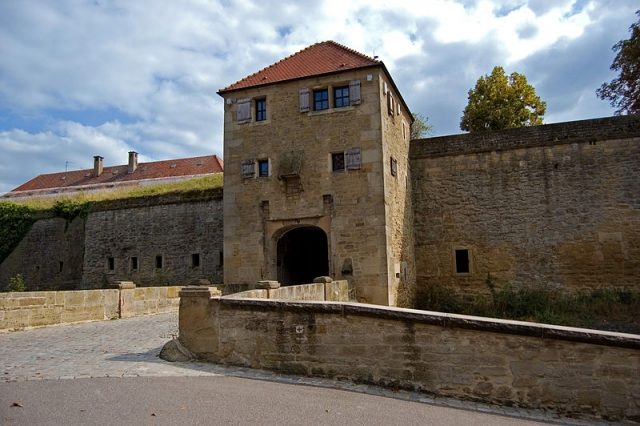
Hohenasperg, located in the federal state of Baden-Württemberg near Stuttgart, Germany, of which it is administratively part, is an ancient fortress and prison overlooking the town of Asperg. It was an important Celtic oppidum, and a number of very important "princely" burials are close by, in particular the Hochdorf Chieftain's Grave.
Geography+
Hohenasperg is located on a 90-metre-high Late Triassic hill. The hill is located in an upland area, but because of its steep overhangs and wide plateau, it is visible from a long distance and offers an ideal location for a fortification.
History+
Iron Age+
Around 500 BC, during the Hallstatt period, the Hohenasperg was a Celtic principality with a fortified settlement, known as a 'princely seat'. Numerous Celtic burial sites in the surrounding area are aligned so as to offer a line of sight to the Hohenasperg, e.g. the large Hochdorf Chieftain's Grave, the Ludwigsburg-Römerhügel grave, and the Grafenbühl grave on the Katharinenlinde by Schwieberdingen. Kleinaspergle, which has been well-known since an excavation in 1839, is a burial mound lying 1,000 metres south of Hohenasperg, which offers an exceptionally good view of the Hohenasperg.
Iron Age finds
Middle Ages+
Around 500 AD, after the victory of the Franks over the Alamanni, Hohenasperg became the seat of the Frankish Lord and Frankish Thing, the legislative assembly. At this time Hohenasperg was called "Ascicberg."
The first time Asperg was referred to was in the year 819, as the Shire Gozberg granted local suzerainty to Weissenburg Abbey in the Alsace. The location however achieved more importance in the 13th century with the founding of the independent town of Hohenasperg, which lasted until 1909.
Early Modern period+
Hohenasperg was officially chartered in 1510. In 1519, forces of the Swabian League under George von Frundsberg laid siege to Hohenasperg where Duke Ulrich of Württemberg was holding out. On 12 May 1525, the peasant leader, Jäcklein Rohrbach, was taken prisoner by the governor of Asperg. He was held there until the surrender of the Steward of Waldburg-Zeil. After 1535, the castle was expanded and turned into a fortress. The residents were resettled at the foot of the hill. Between 1634 and 1635, during the Thirty Years War, the castle was defended against imperial troops by a garrison of Protestants from Württemberg, reinforced by Swedish forces. The siege ended finally with the surrender to the imperial troops, who occupied the fortress until 1649. After the Thirty Years War, the fortress was returned to the rule of Württemberg. In 1688 and 1693, it was occupied by French troops; afterwards it lost its importance as a defensive fortress and became a garrison and a state prison. In 1718, Asperg was integrated into the district Ludwigsburg, but 17 years later became its own district. In 1781, Asperg was permanently incorporated into the district of Ludwigsburg.
Prisoners+
The use of the fortress as a prison is responsible for the fact that Hohenasperg is jokingly referred to as "Württemberg's highest mountain" as they say "it takes only five minutes to come to the top, but years to come back down again."
Holy Roman Empire+
In 1737, Joseph Süß Oppenheimer, a Jew and the financial adviser to the Duke of Württemberg, was arrested and held at Hohenasperg for seven months before being executed in Stuttgart. The poet C. F. D. Schubart was held prisoner there between 1777 and 1787; Friedrich Schiller was mindful of Schubart's fate when he wrote his play "The Robbers," inspired by one of Schubart's short stories. Schiller himself escaped imprisonment in the Hohenasperg by fleeing to Mannheim in the neighboring Electorate of the Palatinate.
19th century+
During the rule of King Frederick of Württemberg, deserters, military prisoners, and separatists from the Radical Pietist group from the circle of Rottenacker were kept at Fort Hohenasperg. By 1813, about 400 prisoners were arrested on the fortress. When his son King William I of Württemberg became ruler in 1817, corporal punishment, such as running the gauntlet, was abolished.
Source: Wikipedia · Licence: CC BY-SA 4.0 · Image: http://de.wikipedia.org/wiki/Datei:Festung_Hohenasperg_01.jpg
This description is an excerpt from the linked Wikipedia article and was written by its authors. Like the original it is licensed under CC BY-SA 4.0 and may be reused under the same terms.
Location: 48.9103, 9.1383