To be privately owned
Fortress Koblenz-Luisenturm

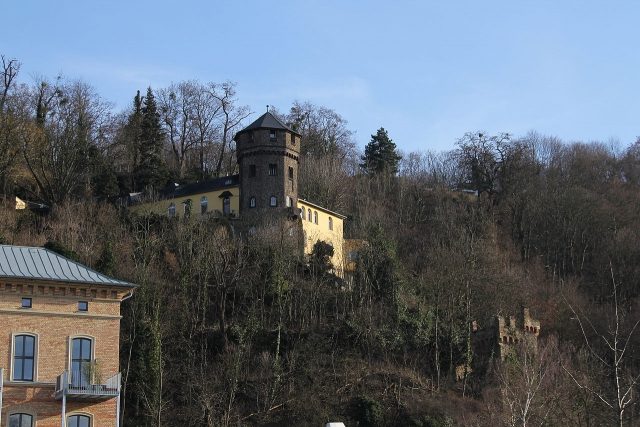
The Luisenturm (Luise Tower) is a tower of the former Prussian city fortifications of Ehrenbreitstein, which is now a district of Koblenz. It was built in 1856 according to plans by Karl August von Cohausen on the steep slope of the Asterstein and belonged to the Niederehrenbreitstein system of the Koblenz Fortress, built at the beginning of the 19th century. The tower was named after the Prussian Princess Luise.
In the course of the expansion of the Ehrenbreitstein city fortifications, Karl August von Cohausen planned an octagonal tower with battlements in 1855 in the section between Asterstein and the Pfaffendorfer Tor for aesthetic reasons. After a tower at this location had been repeatedly rejected as unnecessary by the Ministry of War, von Cohausen finally succeeded in obtaining a building permit from King Friedrich Wilhelm IV by associating it with Princess Luise. The construction of the building was completed in 1856, and the interior work followed in 1857. The installation of a cast-iron spiral staircase from a Frankfurt art foundry inside the tower marked the end of the expansion. It was named in honor of Princess Luise, in memory of her engagement to the Baden Grand Duke Friedrich I in 1856.
After the abandonment of the city fortifications in 1890, the city of Ehrenbreitstein bought the tower to resell it. It was not until 1908 that it was finally able to sell the property, including the Luisenturm, to the Privy Councillor of War Joseph Dornbach. His son, the painter Hans Dornbach, added two wings to the south and east of the tower in 1920. With the conversion into a residential house with a studio, the cast-iron staircase was moved to the outside. During an air raid on Koblenz in 1944, the tower and studio burned out, destroying 170 paintings by the artist. Reconstruction took place from 1945–1947, during which the open tower floor received a tent roof over the battlements. Around 1980, a small extension was built on the south wing. The last renovation took place from 1985–1987.
Construction+
The Luisenturm is an octagonal four-story building made of quarry stone. The architectural elements consist of black basalt. The windows are round-arched, on the third floor as biforium windows with basalt columns and imposts. On the second floor, a cantilevered balcony is attached on the Rhine side. The uppermost floor with corner battlements is provided with small round arches and is slightly cantilevered. Windows were installed here by adding the tent roof. Between the second and third floors, a Prussian eagle is attached on the Rhine side. On the opposite side, the second floor is accessed by an attached polygonal stair tower with a cast-iron spiral staircase in neo-Gothic style. Inside the house, a keystone depicting the Mother of God with child is attached to the outer tower wall. It comes from the Dominican Church, which was destroyed in World War II.
Parts of the crenellated city wall of Ehrenbreitstein are preserved on the property. In the garden, baroque fountain basins, rocaille vases, volute cheeks, and a lion relief are displayed, presumably originating from the gardens of Philippsburg Castle, which was destroyed in 1801.
In memory of the engagement of Grand Duke Friedrich I to Luise, a commemorative plaque is embedded in the tower:
- „The Luisenturm I am called / Because I arose before your eyes / And stretch the bond of memory / When you moved to the neighboring land / God bless you and your kin. A.D. MDCCCLVI.“
Take Mobile History with you
You are reading this text for free. Premium adds what matters on the road: descriptions read aloud, sites found through your camera, whole regions taken offline.
- Every description, including the ~17,700 Premium sites
- Audio guide: have descriptions read to you on location
- AR finder: see sites through your camera, with distance and bearing
- Unlimited saved sites
14 days free, then from €2.99 a month. Cancel anytime.
Source: Wikipedia · Licence: CC BY-SA 4.0 · Image: http://de.wikipedia.org/wiki/Datei:Luisenturm_Koblenz-Ehrenbreitstein_2012.jpg
This description draws on the facts documented in the linked Wikipedia article; Wikipedia content is licensed under CC BY-SA 4.0. Wording and editing: Mobile History.
Location: 50.3571, 7.6123