The Fort can be visited
FortressKostrzyn (Küstrin)
Küstrin Fortress - Fort Zorndorf
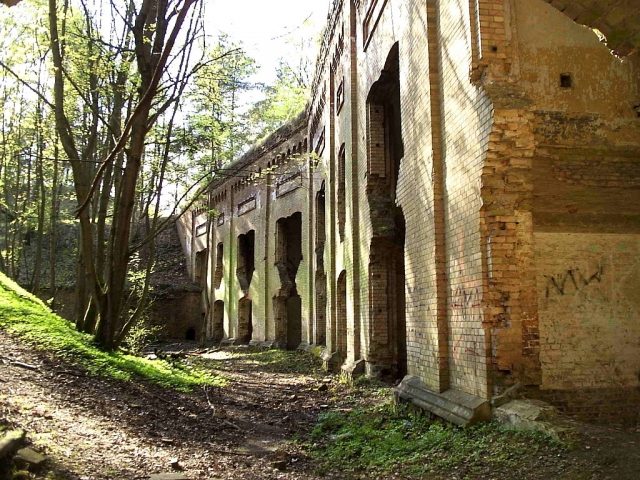
The Küstrin Fortress was a fortress built in the second half of the 16th century to protect the residential city of Küstrin in the then Margraviate of Brandenburg-Küstrin. Since the 18th century, due to its location at the confluence of the Warta into the Oder, and through the expansion of waterways around Berlin, combined with the acquisition of Silesia, it held the key eastern position for the defense of the central landscape of the Brandenburg-Prussian state. In connection with the Küstrin Fortress and its outer fort structures, the term Küstrin Fortress Ring is also used for areas west of the Oder. The great importance of the fortress is evidenced by the fact that its existence was only ended in 1920 by the victorious powers of the First World War through the Treaty of Versailles. Shortly thereafter, the demolition of the eastern city wall began. Towards the end of the Second World War, Küstrin was again declared a fortress in 1945, and the city was almost completely destroyed by fighting until the end of March 1945. Since the end of the war, the part of the fortress structures on the right bank of the Oder lies in Polish Kostrzyn nad Odrą, while the remaining outer works are in the German municipality of Küstriner Vorland. The fortress structures located in Poland, which were already damaged, have been further destroyed by demolitions and dismantling for material extraction. Since the 1990s, the fortress facilities in the old town and the Fort Gorgast, which was spared from war damage, have been undergoing restoration, while the other outer works are decaying due to vacancy.
Before 1535: Prehistory+
The first documented mention of Küstrin dates back to 1232. Küstrin was strategically located at the confluence of the Oder and Warta. To protect the Oder crossing, there was probably a fortification at this location. In 1323, the Ascania rule ended, and Küstrin changed owners several times until 1455. Then it was sold to Frederick II of Brandenburg and thus belonged to the House of Hohenzollern. In 1535, Johann von Brandenburg-Küstrin inherited Küstrin, among other things, and elevated it to his residence.
1535–1920: Fortress Status+
Johann began the expansion of his residence with the construction of Küstrin Castle, which lasted from 1535 to 1537. Subsequently, construction work for the fortress began. The fortifications built from 1537 to 1543 had earth ramparts, which were repeatedly undermined by floods. After a several-year construction interruption, the ramparts were therefore reinforced with masonry from 1553 to 1568, and the newly erected areas were immediately built in masonry. In 1568, the fortress was completed. At that time, it included the bastions König, Königin, Kronprinz, Kronprinzessin, and Philipp, as well as the Berliner Tor and Zorndorfer Tor as city gates. Furthermore, there were the Kietzer Pforte and the Mühlenpforte for pedestrian access. Among the fortress builders active in Küstrin in the 16th century were Francesco Chiaramella and, after him, Rochus zu Lynar, to whom the masonry bastions of the city fortifications are attributed.
During the Thirty Years' War (1618–1648), the Swedish King Gustav II Adolf moved south up the Oder from July 1630. By constructing a field fortification on the left bank of the Oder opposite Küstrin, he controlled the Oder crossing and ship traffic. At the insistence of the Swedes, Brandenburg had to hand over Küstrin to Swedish administration in June 1631. The Swedes immediately began further expansion of the fortress, which was later continued by Elector Frederick William. Between 1631 and 1688, the bridgehead on the left bank of the Oder, the hornwork, and the Brandenburg bastion on the right bank of the Oder between the König and Philipp bastions were built. In addition, the defense of the eastern fortress walls was strengthened by the construction of several redans and the ravelins Gohrin, Albrecht, August-Wilhelm, and Christian Ludwig. A batardeau at the Philipp bastion completed the moat. Küstrin was now one of the strongest fortresses in Germany. Among the prisoners was Aegidius Strauch II, whom Elector Frederick William of Brandenburg had captured by sea from Danzig to Hamburg in October 1675 and imprisoned in the fortress. Strauch was hated by him as a Lutheran zealot against the Reformed confession and a supposed partisan of Sweden. The King of Poland, the King of Sweden, the Elector of Saxony, his relatives, and many other supporters advocated for Strauch's release. A delegation of citizens from Danzig achieved his release on July 9, 1678. In Danzig, tens of thousands of supporters welcomed him, and all Lutheran churches held services for his liberation. The Danzig Council reinstated him in his offices on September 8, 1678. King Frederick William I had his son Crown Prince Frederick, later King Frederick II, imprisoned in Küstrin Castle after his escape attempt in September 1730. There, on November 6, 1730, Frederick had to watch his lover, the Prussian lieutenant Hans Hermann von Katte, be beheaded by order of the king. In April 1732, Frederick's custody in Küstrin ended. In the Seven Years' War, Russian troops besieged Küstrin from August 15 to 18, 1758. The city, largely built of wood, burned down completely without the fortress being conquered. Frederick II relieved the fortress and defeated the Russians on August 25, 1758, east of Küstrin in the Battle of Zorndorf. In the Fourth Coalition War in 1806, Frederick William von Ingersleben surrendered Küstrin to vastly inferior Napoleonic troops without a fight, apart from a brief skirmish at the western bridgehead and the destruction of the Oder bridge. Ingersleben deserted, was sentenced to death in absentia in 1807, and, unlike in other cases, was not pardoned by the king. Küstrin remained occupied by the French until 1814, who further expanded the fortress. After Napoleon's defeat in the Russian campaign of 1812, at the beginning of the Wars of Liberation in March 1813, Küstrin was first shelled by Russian troops. The French burned down the Lange and Kurze Vorstadt as well as the Kietz on the Oder island for strategic reasons. Since the fortress could not be stormed, Russian, and later Prussian, troops blockaded it until its capitulation in March 1814. In the 19th century, the fortress was again expanded to protect it against longer-range artillery. On the Oder island, the bridgehead was expanded and supplemented with two flanking lunettes. From 1850 to 1862, lunettes B on the Oder island and lunettes C and D on the left side of the Oder were built. From 1863 to 1872, the independent Fort "Neues Werk" was built at Küstrin-Neustadt station (today's Kostrzyn station). In 1877/78, the gatehouses at the Berliner and Zorndorfer Tor were demolished and rebuilt as city gates with a double passage. At the same time, the powder towers were removed and replaced by powder magazines outside the city. The road bridges and railway bridges over the Oder and Warta were secured by blockhouses. The construction work concluded with the building of the four outer forts, as Biehler's standard fort: Fort Gorgast and Fort Zorndorf (1882, near Sarbinowo), Fort Säpzig (1887, near Żabice), and Fort Tschernow (1882–1885, near Czarnów). However, these forts were already militarily obsolete upon their completion due to the high-explosive shell crisis, as they could not withstand direct shelling, and the range of artillery was so great that direct shelling of Küstrin would have been possible. Outside the city, shortly before the First World War, a few smaller shelters were still built to allow for flexible deployment of troops in case of defense. The fortress facilities significantly hindered the development of the city. Towards the end of the 19th century, however, the facilities became more permeable. The Küstriner Pforte was replaced in 1887 by the much wider Küstriner Tor, through which wagons could now also pass. Around 1901, the removal of the Oder ramparts at the castle already began. Even before the First World War, there were plans to remove the ramparts, but this could only be implemented years later. The end of its use as a fortress occurred in 1920, when, by order of the Inter-Allied Military Control Commission, the stationed guns and weapons had to be withdrawn. Küstrin lost its importance as a garrison due to the personnel restrictions of the Reichswehr.
From 1920: Coup Attempt, Fortress in World War II, and Subsequent Use+
In the interwar period, the fortification on the east side of the old town was demolished, first the Zorndorfer Tor and the Kronprinzessin bastion in 1921, then from 1925 the Königin bastion and the Albrechtstor. At the same time, the moats were filled in so that a new road (today's DK 22) could be routed around the old town. After 1929, the green areas of the Kattewall were created on the ramparts on the Oder bank. The Casemate Museum was opened in the Philipp bastion. From 1930 to 1931, the Kronprinz bastion – also called Hoher Kavalier – was demolished. The outer works were partially rented out and used by, among others, tradespeople. In 1923, a coup attempt occurred, which was named the Küstrin Putsch. Adolf Hitler declared Küstrin a fortress on January 25 or 26, 1945, towards the end of World War II, to halt the advance of the Red Army on Berlin. A few days later, he appointed Heinz Reinefarth, a fanatical police officer, as "Fortress Commander" of the Küstrin Fortress. At the conclusion of their Vistula-Oder Operation, Soviet troops reached the Oder near Küstrin in early February 1945 and formed bridgeheads on the western bank. During the fighting, which lasted until the end of March, Küstrin was almost completely destroyed. The bridgehead near Küstrin became the most important starting point for the Soviet army in the offensive on Berlin on April 16, 1945. The larger part of Küstrin (formerly located on both sides of the Oder) was annexed to Poland after the end of World War II in 1945, while the part of the city area west of the Oder today belongs as a district Küstrin-Kietz to the Brandenburg municipality of Küstriner Vorland. After the war, Russian troops rendered the outer forts militarily unusable by partial demolition. Other areas, such as the Neues Fort, were completely or partially removed to obtain building materials. Fort Gorgast later served the National People's Army as a warehouse. After 1989, it became possible to use some fortress structures for tourism. The deserted old town and thus also the existing ramparts on the Oder bank between the Berliner Tor and the Küstriner Tor are again accessible. Fort Gorgast can also be visited. The other structures are ruins.
Take Mobile History with you
You are reading this text for free. Premium adds what matters on the road: descriptions read aloud, sites found through your camera, whole regions taken offline.
- Every description, including the ~17,700 Premium sites
- Audio guide: have descriptions read to you on location
- AR finder: see sites through your camera, with distance and bearing
- Unlimited saved sites
14 days free, then from €2.99 a month. Cancel anytime.
Source: Wikipedia · Licence: CC BY-SA 4.0 · Image: http://de.wikipedia.org/wiki/Datei:Sarbinowo_fort.jpg
This description is a machine translation of an excerpt from the linked Wikipedia article. The source text was written by its authors, the translation is by Mobile History; like the original it is licensed under CC BY-SA 4.0.
Location: 52.6215, 14.6672