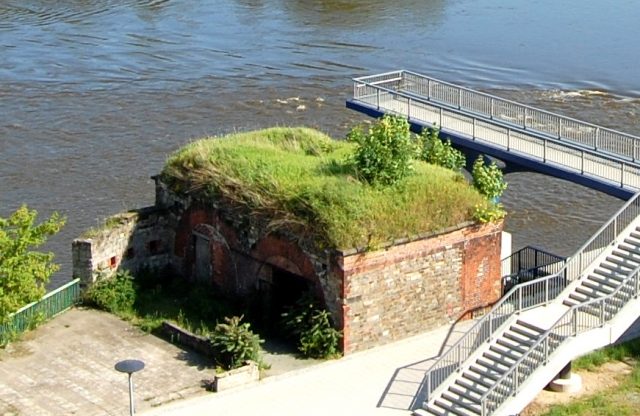
The remains of the fortress can be visited
Fortress Magdeburg-Old Leipzig Gate
From the beginning of the 18th century until 1912, the Fortress of Magdeburg was one of the strongest fortresses in Prussia.
Development up to the Thirty Years' War
The first fortifications of Magdeburg can be traced back to the 13th century. At that time, the city walls ran around the area of today's northern Old Town between Krökentor and Otto-von-Guericke-Straße, and immediately south of the Cathedral. Remains are preserved in the area of Wallonerkirche - Tränsberg. Due to the development of firearms, the existing fortifications could no longer withstand enemy attacks. Therefore, extensive reconstruction and expansion work on the city's fortifications took place in Magdeburg between 1450 and 1550. This included, among other things, the new construction of wall sections, the erection of a second city wall and a new moat, the first-time fortification of the Elbe front, and the construction of new city gates with gun towers. In addition, the fortifications were also extended to the eastern bank of the Elbe. The thus reinforced fortification proved its worth during the unsuccessful siege of 1550/51 on the occasion of the execution of the Imperial Ban in connection with the introduction of the Lutheran Reformation. The Magdeburg fortress also withstood the siege of 1629 during the Thirty Years' War. In the further course of the war, the fortification was expanded from 40 to up to 150 meters in depth under the direction of the Swedish Colonel Dietrich von Falkenberg. Redoubts and hornworks were erected in front of the gates. However, since the expansion of the southern front was neglected, imperial troops succeeded in taking the city at this point in 1631. The fortifications were razed on the orders of General Pappenheim.
Prussia's Strongest Fortress
Until the end of the war, the fortunes of Magdeburg were directed by the Archbishopric of Magdeburg, after which the city came under the rule of Brandenburg-Prussia. Elector Frederick William ordered the repair of the fortifications in 1666. Work began with the reinforcement of the Elbe front, which led to the creation of the bastions Cleve and Preußen. A parapet was erected in front of the city moat, and a citadel of about 800 m² was built on the Elbe island of Werder. In 1702, a second phase of expansion began, under the direction of Magdeburg's governor Prince Leopold I of Anhalt-Dessau. By 1713, a belt of eleven bastions had been created. In a third construction phase, under the fortress builders Hans Martin von Bosse and Gerhard Cornelius von Walrave, another eleven bastions were built, as well as the Turmschanze and Fort Berge. Around 1740, the fortifications of the northern front were staggered to a depth of 400 meters, the western front 600 meters, and the southern front between 300 and 600 meters. The entire defensive system covered an area of 200 hectares, compared to 120 hectares of urban area.
Fortress Expansion in the 19th Century
Although Magdeburg was subsequently considered Prussia's strongest fortress, Magdeburg surrendered almost without a fight to Napoleonic troops during the Fourth Coalition War in 1806. In 1807, Magdeburg was incorporated into the French Kingdom of Westphalia, and the city became an important link in the French Elbe defense line. The most important measure for the further expansion of the fortifications was the enlargement of the glacis, which was accompanied by the relocation of the suburbs of Neustadt and Sudenburg. Their former area was declared a free firing zone, or "rayon." During the Wars of Liberation from 1813 to 1815, Magdeburg withstood the sieges by Prussian-Russian troops. After Napoleon's defeat, Prussian troops re-entered the city on May 24, 1814. With the introduction of the New Prussian Fortress Style, the Fortress of Magdeburg underwent a renewed expansion and reconstruction of its defensive installations. The ramparts were modernized, the Elbe riverbank was further fortified, and fortress gates were newly built or rebuilt. Numerous military buildings such as barracks and magazines were constructed within the fortress. The railway line Magdeburg–Leipzig, completed in 1840, and the creation of further railway connections brought profound changes to Magdeburg's defense system. To allow the railway lines to enter the city, new railway gates had to be built, of which the Alte Leipziger Tor was the first to be completed in 1840. By 1873, a total of eight railway gates had been built in the fortress belt. With the introduction of the "rifled gun barrel," the necessity for further expansion of the fortifications arose again. For this purpose, a belt of 14 forts was built starting in 1866, located at a distance of 1000 to 3000 meters from the core fortress. After the rayon area had been extended, the construction of eight intermediate works began in the fort belt from 1890 onwards.
Dismantling of the Fortress
After the general dismantling of fortresses in Germany had already been decided with the imperial cabinet order of December 8, 1886, the fortress status of Magdeburg was lifted with the cabinet order of January 23, 1900, and the fortress area was released for sale. The city used the abandonment of the fortifications to acquire most of the land for the expansion of residential development and the improvement of infrastructure. In the north, the connection to Neustadt, incorporated in 1886, was created; in the west, Wilhelmstadt was developed, and the development in the south established the connection to Buckau, incorporated in 1887. The demolition of the city gates had already begun in 1888. The two largest fortifications, Fort Stern and the Citadel, were demolished in 1903 and 1922, respectively. Only large parts of the fortress buildings of the western front remained. Five forts were completely removed, while the others were initially converted for civilian use. After World War II, only remnants of these also remained.
Alte Leipziger Tor
The Alte Leipziger Tor was a railway fortress gate of the Fortress of Magdeburg and parts of it have been preserved.
It is the oldest railway fortress gate built in Germany and was constructed with the building of the first Prussian railway line Magdeburg–Leipzig by the Magdeburg-Leipziger Eisenbahn-Gesellschaft between 1837 and 1840.[1] Since Magdeburg, as a fortress city, was completely surrounded by fortifications, the railway had to be led into the fortress through its own militarily secured gate. A three-part gate was created, situated between two casemates. The eastern casemate was built into the Elbe, which flows over the Domfelsen here. West of the gate, immediately south of Magdeburg Cathedral, lay the Cleve Bastion. In front of the gate was a moat with a drawbridge, which, however, was removed before 1870.
The eastern casemate battery, built of rubble masonry and now a protected monument, has been preserved. Inside are brick vaults. The structure is covered by an earth covering. The eaves cornice is made of ashlar.
The structure is located in Magdeburg's Old Town, east of the Schleinufers directly on the Elbe.
Take Mobile History with you
You are reading this text for free. Premium adds what matters on the road: descriptions read aloud, sites found through your camera, whole regions taken offline.
- Every description, including the ~17,700 Premium sites
- Audio guide: have descriptions read to you on location
- AR finder: see sites through your camera, with distance and bearing
- Unlimited saved sites
14 days free, then from €2.99 a month. Cancel anytime.
Source: Wikipedia · Licence: CC BY-SA 4.0 · Image: http://commons.wikimedia.org/wiki/File:S%C3%BCdliches_Festungstor.JPG
This description draws on the facts documented in the linked Wikipedia article; Wikipedia content is licensed under CC BY-SA 4.0. Wording and editing: Mobile History.
Location: 52.1232, 11.6365