The Gate can be visited
Fortress Mainz-Gonsenheimer Tor

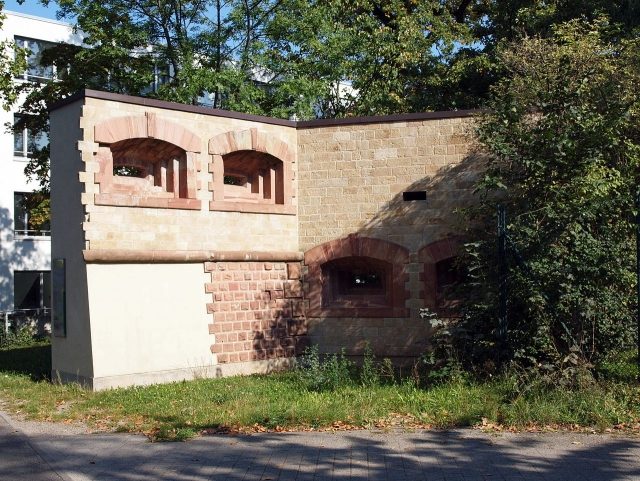
The Gonsenheimer Tor is a former fortress gate of the Mainz Fortress and is located in the Hartenberg-Münchfeld district.
The Gonsenheimer Tor was part of the Rheingauwall, which was intended to militarily secure the expansion of the city of Mainz after the Franco-Prussian War. The gate was located west of the old fortress between Fort Hartenberg and Kavalier Judensand and formed the sally port to Gonsenheim and the flood-proof roads to the west. The current street Am Fort Gonsenheim led through the gate. It was located at the highest topographical point of the Rheingauwall and was built as early as 1872, shortly after the war. In further expansion stages until 1877, an embankment with a parallel ditch and elevated positions in the form of cavaliers was created. The gate was one of the few passages of the new wall and was located next to the Mombacher Tor in the valley and other northwestern passages.
Description and Architecture+
The Gonsenheimer Tor was a gate system with separate passages for vehicular and pedestrian traffic. To secure the gate, barrel-vaulted casemates were located to its right and left, illuminated by large arched windows from the city side. On the field side, there are double-story firing openings on both sides of the passages, the lower ones of which were only just above the bottom of the ditch. An increased defensive effect was achieved by a bridge spanning the upstream ditch, made of steel double-T girders, which could be quickly dismantled in case of war. Inward, the gate was additionally secured by a drawbridge. Passively, the gate was protected by a massive earth cover as protection against artillery fire.
The gate has a total width of 35 meters. It was not adorned with a show facade, but the ashlar cladding consisting of sandstone frames, lintel arches, rusticated corner blocks, and profiled cornices shows high craftsmanship.
Rediscovery+
The fortress gate was demolished at the beginning of the 20th century, as an additional defensive ring became necessary due to improved artillery technology. In 1904, the city was decommissioned as a fortress. By order of Emperor Wilhelm II, many of the fortifications and city gates were demolished by 1912, including the Gonsenheimer Tor. The upper part of the gate was demolished, lower parts were backfilled, covered, and everything leveled.
During construction work for a new Südwestrundfunk building including an underground car park in 2003, remains of the lower part reappeared. After negotiations with the city and the state monument authorities, SWR took over the sponsorship and responsibility for restoring the structure, albeit about 40 meters from its former location. A wall plaque provides information about the monument.
Take Mobile History with you
You are reading this text for free. Premium adds what matters on the road: descriptions read aloud, sites found through your camera, whole regions taken offline.
- Every description, including the ~17,700 Premium sites
- Audio guide: have descriptions read to you on location
- AR finder: see sites through your camera, with distance and bearing
- Unlimited saved sites
14 days free, then from €2.99 a month. Cancel anytime.
Source: Wikipedia · Licence: CC BY-SA 4.0 · Image: http://commons.wikimedia.org/wiki/File:Gonsenheimer_Tor.jpg
This description draws on the facts documented in the linked Wikipedia article; Wikipedia content is licensed under CC BY-SA 4.0. Wording and editing: Mobile History.
Location: 50.0036, 8.2476