Cultural center
Museum
The Fortress can be visited
Fortress Mainz-Reduit

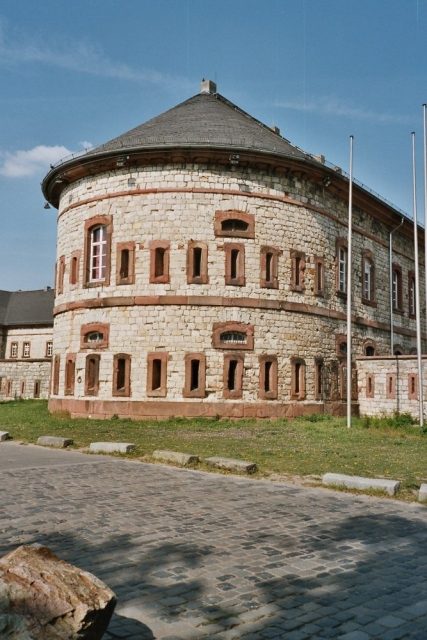
The building now called "die Reduit" in Mainz-Kastel originally served as the Reduit barracks of the Kastel bridgehead of the Federal Fortress of Mainz (due to the colloquial shortening of the original designation, the Reduit is now commonly referred to as "die Reduit" in Mainz and Wiesbaden). The work is now located in the Wiesbaden district of Mainz-Kastel between the Rhine and the (former) Taunus railway directly at Mainz-Kastel station.
The Reduit barracks on the Rhine bank were erected shortly after the completion of the main rampart of Kastel, which was redesigned and reinforced between 1828 and 1830, between 1830 and 1834 by Austrian pioneers according to plans by Engineer General Franz Scholl under the direction of Engineer Captain Christoph von Pittel next to the then pontoon bridge over the Rhine (near today's Theodor-Heuss-Brücke). It consists of a massive, two-story barracks designed for defense with crenellated (i.e., loopholed) walls on the outer sides for close defense of the work. Its slightly bastioned front with two long faces meeting at an obtuse angle and two short flanks is oriented to the north towards the land side. The Reduit barracks were founded on a pile grating of 1800 oak piles. On the gorge side on the Rhine bank, separated from the actual barracks by an enclosed courtyard, there is a detached caponier, which is only connected to the flanks of the defensible barracks by a freestanding crenellated wall. The entire work thus acquires the ground plan of a slightly irregular lunette. Directly behind the caponier was the access to the pontoon bridge to Mainz, which was thus completely covered by the Reduit barracks. From the opposite bank of the Rhine, the work and the pontoon bridge were only covered by the small "Eisenthor Batterie" (this was located approximately where today's Mainz City Hall stands) and flanked by the Lower Redoubt of the Rheinschanze on the (island) Maaraue.
The keystone of the gate in the right face of the barracks building is a Medusa head, flanked on the right and left by an olive branch and a laurel branch respectively. Above the outside, between victory trophies, rests a lion holding a fasces in its claws. Above it is armor with six flags indicating the German Federal Army. Below it, in lapidary script, is "Cura confoederationis conditum MDCCCXXXII".
At the time of the German Confederation, Prussian and Austrian soldiers formed the garrison of the Federal Fortress of Mainz. Around 1900, the 2nd Nassau Infantry Regiment No. 88 of the 21st Division was stationed there.
Current use of the work+
During World War II, the Reduit was damaged, but was repaired (though not fully restored) in the 1950s and 1960s. Today, it houses several Kastel associations, as well as a youth center and the Kastel local history museum Museum Castellum. The inner courtyard is used in summer for open-air cinemas, concerts, and other events.
Take Mobile History with you
You are reading this text for free. Premium adds what matters on the road: descriptions read aloud, sites found through your camera, whole regions taken offline.
- Every description, including the ~17,700 Premium sites
- Audio guide: have descriptions read to you on location
- AR finder: see sites through your camera, with distance and bearing
- Unlimited saved sites
14 days free, then from €2.99 a month. Cancel anytime.
Source: Wikipedia · Licence: CC BY-SA 4.0 · Image: http://de.wikipedia.org/wiki/Datei:Bundesfestung_Mainz_Kastel.jpg
This description draws on the facts documented in the linked Wikipedia article; Wikipedia content is licensed under CC BY-SA 4.0. Wording and editing: Mobile History.
Location: 50.0065, 8.2813