The remains of the fortress can be visited
FortressProwadija (Провадия)
Ovech (Овеч) Fortress
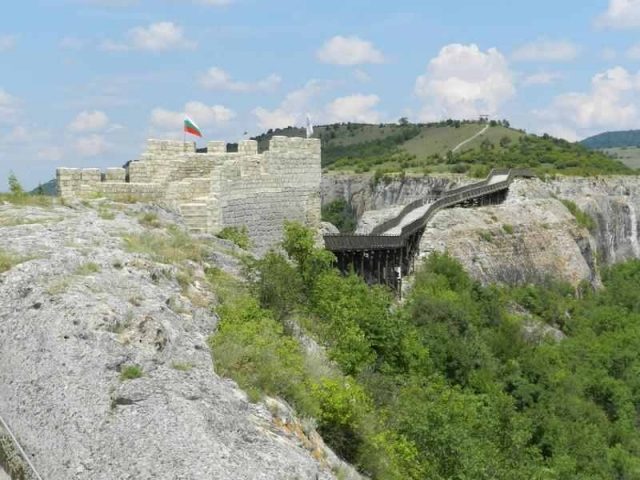
The Ovech Fortress, a historical complex, overlooks the city of Provadia in Bulgaria. Surrounded by steep cliffs on all sides.
History+
The origins of Ovech Fortress date back to the 4th century AD, being used until the 7th century before a hiatus of about a hundred years. From the 9th century, the complex was re-inhabited. The Byzantines knew it as Provach, meaning “Sheep Fortress,” while the Bulgarians called it Ovech – a direct translation of the Greek name. Under Ottoman rule, it bore the name Tash Hisar. The geostrategic location, particularly its proximity to the early Bulgarian capitals of Pliska and Preslav, fostered the development of the settlement that emerged next to the fortress, which also became an episcopal see after the Christianization of the Bulgarians. The Bulgarians expanded the fortress inland to prepare for Byzantine attacks from the sea, as Varna, although Bulgarian since 681 AD, was difficult to defend. In 1278, two Byzantine armies suffered a defeat against the Bulgarian Tsar Ivaylo near the fortress. It was not until 1202, under Tsar Kaloyan, that Varna finally became Bulgarian. The fortress was also used by Tsar Kaloyan and his brother Petar II. In 1366, three knights, including the Marshal of Burgundy, were imprisoned here and ransomed for a high price. In 1388, the fortress fell after a siege by 30,000 Ottomans under Lala Shahin. Following a Bulgarian uprising, it was back in Bulgarian hands for about three years from 1409. By the end of the 17th century, the fortress was finally abandoned, as it lay deep within the Ottoman Empire and had lost its military significance.
Location+
Ovech Fortress is located at an elevation of approximately 143 m above sea level near the city of Provadia, in the Provadia district, in the Varna region of Bulgaria.
Take Mobile History with you
You are reading this text for free. Premium adds what matters on the road: descriptions read aloud, sites found through your camera, whole regions taken offline.
- Every description, including the ~17,700 Premium sites
- Audio guide: have descriptions read to you on location
- AR finder: see sites through your camera, with distance and bearing
- Unlimited saved sites
14 days free, then from €2.99 a month. Cancel anytime.
Source: bulgariatravel.org · Image: http://www.wehrbauten.de
Text and/or image for this object come from the linked site and are used with the permission of its operators; the linked page remains the copyright of its authors. The legacy catalogue kept text source and image source in a single field, so which part came from there can no longer be told apart entry by entry.
Location: 43.1731, 27.4475