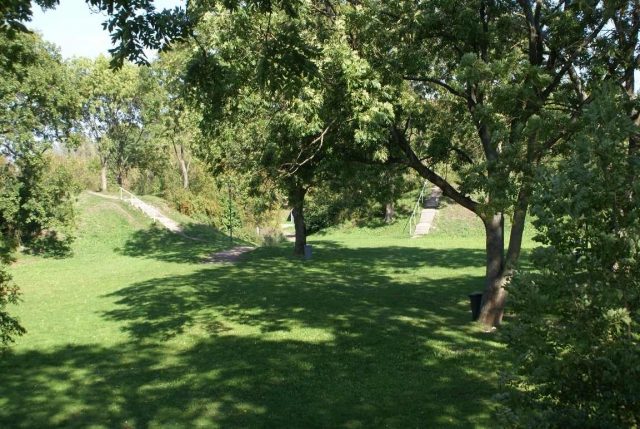
The remains of the fortress can be visited
Poel Fortress

In 1614 Duke Johann Albrecht II (Mecklenburg) started the construction of a fortress on the island in the vicinity of the church, making use of the strategically good location. In 1618 it was completed. In June 1620 Gustavus Adolphus II of Sweden visited his cousin Duke Johann Albrecht II here, and in September of that same year his bride-to-be, Princess Maria Eleonora of Brandenburg, visited the island and stayed at the castle on the way to her marriage in Stockholm. She was received by Duke Johann Albrecht II with a festive worship service in the church and will a feast that went on for several days. During the Thirty Years' War the Duke had to give up the castle to enemy imperial troops (= Catholic coalition) in 1628. General Wallenstein ruled over Mecklenburg for several years. In 1631 Gustav Adolf helped the dukes of Mecklenburg regain their power, and Johann Albrecht II returned to Poel finding the castle in a desolate condition. When Mecklenburg signed a truce with Emperor Ferdinand II (Holy Roman Empire) in 1635, the Swedes invaded the land and took over the castle on Poel. The emperor's troops returned in 1638, drove the Swedes away and burned several villages. After the Treaty of Westphalia in 1648 two-thirds of Poel together with Wismar and the municipality of Neukloster were granted to the King of Sweden. The western third of the island remained the property of the Holy-Spirit-Hospital (Heiligen-Geist-Hospital) in Lübeck which had already had this endowment for several centuries. The Swedes were in possession of the castle on Poel but had no interest in it, since they invested all their money and efforts in making Wismar a major military centre on the Baltic Sea. The castle quickly deteriorated and by 1740 there were only ruins left. In the 19th century the inhabitants of Poel were allowed to use the bricks to build their homes and barns so that the buildings were completely disassembled. Today one still can see the impressive earthen embankments and most of the moats which were constructed between 1614 and 1618 for defense purposes. The castle grounds were formed in a five-pointed star form, and the church with its grounds (see above) were enclosed into a similar defense compound in the shape of the tail of a star (the so-called "Hornewerck"). In November 1802 the House of Mecklenburg under the leadership of Duke Friedrich Franz I came in possession of the property of the Holy-Spirit-Hospital in Lübeck. The Swedish portion of the island was leased for 99 years by the Duke in 1803. It officially remained in Swedish possession until 1903, when it completely returned to Mecklenburg. Since the 17th century Poel has been connected to the mainland with dams and bridges. Since 1927 the island has been connected to the mainland by a causeway.
In 2003 a sister city treaty was signed with Hammarö Municipality, an island in lake Vänern in Sweden.
Take Mobile History with you
You are reading this text for free. Premium adds what matters on the road: descriptions read aloud, sites found through your camera, whole regions taken offline.
- Every description, including the ~17,700 Premium sites
- Audio guide: have descriptions read to you on location
- AR finder: see sites through your camera, with distance and bearing
- Unlimited saved sites
14 days free, then from €2.99 a month. Cancel anytime.
Source: Wikipedia · Licence: CC BY-SA 4.0 · Image: Roland Neubert, Halle (Saale)
This description draws on the facts documented in the linked Wikipedia article; Wikipedia content is licensed under CC BY-SA 4.0. Wording and editing: Mobile History.
Location: 53.9931, 11.4374