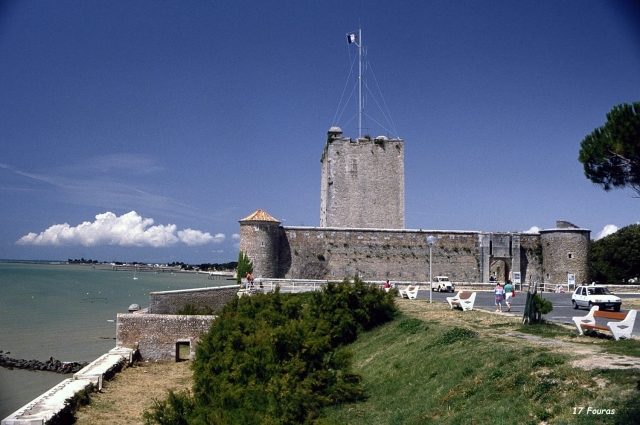
FortressFouras

Fort de Fouras

Fort de Fouras

The Fort can be visited

The Fort de Fouras or the Sémaphore de Fouras is the medieval castle of Fouras, a small French town in the Charente-Maritime department. It is often mistakenly called Fort Vauban, although it was largely built long before Sébastien Le Prestre de Vauban's influence.

The fort is one of the best examples of stately coastal fortifications. Nothing remains of the first medieval buildings. The current castle stands on a 15th-century crypt and the 30-meter high south wall of the first chamber. It is surrounded by 17th-century fortifications.

The mouth of the Charente has long been of strategic importance, and the Romans already built a castellum there. The current fortress construction dates back to the Rochefort family in the 11th century, who collected tolls from boats on the Charente. In 1305, Philip IV (1268–1314) bought Fouras, which thus came directly under the crown. He then granted Fouras as a fief. The fief changed hands several times until it fell to Jean II de Brosse (circa 1423 to 1483), who had the keep built between 1480 and 1490.

Louis XIII (1601–1643) undertook a campaign against the Huguenots and, after the Siege of La Rochelle (1627–1628), had fortified towns inhabited by Huguenots destroyed. Fouras escaped destruction because its strategically favorable position made it valuable to the king. He turned it into a royal fortress.

During the Dutch War (1672–1679), the fort's garrison protected the mouth of the river, and construction work on the fortress continued until 1693.

When the castle of Rochefort was converted into a naval arsenal, the keep of Fouras served to observe ship movements and to send messages to the signal tower, which had been built in the 18th century not far from the residence of the Chef d’escadre (a military title comparable to rear admiral in the Ancien Régime) in Rochefort.

During the Seven Years' War, in 1757, Henry Seymour Conway, the second-highest British officer in the attack on Rochefort, repeatedly demanded the destruction of Fort de Fouras, but his fellow officers ultimately only agreed to a half-hearted night attack, which failed. Finally, the expedition returned to Portsmouth without having achieved anything. Although the responsible commander John Mordaunt was acquitted by court-martial, the affair damaged the reputation of both.

The fortress and the citadel were classified as a historical monument on March 13, 1987.

Take Mobile History with you

You are reading this text for free. Premium adds what matters on the road: descriptions read aloud, sites found through your camera, whole regions taken offline.

  • Every description, including the ~17,700 Premium sites
  • Audio guide: have descriptions read to you on location
  • AR finder: see sites through your camera, with distance and bearing
  • Unlimited saved sites

14 days free, then from €2.99 a month. Cancel anytime.

Source: Wikipedia · Licence: CC BY-SA 4.0 · Image: Hervé Rebours

This description draws on the facts documented in the linked Wikipedia article; Wikipedia content is licensed under CC BY-SA 4.0. Wording and editing: Mobile History.

Location: 45.9860, -1.0974