FortressWesel

Fort I (Wesel)

Fort I (Wesel)

To be privately owned

The historic Wesel railway bridge was built between 1872 and 1874 by the Cöln-Mindener Eisenbahn-Gesellschaft (CME) as part of the Hamburg-Venlo railway and was, throughout its existence, the northernmost Rhine bridge in Germany. From 1917, an additional road bridge existed in direct proximity to the railway bridge, until both bridges were destroyed during World War II. Only the road bridge was subsequently rebuilt.

Construction History+

The reason for bridging the lower Lower Rhine in Wesel was the construction of the Hamburg-Venlo railway from Venlo via Wesel, Haltern (Westf), Münster (Westf) and Bremen to Hamburg. The Prussian state prevented the route originally planned by a foreign consortium through the densely populated Ruhr area with a Rhine bridge near Duisburg, demanding a route via the then Prussian fortress of Wesel and granting the CME the necessary concession for the entire route to Hamburg. This allowed the soldiers stationed in the Wesel fortress to defend the bridge against a Rhine crossing in case of war, and also to use it as a base for an advance to the west. Even in the planning stage, the track area was to be covered with planks so that the bridge could also be used by other vehicles.

On both sides, the actual river bridge was flanked by approach bridges built of hard-fired bricks; on the left bank of the Rhine, 65 of these with a total length of 770 meters, and on the right bank, 32 similarly brick-built and 6 steel bridges with a combined length of 766 meters. In between, the river at Rhine-kilometer 815 was spanned by a river bridge consisting of four steel sections, each 104 meters long. At the time of construction, the structure, with its 1950 meters, was the longest Rhine bridge ever built. The bricks were fired on site during construction from the clay extracted during the excavation of the piers. The extraordinary dimension of the structure was chosen not only because of the frequent risk of flooding, but also because the military did not tolerate an embankment and wanted a clear view for the fortress.

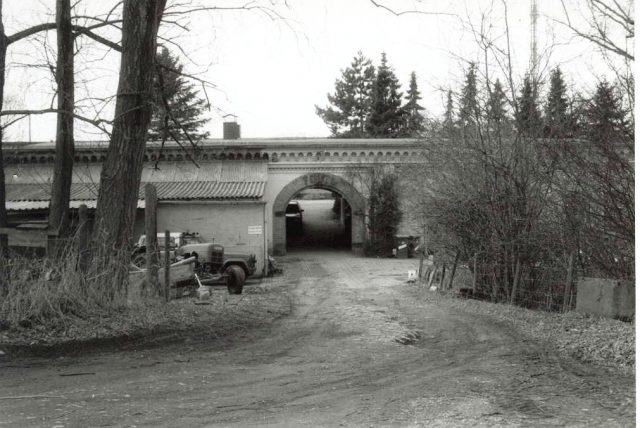
At the beginning and end of the river bridge, the bridge was equipped with so-called tambour works for defense, as was customary for Rhine bridges at the time. Further fortifications were also built in the foreland. On the left bank of the Rhine, behind the dike next to the tracks, Fort I was built at the expense of the Cöln-Mindener Eisenbahn. It is still completely preserved and is in private ownership. On the right bank of the Rhine, further forts were located along the Wesel railway lines, intended to protect the Wesel fortress. No traces of these fortifications remain.

On both sides of the Rhine, concrete bunkers were built during World War I to defend the Wesel bridgehead. These were blown up in 1921 by order of the Allies.

Towards the end of World War II, the bridge was the last line of retreat for the retreating Wehrmacht during the conquest of the left Lower Rhine by British, Canadian, and American troops. When the bridgehead could no longer be held, German pioneers blew up the Wesel railway bridge on March 10, 1945, three days after the Ludendorff Bridge near Remagen was captured by American troops, making it the last Rhine bridge under German control at that time. The destruction was so extensive that after the war, due to the high renewal costs, reconstruction was abandoned, especially since the bridge had only been used by two branch lines.

It was not until 1968 that the remnants of the two river piers, which hindered shipping, were removed. Today, the preserved arches of the approach bridges on the right bank of the Rhine are used for sheltering gliders. Furthermore, the bridge is part of the Route of Industrial Heritage.

Railway History+

After the Wesel – Haltern section of the Paris-Hamburg railway had already been opened on March 1, 1874, the first train from Wesel to Venlo crossed the new bridge on New Year's Eve 1874 without major celebrations. From July 1, 1878, it was also co-used by the Boxtel railway, which joined the Venlo line in Büderich. However, the hopes of the builders for the use of the Venlo – Haltern line were not fulfilled, and operations remained similar to a branch line. Only the international express trains of the Boxtel railway heavily frequented the bridge until World War I. Due to the high construction costs and low line usage, the Cöln-Mindener Eisenbahn and, after its nationalization, the Prussian State Railway, charged a surcharge of 11.25 kilometers for every ticket of bridge users. Between 1926 and 1927, the bridge was renewed on the old river piers and adapted to the increased train weights.

Take Mobile History with you

You are reading this text for free. Premium adds what matters on the road: descriptions read aloud, sites found through your camera, whole regions taken offline.

  • Every description, including the ~17,700 Premium sites
  • Audio guide: have descriptions read to you on location
  • AR finder: see sites through your camera, with distance and bearing
  • Unlimited saved sites

14 days free, then from €2.99 a month. Cancel anytime.

Source: Wikipedia · Licence: CC BY-SA 4.0

This description draws on the facts documented in the linked Wikipedia article; Wikipedia content is licensed under CC BY-SA 4.0. Wording and editing: Mobile History.

Location: 51.6486, 6.5858