FortressCuxhaven - Döse

Kugelbake Fort

Kugelbake Fort

Cultural Events

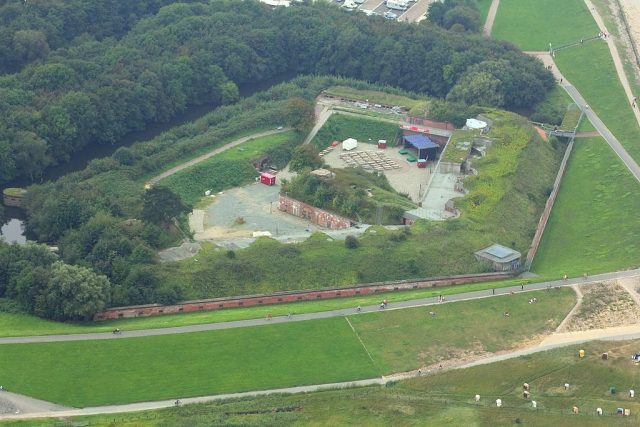
Fort Kugelbake is a former naval fortress in Cuxhaven, in today's spa district of Döse. It is located on the last headland at the mouth of the Elbe, behind the sea dike near the eponymous Kugelbake navigation mark. The fort was built between 1869 and 1879 at a strategically favorable position at the river mouth, to block enemy warships, then French, from accessing the Elbe with its 14 coastal guns. Today, it is the last preserved artillery fort of the navy on the German North Sea coast.

Construction Description+

Fort Kugelbake is a five-hectare, pentagonal structure with an area of 250 meters wide and 150 meters deep. The complex is surrounded by a moat, which was about 12 meters wide and approximately 2.5 meters deep. On the two sides facing the sea and the dike, a dry moat was created, along which there is a brick embrasure wall as an approach obstacle. On the flanks and the gorge side, the moat was designed as a water moat about two meters deep. The moat defense was carried out by shoulder caponiers. The cannon wall on the seaward side consisted of piled earth over casemates, which were built of brick and housed the crew's quarters and ammunition magazines. The gun emplacements were located on the brick structures. The individual positions were separated from each other by traverses to protect against enemy fire from the sea side. By 1887, a massive structure was built in the fort's courtyard as a central traverse, dividing the complex into two courtyards. Its purpose was to mitigate the effect of incoming shells and their splinters.

The main access was in the rear area towards the land side. There was a bridge over the water moat, which was originally designed as a drawbridge. The outer gate defense was provided by a stone blockhouse located outside the fort at the water moat. Inside the fort, corresponding structures enabled the defense of the gate and the bridge. To supply the crew with water, a well was drilled in 1876. Due to poor water quality, the fort received a water pipeline and connection to the local waterworks around 1910.

Initial Armament and Crew

The first guns installed in 1870 had a caliber of 28 cm. Their range was up to 10 kilometers, so that the entire shipping channel of the Elbe could be covered. In 1879, the facility was fully operational. In 1880, the fort had a total of 10 cannons of 28 cm caliber, positioned on a left and right battery with five guns each. Another four 12 cm caliber cannons were on the left flank of the fort, facing the sea. In 1899, the fort received a rail connection for ammunition and material transport via a narrow-gauge railway to Cuxhaven station, which was briefly used by the Cuxhaven tram in 1914. To detect unlit ships at night, the fort received the world's strongest searchlight at the time in 1909, whose beam reached 4.5 km. The five-ton searchlight was installed in a specially built concrete bunker and was operational in 1911. Power for its operation was supplied by the fort's power plant.

The fort's crew comprised 10 officers and 446 non-commissioned officers and enlisted men. The crew was initially housed in the casemates, where the men slept in hammocks. Due to the health-damaging effects of housing in the constantly damp casemates, a staff building was erected on the fort's grounds in 1913, serving as a living barracks.

Construction

Under the foreign rule of Napoleon, the military-strategic importance of the exposed location at the mouth of the Elbe was already recognized at the beginning of the 19th century. About 50 years later, in 1867, the Prussian authorities presented initial plans for the construction of a fortress. In 1869, the General War Department of the Prussian Ministry of War granted approval for the construction of the fort, so that earthworks could begin that same year. The foundation stone was laid on May 28, 1870. Already in the autumn of 1870, the first guns were installed. The construction work was carried out not by military units but by civilian companies. From 1870, they lay fallow due to the Franco-Prussian War and were resumed after the end of the war in 1871. Financing was then provided by French reparations payments. In 1873, the fort was completed in a first expansion phase, in which it had more the character of a coastal battery.

Between 1876 and 1878, numerous alterations and structural reinforcements were made. Due to constant moisture problems inside the fort, the ceilings of the casemates were sealed against water penetration from above. Unforeseen groundwater rose from below, causing significant health problems for the crews due to the humidity. In the ammunition chambers, the damp storage conditions were unfavorable for gunpowder, as it is hygroscopic.

The opening of the Kiel Canal on the opposite side of the Elbe in 1895 increased the strategic importance of the fort, which was accordingly reinforced until 1911.

First World War

In the vicinity of Cuxhaven, seven more fortifications were built in the last years before the First World War. During the war, however, no enemy ships approached, so the fort did not need to fire a single shot. Already in 1914, five 28 cm caliber cannons were moved to Flanders.

After the war, according to the Treaty of Versailles, the fort could be maintained as a coastal defense facility, but with a reduced number of guns and ammunition. In the 1920s, the military details of the fort had to be disclosed to the League of Nations. In 1922, the Hamburg Senate, which was responsible for Cuxhaven at that time, demanded the de-fortification of the complex. In 1931, the first maintenance work since the end of the war in 1918 took place.

Second World War

Before the Second World War, an anti-aircraft position was set up in the fort in 1937, which was operational in 1938. It initially consisted of four openly positioned 8.8 cm anti-aircraft guns. From about 1941, these were replaced by four 10.5 cm anti-aircraft guns in the quick-loading cannon version, which were equipped with protective shields. They had been named after the rivers of the region, such as Elbe, Weser, Jade, and Ems. A round observation tower built of concrete in the fort's courtyard around 1941 served as a command post. Immediately next to the fort, a tower-like building was also erected around 1941 as a command post with a radar system, which featured the Freya radar device. During the war, a Wehrmacht barracks with relatively thin concrete walls was built on top of the fort, serving as accommodation for the anti-aircraft crews. The fort's crew at the beginning of the war consisted of 350 soldiers and dwindled towards the end of the war to about 50 soldiers, including 25 naval anti-aircraft auxiliaries and about 25 Russian prisoners of war as volunteers.

Shortly after the United Kingdom's declaration of war against Germany on September 3, 1939, the fort's anti-aircraft battery shot down a British Wellington bomber as early as September 4, 1939; but remained insignificant thereafter. Throughout the entire Second World War, the Marineflakabteilung 214 stationed in Cuxhaven, which included other batteries besides the fort, achieved 12 downed enemy bombers out of 15,000 shots fired. As in the First World War, the fortress crew did not need to fire at any enemy ship in the Elbe estuary during the Second World War. The Elbe-Weser triangle was occupied by the Allies from the land side in April/May 1945.

Post-War Period

After the capture of Cuxhaven by the Allies at the end of the war and the subsequent evacuation of the fort by the German military, it was occupied by the British military. It also served as a base for the German Mine Sweeping Command for two years. After the war, the fort was de-fortified by blowing up the command posts on the central traverse and the left flank, the four anti-aircraft positions, and the anti-aircraft command post in the courtyard.

After the military withdrew in 1947, the entire fort area with its buildings, casemates, and bunker facilities was used for various purposes in the post-war period. Due to the housing shortage of the many refugees and displaced persons, it served as emergency accommodation for 24 families at that time. During this period, a youth hostel was established in the fort, which remained until 1967 and was located in the concrete structure of the Wehrmacht barracks. In addition, seven commercial enterprises subsequently used the buildings, including as a chicken farm, mink farm, foundry, and rendering plant.

Current Use+

From 1969, the fort stood empty. In 1970, the city of Cuxhaven acquired it from the Federal Republic of Germany. In 1984, the Institute for Monument Preservation classified the complex as a historically valuable structure under the Lower Saxony Monument Protection Act, with the aim of restoring the fort to its structural condition of 1910. In 1991, an artists' symposium took place in the fort under the motto "Protect Arm Disarm". From 1992 to 1994, the fort was restored with financial resources amounting to 6.5 million DM, largely with EU funding. This stopped the decay of the complex and partially restored its historical character to do justice to the facility as the last remaining naval artillery fort on the German North Sea coast. The work was extensive and technically complex. For example, before the restoration, the inner courtyard was covered with up to 1.5 meters high debris, the roofs of the cannon wall were leaky, the moat was silted up, all windows and doors were altered, the bridge was dilapidated, casemate passages were flooded, and the outer embrasure wall was largely damaged and covered with earth.

As part of the alterations, the command post in the fort's inner courtyard, which was blown up after the war, has been made recognizable by paving. An identical 10.5 cm anti-aircraft gun was set up on a concrete platform at the original position. This is a permanent loan from the Norwegian fortress Oscarsborg.

Today, the approximately five-hectare site, with a small museum on the history of the complex, can be visited during guided tours. Rooms of the complex can be rented for events. In 2005, the Deichbrand music festival took place at Fort Kugelbake. Since 2009, the Störtebeker Open-Air Theater has been performed here annually.

Take Mobile History with you

You are reading this text for free. Premium adds what matters on the road: descriptions read aloud, sites found through your camera, whole regions taken offline.

  • Every description, including the ~17,700 Premium sites
  • Audio guide: have descriptions read to you on location
  • AR finder: see sites through your camera, with distance and bearing
  • Unlimited saved sites

14 days free, then from €2.99 a month. Cancel anytime.

Source: Wikipedia · Licence: CC BY-SA 4.0 · Image: http://commons.wikimedia.org/wiki/File:2011-09-04-IMG_6580_a_Fort_Kugelbake.JPG?uselang=de

This description draws on the facts documented in the linked Wikipedia article; Wikipedia content is licensed under CC BY-SA 4.0. Wording and editing: Mobile History.

Location: 53.8906, 8.6807