The Fortress can be visited
FortressToulon
Fort Lamalgue
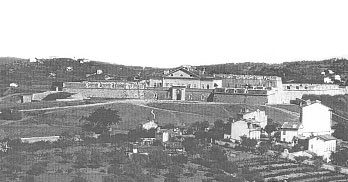
Fort Lamalgue is a French fort built in Toulon in the second half of the 18th century (between 1764 and 1789), with the aim of covering the land approaches to Toulon from the east and ensuring the position of Fort Saint Louis facing the sea. Located in Mourillon on a hill to the east of Toulon, it now houses various services responsible for managing the personnel of the French Navy (payroll computing center, administrative file archiving, etc.).
History+
Construction+
During the siege of 1707, Fort Saint-Louis, facing the sea, was attacked by Austro-Savoyard batteries erected on the neighboring height of La Malgue. The fort was disabled and abandoned after a cannonade of nearly ten days. The fall of this work allowed the bombardment of the city and port from the roadstead, confirming the key role of this position facing the sea. Following these events, it was decided to strengthen the city's defenses. At La Malgue ("the margin" in Provençal), a small redoubt with two dry-stone half-moons was begun in 1738. Located on a height, it protected the entrance to the small roadstead. Construction of the fort began in 1764 by the military engineer Millet de Monville, director of fortifications. Only the return of peace after the Seven Years' War (1756-1763) allowed the works to be financed sustainably (but slowly). Around a large main courtyard, four bastions were built, each with its casemate. Its construction was only completed around 1789. It was designed to house a garrison of 600 men. Joubert having been mortally wounded at the Battle of Novi on August 15, 1799, the First Consul had his remains deposited in Fort La Malgue, thereafter called Fort Joubert. He was then buried in the church of Pont-de-Vaux, his native village.
A fort used as a prison+
The fort served as a prison mainly during the revolutionary period, then after the Var insurrection in 1851, and until 1923. Emir Abd el-Kader (1808-1883) was detained there for a few weeks in 1848.
The detention of Abd-el-Kader+
After fighting against the colonization of Algeria, he surrendered to General de Lamoricière with the promise of being sent into exile in Saint-Jean-d'Acre or Alexandria. He, along with part of his family and entourage, embarked on the frigate Asmodée which disembarked them in Toulon on December 29. They were quarantined at the lazaretto of Saint-Mandrier. King Louis-Philippe was in favor of his transfer to Alexandria but Parliament opposed it.
Source: Wikipedia · Licence: CC BY-SA 4.0 · Image: Marius Bar / Public domain via Wikimedia Commons
This description draws on the facts documented in the linked Wikipedia article; Wikipedia content is licensed under CC BY-SA 4.0. Wording and editing: Mobile History.
Location: 43.1106, 5.9455