The Fortress can be visited
FortressCivita Castellana
Forte Sangallo
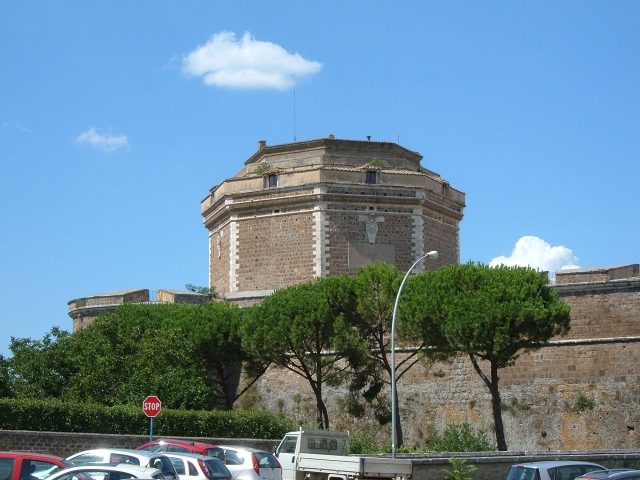
Forte Sangallo is a fortress near the historic village of Civita Castellana, in the province of Viterbo. Since December 2014, the Ministry of Cultural Heritage and Activities has managed the fort and the Archaeological Museum of Agro Falisco within it through the Lazio Museum Hub, which in December 2019 became the Regional Directorate of National Museums Lazio.
History and characteristics+
It was built starting in 1494 by Pope Alexander VI, as part of a vast program to strengthen the fortifications of places intended to be secured for the hereditary lordship of the Borgia family. The project is by Antonio da Sangallo the Elder, documented on the construction site, with numerous collaborators, between 1499 and the death of the Pope in 1503, leaving here one of the most significant works of his activity. Sangallo in those years was a trusted architect of the Borgias and a specialist in the design of "modern fortifications". After the Borgias, the fortification passed to the papacy and the works were completed under Pope Julius II, perhaps by Bramante and certainly by Antonio da Sangallo the Younger. The fortress remained a papal residence for a long time. In the 19th century, it was used as a prison. After a period of disuse, today it houses the Archaeological Museum of Agro Falisco. From the beginning, the fort had the dual function of fortification and "palace" with representative and residential functions as a secure residence, outside Rome, for the Pope. It applied the most modern concepts of modern fortification with an irregular pentagonal shape, with re-entrant polygonal bastions at the vertices with rounded tips and the absence of projecting machicolations for plunging defense. Inside the perimeter, a complex building contained the Pope's apartment and a courtyard of honor with a double order of Doric and Ionic pilasters framing arches, representing one of the very first examples of this typical early sixteenth-century solution, inspired by Roman architecture. An octagonal keep was built years later by Antonio da Sangallo the Younger.
The Forte Sangallo in Civita Castellana represents one of the highest achievements of military architecture of the Papal States in the 16th century. Due to its location, the town of Civita Castellana serves as a true defensive bulwark of the northern borders of the church's territories, at the center of the fortified system of Tuscia. The town was assigned by Pope Adrian IV to the prefects of Vico and in the mid-13th century was occupied by the militias of Frederick II of Swabia. In the early 14th century, Pope Boniface VIII had the town walls rebuilt, and at the end of the following century, Cardinal Rodrigo Borgia had the fortress built. Rodrigo, who ascended to the papal throne as Alexander VI, commissioned the work to Antonio da Sangallo the Elder, a skilled expert in military architecture, who completed the work in 1503. Pope Julius II della Rovere continued the works, improving them, thanks to the valuable contribution of Antonio da Sangallo the Younger. The fort stands in the western area of the city, outside the old inhabited area, on the area already occupied by medieval fortifications, guarding the only undefendable side of the inhabited area, which is otherwise naturally defended by the deep tufa rock ridges that surround Civita Castellana on all other sides. Thus, what had been previously built was reused but improved to integrate this primitive system into the new model of military fortifications with the use of gunpowder.
An enormous polygonal curtain wall was built to enclose two open spaces within: a first entrance courtyard aligned with the mighty octagonal Keep, and a more elegant and modern square with a doubl …
Source: Wikipedia · Licence: CC BY-SA 4.0 · Image: http://commons.wikimedia.org/wiki/File:Civita_Castellana_-_Forte_Sangallo.JPG
This description draws on the facts documented in the linked Wikipedia article; Wikipedia content is licensed under CC BY-SA 4.0. Wording and editing: Mobile History.
Location: 42.2881, 12.4083